Further learning
Distress in delirium: recognising distress and helping the person
Recognise distress, find out what may be causing it, and help the person feel safer and more comfortable.
About this module
Delirium can be frightening, confusing and humiliating. Some people call out, pace or try to leave. Others lie quietly while experiencing pain, fear, hallucinations or a sense of threat. Assess distress directly and separately from agitation. Address the acute illness and other causes of delirium while also attending to what the person is experiencing.
Before you start: With JavaScript and browser storage available, quiz answers and your place are saved in this tab for the current browser session. Names and completion certificates are not saved. Print or save your completion certificate before leaving.
Learning outcomes6 outcomes
By the end, you should be able to
- Distinguish distress from agitation and recognise distress in quiet or hypoactive delirium.
- Assess distress using brief questions, observation, communication support and information from family, carers or records.
- Assess physical, psychological, sensory, environmental and care-related contributors.
- Use clear communication and de-escalation, and involve family or carers when this helps the person.
- Explain the restricted role of medication and physical restraint.
- Review, document and communicate distress, the response to care and follow-up needs.
Immediate danger: if serious harm is imminent, summon appropriate help immediately and use the least restrictive response that can keep people safe.
- NoticeQuiet does not mean comfortable
- Ask and listenAdapt how you speak and listen
- Look for causesCheck illness, pain, fear and surroundings
- RespondReduce threat and explain care
- ProtectUse the least restrictive safe approach
Review: describe what happened, record what helped and reassess as delirium and distress fluctuate.
1. Distress and agitation are different
Distress is the person’s experience of suffering. It may include fear, anxiety, helplessness, loneliness, anger, shame, pain, a sense of being trapped, or frightening hallucinations and delusional beliefs. Delirium can also make it difficult to understand where they are, why care is being given and whether other people can be trusted.

Agitation describes observable increased motor or verbal activity, such as pacing, repeated calling out or pulling at equipment. It may accompany distress, but motor activity alone does not establish whether distress is present or how severe it is. Refusal of care and purposeful walking are not, by themselves, agitation; assess the person’s communication, purpose and circumstances. A person may be quiet or drowsy yet frightened or in pain.
Distress is not the same as agitation
- fear or anxiety
- pain
- feeling trapped
- frightening hallucinations
- pacing
- repeated calling out
- pulling at equipment
Describe what the person did and said. Avoid labels such as “difficult”, “combative” or “non-compliant”. “Pulled twice at the cannula and said, ‘Let me out'” is more useful than “agitated” because it helps the next clinician assess risk, possible meaning and change over time.
Qualitative studies conducted after the acute episode describe distress for patients and relatives. Recall can be incomplete or selective, and these studies do not establish one prevalence figure for all settings or presentations (Lange et al. 2022; Meyer et al. 2023).
Unscored observation activity
Watch closely: quiet does not mean comfortable
Task: watch the whole clip. Which conclusion is safest?
Simulated teaching scene.
- The absence of calling out or resistance makes distress unlikely, so routine observation is enough unless her behaviour changes.
- Her response proves severe depression, which should be managed as depression until the delirium resolves.
- Reduced engagement does not show comfort; assess directly if possible and use observation and information from someone familiar.
- Because she did not respond to her grandson, family visits should be postponed until her alertness improves.
Show the suggested answer and commentary
Best answer: C. The clip shows reduced engagement, not the person’s internal experience. Ask directly if possible, look for non-verbal signs, check pain and physical needs, and ask family what is usual. Do not make reassurance or treatment decisions from activity level alone.
Read the transcript
She looks down and picks at the edge of the blanket. Her grandson says, “Nani! It’s me. I brought your favourites.” She does not look up.
This activity does not count towards the 10-question module score.
2. Ask about distress
Begin with the person whenever communication is possible. Explain why you are asking and use short questions, one at a time:
- “How are you feeling?”
- “Is anything bothering you?”
- “Are you in pain?”
- “Are you frightened?”
- “Do you feel safe here?”
- “Are you seeing or hearing anything unusual?”
- “Do you need the toilet, a drink or something else?”
- “Would you like me to contact someone you know?”

Adapt your questions and how the person can answer. A person with severe inattention, difficulty using or understanding language, or hearing impairment may answer simple yes-or-no questions or communicate by gesture, pointing or pictures. Some people will not be able to give a verbal answer at that time; do not force a response. If there is no shared language, use a professional interpreter where available and follow local policy. Check that glasses and hearing aids are available and working. Pause an interview that is adding to distress without clinical benefit.
Look for facial tension, tears, guardedness, scanning the room, withdrawal, repeated attempts to move away, restlessness or a change during examination or personal care. These signs are not specific, so interpret them alongside the clinical assessment and what is known about the person. Ask family, carers or familiar staff what the person is usually like, how they show pain or fear, what reassures them, and whether the present response is new.
How to ask about distress
Reassess after an intervention and when the person or their care changes
An exploratory research rating: the QDAT
A 2025 single-centre study used a study-specific distress rating alongside repeated 4AT assessments. It suggests that distress may be common, but the rating is not validated for clinical use and the findings are not prevalence estimates (McCartney et al. 2025).
Study detail and limitations
The Quick Distress Assessment Tool (QDAT) combined two questions, “How are you feeling?” and “Is anything bothering you?”, with observed physical signs to give a study rating from 0 to 3.
QDAT data were available for 118 of the 120 participants at the first assessment, when all had delirium. Distress was recorded in 64% (76/118), and, using the study’s own categories, 25% (29/118) had moderate-to-severe distress. These figures describe a selected, single-centre acute-hospital cohort aged 70 years or older; they are not prevalence estimates for all people with delirium. The QDAT has not been validated, has no established clinical cut-offs or diagnostic role, and is not a mandated clinical tool. Further validation is needed.
Distress can fluctuate, as delirium does. Reassess after an intervention and when the person’s behaviour, alertness, surroundings or care needs change.
3. Look for causes of distress
Distress often has more than one contributor. Check for urgent illness and physiological disturbance first, then consider what may be uncomfortable, frightening or difficult to understand for this person.
Physical illness and unmet needs
- Acute illness, hypoxia, hypotension or another cause of clinical deterioration.
- Pain, including pain during movement, examination or personal care.
- Urinary retention, constipation or need for the toilet.
- Breathlessness, thirst, hunger, dehydration, dry mouth or temperature discomfort.
- Medication effects, recent medication changes or omitted usual medication. If withdrawal is possible, use the relevant specialist pathway.
- Immobility, an uncomfortable position, invasive equipment or an unfamiliar device.
- Sleep disruption.
Perception, emotion and communication
- Hallucinations, delusional interpretations or vivid dream-like experiences.
- Disorientation and inability to make sense of care.
- Fear of injury, imprisonment, abandonment or death.
- Difficulty expressing a need or understanding what staff are saying.
- Loss of control, privacy or dignity, or separation from familiar people and routines.
Sensory and environmental factors
- Missing or ineffective glasses and hearing aids.
- Noise, alarms, glare, darkness or crowding.
- Several people speaking or touching the person at once.
- Repeated ward moves, unfamiliar staff or lack of daytime cues.
- Care being started without explanation.
Treat what is found. Simple needs should not wait for the whole medical assessment to finish. Analgesia, bladder care, a hearing aid, a quieter space or a clear explanation may be needed while investigation and treatment of the delirium continue.

4. Help the person feel safer
The way staff speak and provide care can help a frightened person feel safer. Listening, explaining and giving the person time to respond are sometimes described as therapeutic engagement. Qualitative studies report that people valued patience, kindness, explanation, familiar contact and some control over what happened. Evidence for a specific therapeutic engagement package is still limited, so it should not be presented as a treatment proven to shorten delirium (MacLullich et al. 2022).
Practical measures include:
- Reduce noise, crowding and unnecessary stimulation.
- Ask one calm staff member to lead communication where possible.
- Approach within the person’s field of vision and allow personal space.
- Introduce yourself and explain where the person is and what is happening.
- Explain before touching, examining or moving the person.
- Use short, concrete sentences and allow time for a response.
- Repeat information patiently, without testing the person’s memory.
- Offer choices the person can make, such as which arm to use for observations.
- Use familiar conversation, music, photographs or activity if the person finds these helpful.
- Involve a familiar person when this reduces rather than increases distress.
When a person expresses a frightening belief, acknowledge the emotion without confirming the belief or entering an argument. For example:
“I can see that this feels frightening. You are in hospital because you became unwell. My name is Sam and I am staying with you. First I want to check whether you are in pain or need the toilet.”
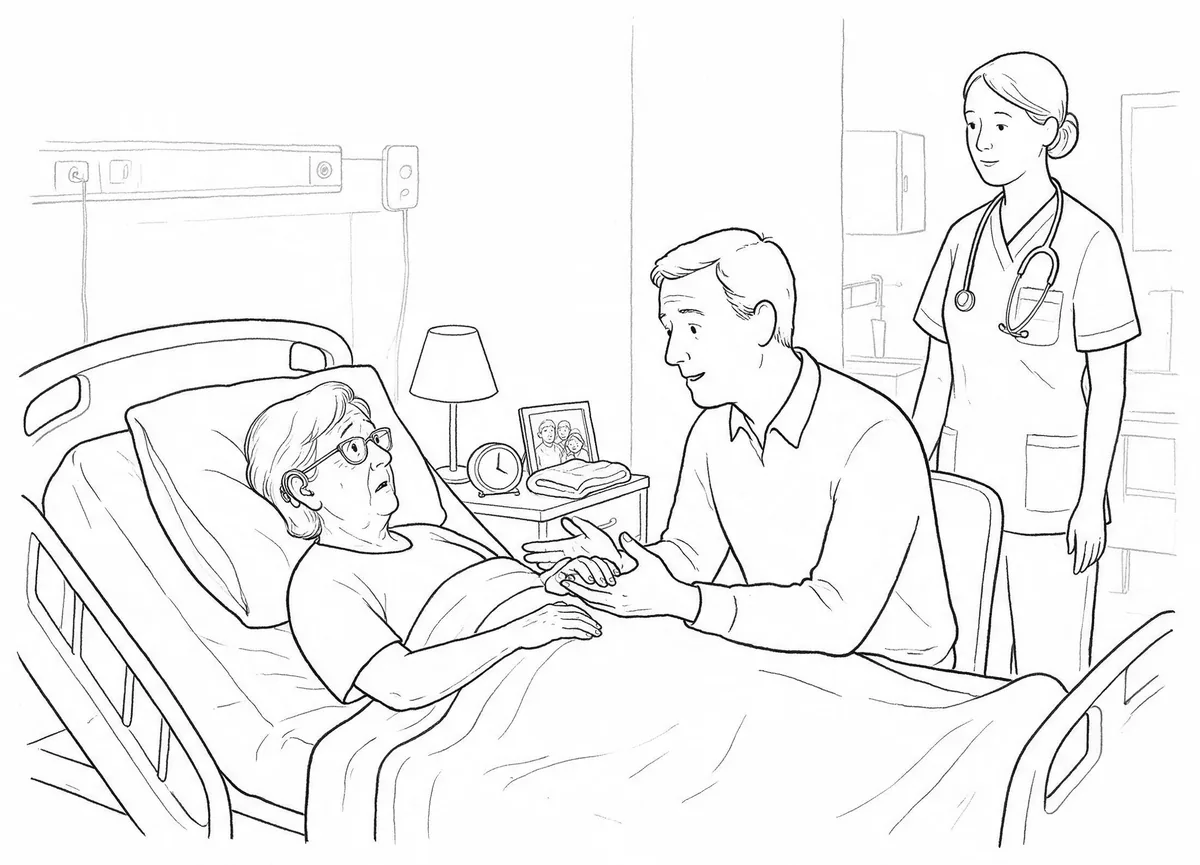
Offer orientation as information, not as repeated correction. “It is Tuesday morning and you are in the medical ward” is usually kinder and clearer than repeatedly asking the person to state the date and place. If an explanation increases fear or suspicion, pause and try another approach.
Ask the person who they want involved where possible, and respect their preferences and confidentiality. Family or carers may provide baseline information, preferred forms of address, language needs, signs of pain, routines and known sources of comfort. They may also bring glasses, hearing aids or familiar objects and take part in ordinary conversation. Explain the purpose and do not transfer clinical responsibility to them.
Unscored observation activity
Watch closely: responding to fear
Task: watch the whole clip. Which feature of the response is most helpful?
Simulated teaching scene.
- The nurse checks that the corner is empty and then explains why Vera’s perception is not accurate.
- The nurse agrees that someone is present so that Vera feels believed, then offers to ask them to leave.
- The nurse calmly reassures Vera that she is with her and that she is safe, without agreeing that someone is in the corner.
- The nurse changes the subject promptly and avoids any reference to the frightening experience.
Show the suggested answer and commentary
Best answer: C. The reported experience may feel real to the person. Acknowledge the emotion without arguing about or affirming the perception. Begin by speaking calmly and reassuring the person that you are there to help. Then assess pain and other causes of distress, reduce avoidable stimulation and reassess. The nurse appears to hold Vera’s hand, but touch is not universally reassuring. Explain before touching, seek consent where possible and individualise the approach because touch may increase fear.
Read the transcript
Vera says, frightened, “There’s someone standing there. Get them away!” The corner is empty. The nurse holds Vera’s hand and says, “I’m here with you, Vera. You’re safe.”
This activity does not count towards the 10-question module score.

5. Manage risk with the least restrictive care
Reassess risk as the situation changes. A person who is walking towards a door, pulling at a cannula or refusing care may be responding to fear, discomfort or a perceived need. Establish what the person is trying to do, check for immediate danger, and address the likely reason while protecting them and others.
From least to most restrictive
Find out what the person is trying to do. Check for danger. Address the likely reason.
For this decision, at this time. Respect a valid refusal.
Verbal and non-verbal de-escalation first. Continue it throughout.
Summon help. Physical restraint only if injury is imminent. Shortest time, frequent monitoring.
Only if all three: de-escalation ineffective, causes assessed and addressed, significant distress or risk of harm.
If serious harm is imminent, summon appropriate help and use the least restrictive response that can keep people safe. Continue verbal and non-verbal de-escalation. Restrictive measures should be proportionate, last for the shortest possible time, and be accompanied by frequent monitoring and repeated reassessment. The 2025 American Psychiatric Association guideline recommends that physical restraint should not be used except when injury to the person or others is imminent, after reviewing factors that may contribute to racial, ethnic or other biases in restraint decisions, and with frequent monitoring and repeated risk-benefit assessment against less restrictive alternatives. This is a strong recommendation with a low-confidence evidence rating (1C), reflecting limited direct evidence and expert consensus (Crone et al. 2025).

Antipsychotics and sedatives used for neuropsychiatric disturbance do not treat delirium as a syndrome and should not be used simply because delirium, confusion or agitation is present. The 2025 American Psychiatric Association guideline recommends medication, including an antipsychotic, only when all of the following apply:
- Verbal and non-verbal de-escalation has been ineffective.
- Contributing factors have been assessed and, as far as possible, addressed.
- The disturbance is causing significant distress or a risk of physical harm.
NICE similarly advises verbal and non-verbal de-escalation first. If this is ineffective or inappropriate and the person remains distressed or is considered a risk to themselves or others, NICE advises considering short-term haloperidol, usually for one week or less, starting at the lowest clinically appropriate dose and adjusting the dose cautiously according to symptoms.
Follow local prescribing guidance and check contraindications and interactions. In UK practice, MHRA advice for older people states that haloperidol is contraindicated in Parkinson’s disease and dementia with Lewy bodies. Before treatment, a baseline electrocardiogram and correction of electrolyte disturbance are recommended; repeat cardiac and electrolyte monitoring during treatment. Use the lowest possible dose for the shortest possible time and monitor for cardiac effects, movement-related (extrapyramidal) adverse effects, swallowing difficulty, dizziness on standing (orthostatic hypotension) and falls.
Benzodiazepines should not be used routinely for delirium; they require a specific indication. If relevant withdrawal is suspected, follow the appropriate specialist pathway. Its management is outside this module’s scope.
Who can do this: prescribing and restrictive interventions are for appropriately trained and authorised staff. Follow local escalation routes and work within your role.
Record the indication, measures already tried, expected benefit, monitoring plan, review time and stopping plan whenever medication or a restrictive intervention is used.
Example case: assessment and care
6. Helping Mr Lewis
Mr Lewis, aged 81, had been admitted with pneumonia. On the second evening he repeatedly said, “I have to get out”, pulled at his cannula and pushed a healthcare assistant’s hand away. The handover described him as “agitated”. There was no imminent risk of injury to him or anyone else, but several staff had gathered around his bed.
A nurse asked one colleague to remain nearby and the others to step back. She approached within his field of vision, introduced herself and explained that he was in hospital. His hearing aids were in a bedside drawer. Once these were fitted, he answered simple questions. He said that he was frightened and in pain, and pointed to his lower abdomen. His wife confirmed that he normally used hearing aids, took regular analgesia for osteoarthritis and became anxious when he could not find a toilet.
Clinical examination and a bladder scan identified urinary retention. The medication chart showed that prescribed analgesia had been delayed. The team treated the retention and pain, reduced noise around the bed and continued treatment of the pneumonia. His wife stayed for familiar conversation. On review, he was no longer pulling at the cannula and accepted a drink and observations.
The same measures will not settle every episode. Assess the observed behaviour, the person’s account, clinical causes, sensory needs and environment together.
7. Review, record and support recovery
Review the person’s response rather than recording only that they are “settled”. Ask again about pain, fear and safety. Repeat relevant clinical observations. Check whether distress has changed, which intervention preceded the change, and whether a new problem has appeared.
Review, record and support recovery
If distress or delirium persists, review causes, medication, communication and surroundings again
Document:
- The person’s own words where possible.
- The exact behaviour and context rather than a label alone.
- Non-verbal signs and communication limitations.
- Urgent risks and possible contributors assessed.
- What was found and treated.
- Therapeutic and de-escalation measures tried.
- The person’s response and the time of review.
- Information from and communication with family or carers.
- Any medication or restrictive intervention, with its indication, monitoring, review and stopping plan.
During recovery, explain to the person and family that delirium can cause frightening experiences and that recall varies. Offer the person an opportunity to discuss what they remember, without pressing for an account. Check for continuing anxiety, sleep disturbance, frightening memories or fear of recurrence.

When the person transfers to another care setting, the follow-up plan should cover persistent delirium, medication review, assessment for possible effects such as cognitive difficulty or post-traumatic symptoms, and clear information about delirium for the person and their family members or carers.
Recovery time varies. Avoid promising that distress or delirium will resolve within a fixed number of days. If delirium or distress persists, review possible causes, medication, communication needs and the care environment again. Arrange follow-up with a named member of the local clinical team or the person’s primary care clinician, including when the review should occur.
Further information to use and share
Use these alongside local policies, prescribing guidance and contact details.
These links open in a new tab so that your place in the module is preserved.
Knowledge check
Choose one answer for each question. With JavaScript and browser storage available, answers and your place are saved in this tab for the current browser session. Scores and completion-record names remain in the current page. These details are not sent to Delirium Academy. Browser session restoration may bring back saved answers; use Clear all answers to remove them.
Privacy note: the site host and security services may retain standard access logs, as on ordinary websites, but the module does not put quiz answers or the completion-record name into those requests.
0 of 10 questions answered.
Your result
Create your completion certificate
Add your name to create a personal completion certificate. Your name remains only in this browser page and is not sent to or stored by Delirium Academy.
Certificate of completion
Learner name
This records completion of the Delirium Academy online module Distress in delirium: recognising distress and helping the person.
- Knowledge-check result
- 0/10
- Completion date
- Module
- Further learning
- Estimated duration
- 30 minutes
- Provider
- Delirium Academy
- Source check
- 8 August 2026
This record confirms completion of this module and shows the knowledge-check result achieved.
Clinical author: Professor Alasdair MacLullich, Professor of Geriatric Medicine, University of Edinburgh; Consultant Physician; co-developer of the 4AT. Affiliation is given for identification only. Delirium Academy is an independent personal project.
Continue learning
- Review the NICE delirium recommendations, including assessment, communication, de-escalation and short-term medication advice.
- Use the American Psychiatric Association delirium guideline page for the current guideline and supporting material.
- Bookmark Delirium Support to share with patients, families and carers alongside local information.
- Use local policies for acute deterioration, de-escalation, rapid tranquillisation, restraint, mental capacity and medication monitoring.
Research references
Selected peer-reviewed research published within the last five years. Each link opens the verified PubMed record.
- MacLullich, A.M.J., Hosie, A., Tieges, Z., et al. (2022) ‘Three key areas in progressing delirium practice and knowledge: recognition and relief of distress, new directions in delirium epidemiology and developing better research assessments’, Age and Ageing, 51(11), afac271. Available at: https://pubmed.ncbi.nlm.nih.gov/36441120/.
- Lange, S., Mędrzycka-Dąbrowska, W., Friganović, A., et al. (2022) ‘Patients’ and relatives’ experiences of delirium in the intensive care unit: a qualitative study’, International Journal of Environmental Research and Public Health, 19(18), 11601. Available at: https://pubmed.ncbi.nlm.nih.gov/36141873/.
- Meyer, G., Mauch, M., Seeger, Y., et al. (2023) ‘Experiences of relatives of patients with delirium due to an acute health event: a systematic review of qualitative studies’, Applied Nursing Research, 73, 151722. Available at: https://pubmed.ncbi.nlm.nih.gov/37722790/.
- McCartney, H., Noble, E., Thompson, K., et al. (2025) ‘Validation of the 4AT for assessing recovery from delirium in older hospital patients’, Age and Ageing, 54(6), afaf166. Available at: https://pubmed.ncbi.nlm.nih.gov/40586121/.
- Crone, C., Fochtmann, L.J., Ahmed, I., et al. (2025) ‘The American Psychiatric Association practice guideline for the prevention and treatment of delirium’, American Journal of Psychiatry, 182(9), pp. 880-884. Available at: https://pubmed.ncbi.nlm.nih.gov/40887950/.
Clinical guidance and practical resources (5)
References checked on 8 August 2026. Language edited on 27 September 2026.