FOR EDUCATORS AND INSTITUTIONS
A complete delirium teaching pack, free to use
Online courses your staff can take today, with the slides, cases, films and guides you need to teach delirium yourself. Written and reviewed by a professor of geriatric medicine.
The courses and materials are free. Learners do not register. You may use, copy and adapt the materials in your own teaching without asking permission.
- Free to use
- No registration
- No permission needed
Start with your situation
The same materials work in four settings. Each card says where to begin.
You need to train ward staff and have very little time
Ask staff to complete Delirium in 30 at their own pace. Then run one ten-minute case discussion at a handover. Both are ready now. You add the local contacts.
See the ten-minute planYou teach students in nursing, medicine or allied health
Use the curriculum outcomes in your module description, the slides in a lecture, the cases in seminars and the online courses for self study.
See the curriculum and casesYou run training in a care home or home care service
Start with New to healthcare (eight minutes) for staff new to clinical terms, then Delirium in 30. Print the practice card and the cases. Nothing needs an account or a hospital network.
See the printable materialsYou are deciding whether to adopt this across an organisation
Read what the pack covers, how long it takes, how completion is recorded and what your service needs to add. The pack costs nothing.
Read the one-page briefing for managersWhat is included
Everything below is free. Each item shows its format and length or size, so you know what you are opening before you click. Items marked “Planned” are in preparation.
Courses your staff take online
The courses run in a web browser, including on a phone. Learners do not create accounts. They answer the questions, read the feedback and can print a certificate with their name.
Delirium in 30
The foundation for everyone who cares for adults: recognition, assessment, causes, care, prevention and recovery.
New to healthcare
Optional preparation for staff who are new to healthcare terms. Offer it according to learning need.
Safety, distress and agitation
The first minute beside a highly agitated person, looking for causes, therapeutic engagement and de-escalation, falls and pressure ulcers in drowsy delirium, restraint, medicines, staff safety and intensive care, then the hard calls.
Further modules
Identifying triggers, Distress in delirium, Communication in delirium care and Persistent delirium. Choose by staff group.
4AT course
Scoring practice with illustrated cases, using the official 4AT instructions.
Illustrated cases
Forty short online cases, one clinical point each, from drowsy, withdrawn delirium to catatonia. Each suits a five-minute teaching slot.
Interactive case walkthroughs
Two branching cases that run in a web browser and can be linked from a learning system.
Materials you teach with
Editable where that helps and printable where that helps. The speaker notes mean that you do not need to be a delirium specialist to run a session.
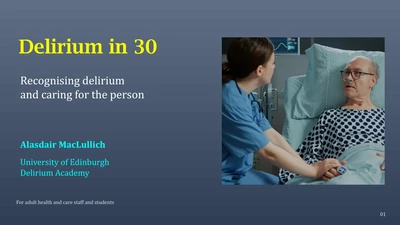
Delirium in 30 teaching slides
The foundation as a teaching session, with speaker notes and source links.
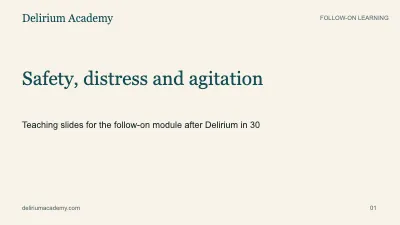
Safety teaching slides
Discussion and rehearsal after the safety module, with scene stills, the hard calls and speaker notes.
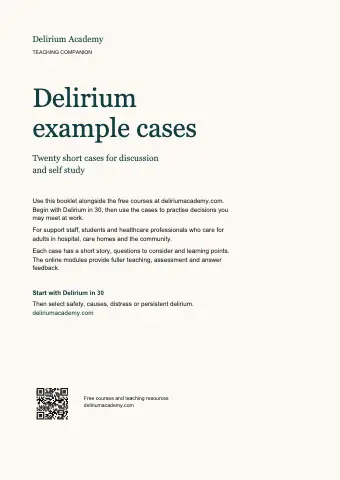
Twenty example cases
One case per page, with decisions, learning points and course links. Also as a print version on white paper with QR codes, and as an accessible web page.
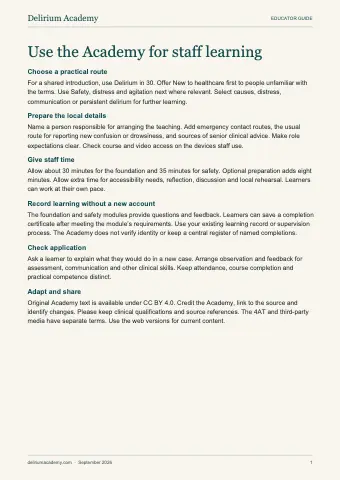
Teaching guide and local preparation sheet
Three session plans, advice for mixed groups and on using film, four evaluation questions and a sheet for your local contacts and routes.
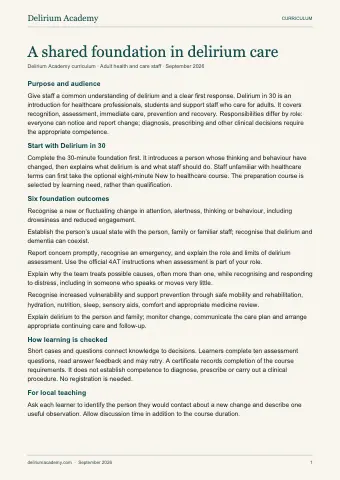
Curriculum
Six learning outcomes for the foundation, how learning is checked, the course sequence and topics to add locally. Also as a three-page PDF.
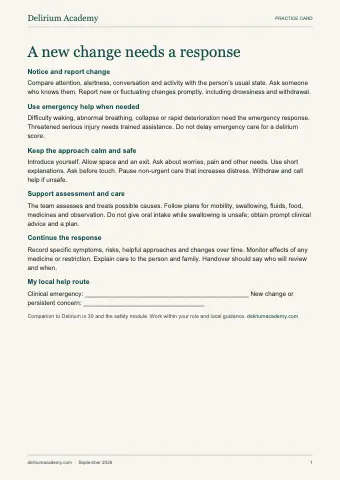
Practice card
Recognition, the immediate response and continuing care on one page. Print it for pockets, notice boards and staff rooms.
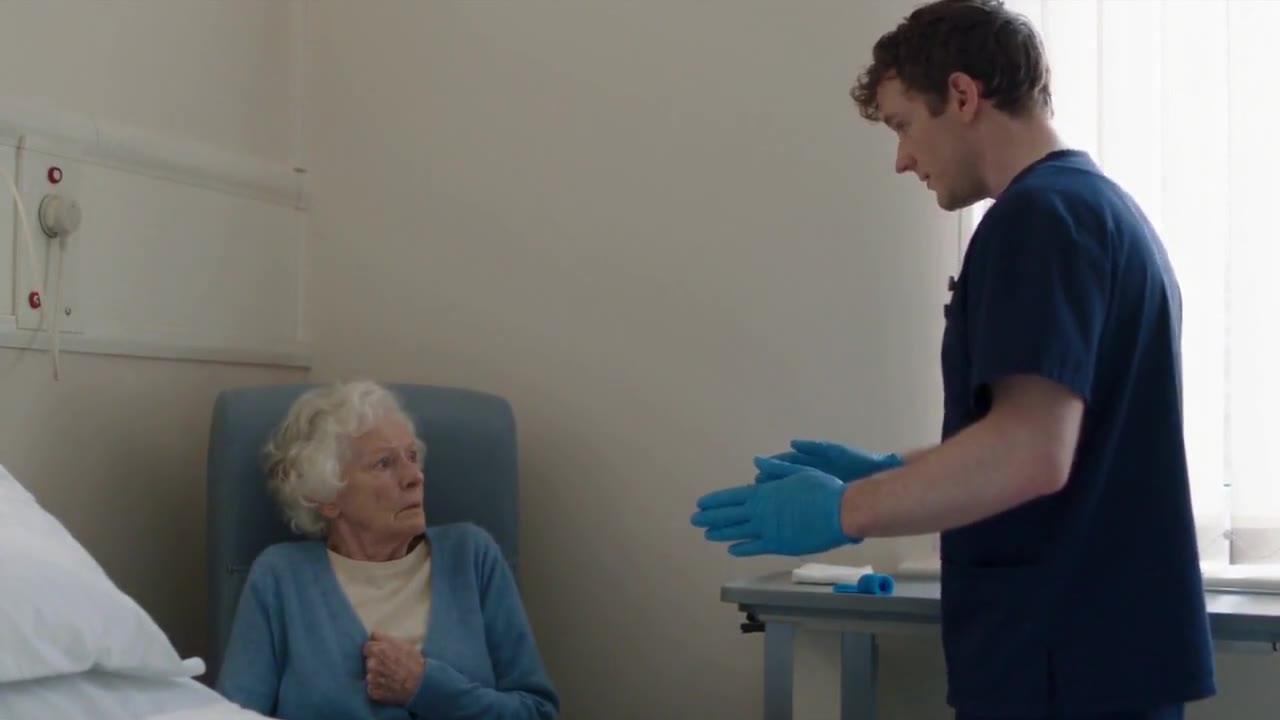
Film clips for teaching
Thirteen short simulated scenes and animations in the online courses, each with a written alternative. The clip index below gives the length, what each clip shows and one question to ask.
Before and after quiz
Ten questions with an answer key, to give before and after a session. Each question links to a foundation outcome.
Simulation scenarios
Three scenarios built from the safety module’s hard calls, with objectives, learner brief, facilitator notes and debrief questions.
Observed practice checklist
For supervised practice: noticing and reporting a change, and supervised use of the 4AT with the official instructions.
Clip index: 13 films and animations
Twelve clips are in the safety module, in the order below; the meal scene is in Delirium in 30. The scenes are simulated teaching scenes. Show a clip once, ask for observations, then replay it only if useful.
| Clip | Length | What it shows | A question to ask |
|---|---|---|---|
| Trying to climb out of bed | 3 s | A distressed older man grips the bed rails and tries to climb out as staff approach. | What are the risks here, to him and to the people around him? |
| A medical emergency | 30 s | At home, a carer finds a man very drowsy and short of breath. She stops asking questions and calls an ambulance. | What is the emergency response where you work, and who starts it? |
| Space | 9 s | Animation: where to stand in a bay. At an angle, out of arm’s reach, with the way to the door clear. | Where would you stand in the bays or rooms where you work? |
| Assess agitation | 32 s | Animation: common causes of agitation, such as urinary retention, pain, constipation, thirst and fear. | Which of these causes could you check in the next ten minutes? |
| Therapeutic engagement: two stages | 36 s | Animation: first find out how the person is feeling, then respond. | What would you ask before offering reassurance? |
| Stop, explain, then ask | 44 s | A staff member starts to take blood without explaining. The woman says no. He stops, introduces himself and explains. | What should he have said before he started? |
| Seeing something you do not | 10 s | A terrified woman sees something on the bed. A nurse takes her hand and tells her she is safe. | Touch helped here. When might it frighten someone, and how would you find out? |
| The third position | 28 s | Animation: how to reply to hallucinations without arguing and without playing along. | What would you say to a person who sees spiders on the bed? |
| Stillness is not comfort | 30 s | Animation: a drowsy, withdrawn person may be frightened, in pain or seriously unwell. | How would you check on a person who is lying still and saying nothing? |
| Refusing a tablet | 5 s | A frightened patient refuses a tablet and says it is poison. The nurse stays beside the bed. | Is the tablet needed now, and could it be given another way or at another time? |
| Care before medication | 20 s | Animation: the order of responses to distress. Causes first, then comfort, then orientation and family, and medicine last, for severe distress or immediate danger only. | What would you try before asking for medicine? |
| Leaving at night | 10 s | At 2 a.m. a man is dressed, holding his bags and walking to the exit. Two nurses are caring for 28 patients. | What would you do first, and whom would you call? |
| Meal scene | 15 s | In Delirium in 30. A man engages little with his meal and with the staff member’s question. | How would you find out whether this is new for him? |
Materials for your organisation
The whole pack as one download
Offline copies of Delirium in 30, New to healthcare and the safety module, each with a reading version, plus the cases, curriculum, guide, card, slides, clips, quiz, briefing, poster and mapping. Put the folder on a shared drive or intranet. The Academy’s own films are included. The linked survivor film on YouTube needs internet. This offline copy was made from the website on 30 September 2026; the online courses carry any later updates.
Invitation to staff
A short message asking staff to complete Delirium in 30 before a session. Copy it and add your local details.
Briefing for managers
One page: what the pack covers, minutes per person, how completion is recorded, cost and what your service needs to add.
Mapping to guidance and standards
The six foundation outcomes set against NICE CG103, SIGN 157, the Australian Delirium Clinical Care Standard, the Care Certificate (2025) and the Dementia Training Standards Framework (2026), quoted from the source documents.
Poster and intranet text
An A4 poster with a QR code to Delirium in 30 and space for your session and contact, and text for your intranet or newsletter.
Attendance certificate
An editable certificate for group sessions that you run.
Ward audit sheet
Five items to check in the notes: change noticed, 4AT done, causes looked for, family told, plan recorded.
Evidence summary
What studies of delirium education found, on one page with references.
Everything in the ZIP file
Start here: START-HERE.html explains how to open the pack. Extract the whole folder and keep the media folder beside the course files.
Courses to open in a browser: foundation.html (Delirium in 30), preparation.html (New to healthcare) and safety.html (Safety, distress and agitation), each with a reading version; cases-reading.html (the 20 cases); curriculum.html; educators.html (this page).
Documents: the 20 example cases (screen and print versions), the curriculum, the teaching guide, the practice card, the before and after quiz, the briefing for managers, the poster, the intranet text and the mapping to guidance and standards as PDFs; the foundation and safety slides as PPTX.
Media: images, the 13 film clips from the courses as MP4 files with a poster image for each, and caption files.
Run a session in the time you have
These three plans come from the teaching guide. Each one uses materials that are ready now.
10 minutes
One case at a handover
- Before
- Choose one case from the booklet.
- In the room
- Give staff two minutes to read it. Ask each person for a first action. Spend five minutes on the learning points and the different roles.
- Afterwards
- Use the last three minutes to confirm the local escalation route and one change in practice.
Uses: the case booklet
50 minutes
A shared introduction
- Before
- Staff complete Delirium in 30 on their own (30 minutes).
- In the room
- Twenty minutes together: five on case 1, five on case 4, five on a local handover rehearsal and five for questions.
- Afterwards
- Staff keep their certificates. Record completion in your usual system.
Uses: Delirium in 30, the case booklet, the foundation slides
60 minutes
Safety and local rehearsal
- Before
- Staff who have done Delirium in 30 complete the safety module (35 minutes).
- In the room
- Twenty-five minutes: five on the opening case and the first minute, ten on two hard calls chosen for your service, five on local help and staff roles, and five on review and handover after an episode.
- Afterwards
- Practical restraint techniques and emergency medicines need separate approved training.
Uses: the safety module, the safety slides, the practice card
These are planned times. Allow extra time for discussion, accessibility needs and individual learning needs.
Make the learning last
Reviews of delirium education find that teaching raises knowledge, and that practice on the ward changes more often when teaching is combined with changes to how the ward works. Six measures you can add:
- A named local leadSomeone who arranges the teaching, answers questions and repeats it for new staff.
- Local contacts in the materialsAdd your emergency route and your route for reporting new confusion to the preparation sheet and the slides.
- The 4AT in the notes or recordWith a rule on who screens, when, and what happens after a positive result.
- Reminders where staff workThe practice card at the nurses’ station, in handover folders and in pockets.
- Short sessions, repeatedRun a ten-minute case every few weeks, and repeat the introduction for new staff.
- A simple audit, fed backCheck a few sets of notes each month for the steps in the practice card, and tell the team what you find.
Who made it and how it is checked
The Academy was created by Professor Alasdair MacLullich, a practising consultant geriatrician and Professor of Geriatric Medicine at the University of Edinburgh. He reviewed the clinical content.
The Academy is an independent personal project. It has no adverts, sponsorship or industry involvement. Clinical statements are checked against peer reviewed research and guidance, including NICE CG103 on delirium, NICE NG10 on violence and aggression and the Australian Delirium Clinical Care Standard (2021). For intensive care, the safety module refers to the PADIS guideline (2018) and its 2025 focused update. References link to PubMed or to the original guidance.
What the pack does not provide: it is not accredited for continuing professional development by an external body. There is no central record of who has completed a course. A certificate records that a course was completed. It does not assess clinical competence. The pack does not cover delirium in children.
- Versions
- Delirium in 30: version 1.1. Safety module: version 2.0.
- Last checked
- Delirium in 30: sources and language checked 22 September 2026. New to healthcare and the educator materials: 20 September 2026. Safety module: sources checked 22 September 2026, language and media edited 27 September 2026.
- Next review
- Causes, distress and persistent delirium modules: by 8 August 2027, or sooner if guidance changes.
- For
- Staff and students caring for adults in hospitals, care homes and the community
- Data
- No accounts and no learner records
- Licence
- Original text CC BY 4.0
Use it freely
You can use everything on this page in your own teaching without asking. Copy the slides and edit them. Add your logo, your local contacts and your own cases. Print the booklet. Put the offline pack on your intranet.
The one thing we ask is that you say where it came from. A line like the one shown is enough. It helps other educators find the source.
Please keep the clinical qualifications and references, and note any changes you make. The 4AT and films from other sources have their own terms.
Please tell us if you are using the pack. One line is enough: your organisation, your country and the staff group. If you find an error, tell us the page and the correction.
Email a.maclullich@gmail.com with the subject “Delirium Academy educator”. Please do not include patient details. For news of new materials, subscribe to the newsletter.
Credit line
Adapted from Delirium Academy (deliriumacademy.com), Professor Alasdair MacLullich. Original text CC BY 4.0.
To cite a module
MacLullich A. Delirium in 30. Delirium Academy; 2026. https://deliriumacademy.com/introduction-to-delirium/
Invite your team
Copy this invitation and add your local arrangements before sending it.
Please complete Delirium in 30 before our teaching session. It is a free introduction to delirium for staff caring for adults, with examples, questions and answer feedback. No registration is needed.
Start at https://deliriumacademy.com/introduction-to-delirium/
If healthcare terms are new to you, use the short preparation course linked from the foundation. Save your completion certificate and bring one question or observation to our discussion.
Session date and local contact: [add details]
Questions educators ask
Can we put the courses on our own learning system or intranet?
Yes. The pack includes offline copies of Delirium in 30, New to healthcare and the safety module that run in a web browser from a shared folder or intranet. You can also link to the online courses. A SCORM package, which lets a learning system record completion, is not available yet.
Is the pack accredited for continuing professional development?
No external body has accredited it. The durations are stated, so learners can record the time as self study where their professional body allows this.
How do we record that staff have completed a course?
Learners answer the assessment questions, read the feedback and may try again. A certificate becomes available once they meet the course requirements and confirm that they have reviewed the explanations. The foundation and safety modules require correct answers to specified safety questions. The learner types a name and prints or saves the certificate. The Academy does not check identity or keep a register, so use your existing learning record. Keep course completion separate from assessment of practical skills.
Can we add our logo and local contacts?
Yes. Edit the slides and the preparation sheet as you need. Please keep the credit line and the references.
We are outside the UK. Does the content apply?
The clinical content on recognising and managing delirium is general. Law on capacity, consent and restraint differs between countries, and some medicine names and services are British. Add your local law and procedures to the preparation sheet.
Does it cover children?
No. The Academy is written for the care of adults.
How often is the content updated?
The dates of the last checks and the next formal review are in the box above and on the About page. Content is updated sooner when guidance changes.
We found an error. What should we do?
Email the page title and the correction to a.maclullich@gmail.com. Please do not include patient details.