Example case 4 of 40
More than one cause
Care and reassessment after hip surgery
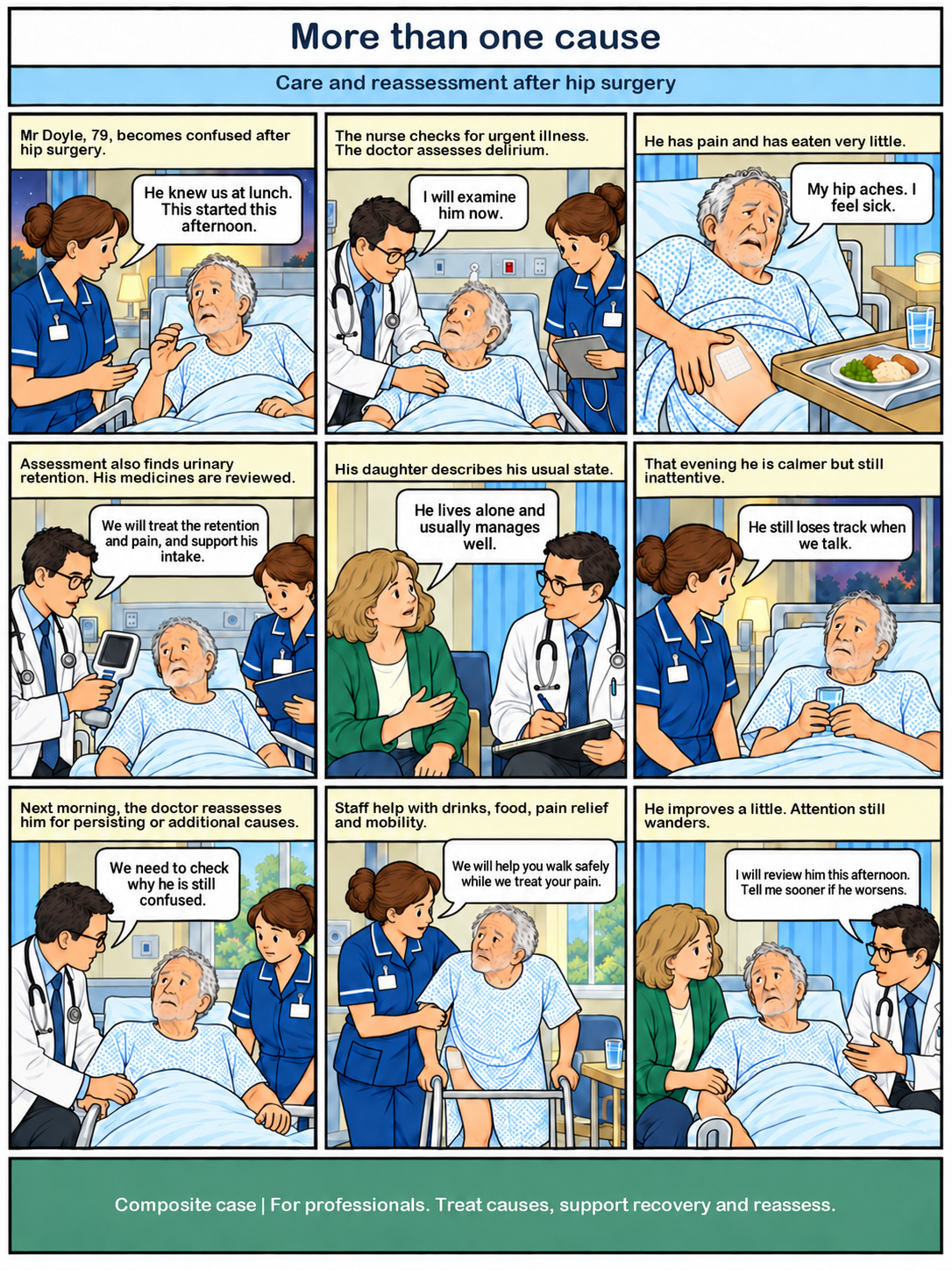
Mr Doyle, 79, becomes confused after hip surgery.
Click or tap each illustration to enlarge it. The commentary and text transcript follow below.
Read the text transcript
Page 1
Panel 1
Mr Doyle, 79, becomes confused after hip surgery.
Nurse: He knew us at lunch. This started this afternoon.
Panel 2
The nurse checks for urgent illness. The doctor assesses delirium.
Doctor: I will examine him now.
Panel 3
He has pain and has eaten very little.
Mr Doyle: My hip aches. I feel sick.
Panel 4
Assessment also finds urinary retention. His medicines are reviewed.
Doctor: We will treat the retention and pain, and support his intake.
Panel 5
His daughter describes his usual state.
Daughter: He lives alone and usually manages well.
Panel 6
That evening he is calmer but still inattentive.
Nurse: He still loses track when we talk.
Panel 7
Next morning, the doctor reassesses him for persisting or additional causes.
Doctor: We need to check why he is still confused.
Panel 8
Staff help with drinks, food, pain relief and mobility.
Nurse: We will help you walk safely while we treat your pain.
Panel 9
He improves a little. Attention still wanders.
Doctor: I will review him this afternoon. Tell me sooner if he worsens.
Commentary
Treat possible causes and continue supportive care. Persistent symptoms need reassessment, including for additional causes.
An anonymised composite case that does not describe one identifiable person and is not research evidence.