Example case 32 of 40
Confusion before the fever
Recognise delirium as an early sign of postoperative illness and separate surgical from cognitive recovery.
Click or tap each illustration to enlarge it. The commentary and text transcript follow below.
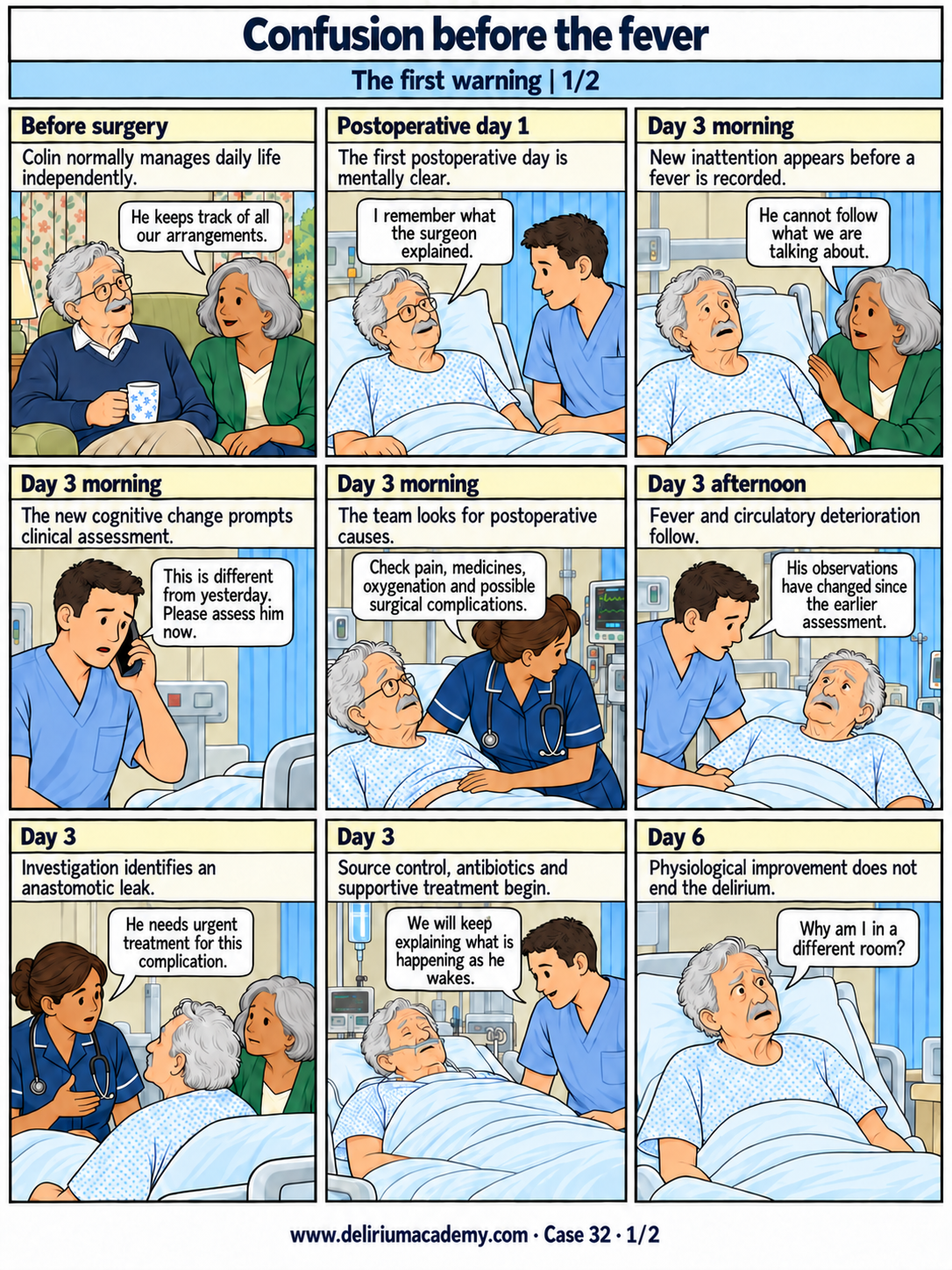
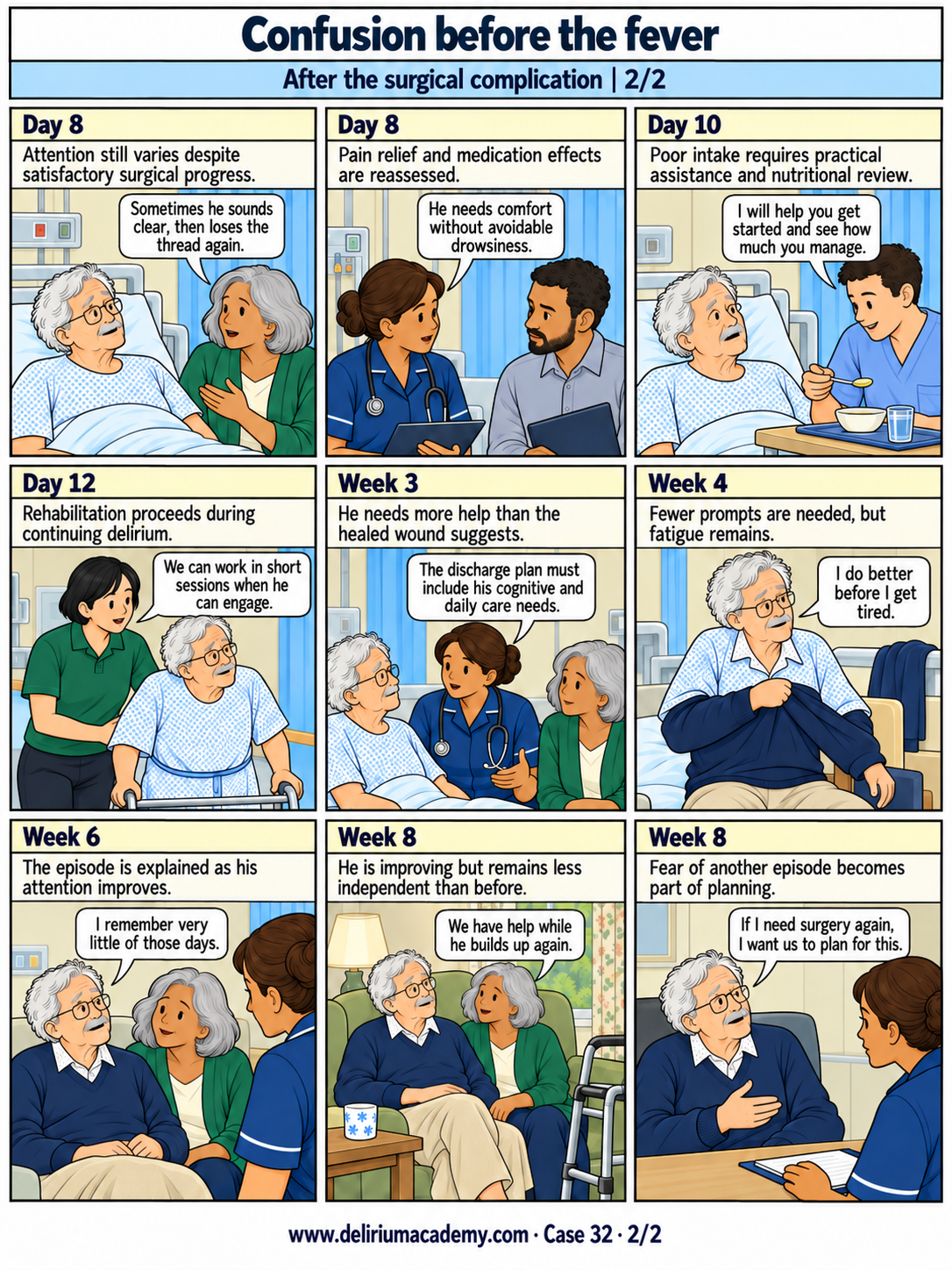
Read the text transcript
Page 1
Panel 1: Before surgery
Colin normally manages daily life independently.
Asha: He keeps track of all our arrangements.
Panel 2: Postoperative day 1
The first postoperative day is mentally clear.
Colin: I remember what the surgeon explained.
Panel 3: Day 3 morning
New inattention appears before a fever is recorded.
Asha: He cannot follow what we are talking about.
Panel 4: Day 3 morning
The new cognitive change prompts clinical assessment.
Nurse Tom: This is different from yesterday. Please assess him now.
Panel 5: Day 3 morning
The team looks for postoperative causes.
Ward doctor Amira: Check pain, medicines, oxygenation and possible surgical complications.
Panel 6: Day 3 afternoon
Fever and circulatory deterioration follow.
Nurse Tom: His observations have changed since the earlier assessment.
Panel 7: Day 3
Investigation identifies an anastomotic leak.
Ward doctor Amira: He needs urgent treatment for this complication.
Panel 8: Day 3
Source control, antibiotics and supportive treatment begin.
Nurse Tom: We will keep explaining what is happening as he wakes.
Panel 9: Day 6
Physiological improvement does not end the delirium.
Colin: Why am I in a different room?
Page 2
Panel 10: Day 8
Attention still varies despite satisfactory surgical progress.
Asha: Sometimes he sounds clear, then loses the thread again.
Panel 11: Day 8
Pain relief and medication effects are reassessed.
Ward doctor Amira: He needs comfort without avoidable drowsiness.
Panel 12: Day 10
Poor intake requires practical assistance and nutritional review.
Nurse Tom: I will help you get started and see how much you manage.
Panel 13: Day 12
Rehabilitation proceeds during continuing delirium.
Physiotherapist Lin: We can work in short sessions when he can engage.
Panel 14: Week 3
He needs more help than the healed wound suggests.
Ward doctor Amira: The discharge plan must include his cognitive and daily care needs.
Panel 15: Week 4
Fewer prompts are needed, but fatigue remains.
Colin: I do better before I get tired.
Panel 16: Week 6
The episode is explained as his attention improves.
Colin: I remember very little of those days.
Panel 17: Week 8
He is improving but remains less independent than before.
Asha: We have help while he builds up again.
Panel 18: Week 8
Fear of another episode becomes part of planning.
Colin: If I need surgery again, I want us to plan for this.
Sources
- [S38] Marcantonio, E.R. (2012) ‘Postoperative delirium: a 76-year-old woman with delirium following surgery’, JAMA, 308(1), pp. 73–81.
- [S04] Nair, A., Arfan, S., Holder, S.S., Bacchus, K.I. and Stear, T.J. (2023) ‘Persistent Postoperative Delirium Following Laparoscopic Cholecystectomy’, Cureus, 15(6), e40523.
- [P43] Dharmarajan K, Swami S, Gou RY, Jones RN, Inouye SK. Pathway from Delirium to Death: Potential In-Hospital Mediators of Excess Mortality. Journal of the American Geriatrics Society. 2017;65:1026–1033.
- [G01] National Institute for Health and Care Excellence. Delirium: prevention, diagnosis and management in hospital and long-term care. CG103.
Commentary
Colin's first clear deterioration is cognitive. The nurse and Asha notice that he is unable to follow familiar conversation before overt fever and haemodynamic instability appear. A focused surgical assessment begins at that point. The team begins assessment before dramatic physiological abnormalities appear.
A postoperative complication is subsequently identified and treated. The exact procedure is kept at the level needed for the learning objective; the source relationship is the timing of confusion before obvious sepsis [S38]. The second page then follows the less dramatic but clinically important period after treatment. Breathing and circulation stabilise while attention, sleep and everyday functioning remain abnormal.
The case also includes medication and pain review, nutritional assistance and adapted mobilisation. The team continues these measures in response to Colin's condition, without promising to shorten delirium by a particular number of days [P43, G01]. Rehabilitation is not postponed until every cognitive symptom has disappeared.
Asha's observations contribute information about baseline and the daily course. They do not replace examination, but they prevent a brief lucid exchange from being taken as proof of recovery. By week eight, Colin is home with additional support and worries about future surgery. Future planning can include subsequent procedures without suggesting that recurrence is inevitable or that any prevention package guarantees its absence. Marcantonio's reported patient had a later operation without delirium, but the individual components responsible were not established [S38].
An anonymised composite case that does not describe one identifiable person and is not research evidence.