Example case 33 of 40
After the tremor settles
Treat withdrawal and nutritional risk while reassessing persistent delirium for concurrent illness.
Click or tap each illustration to enlarge it. The commentary and text transcript follow below.
Read the text transcript
Page 1
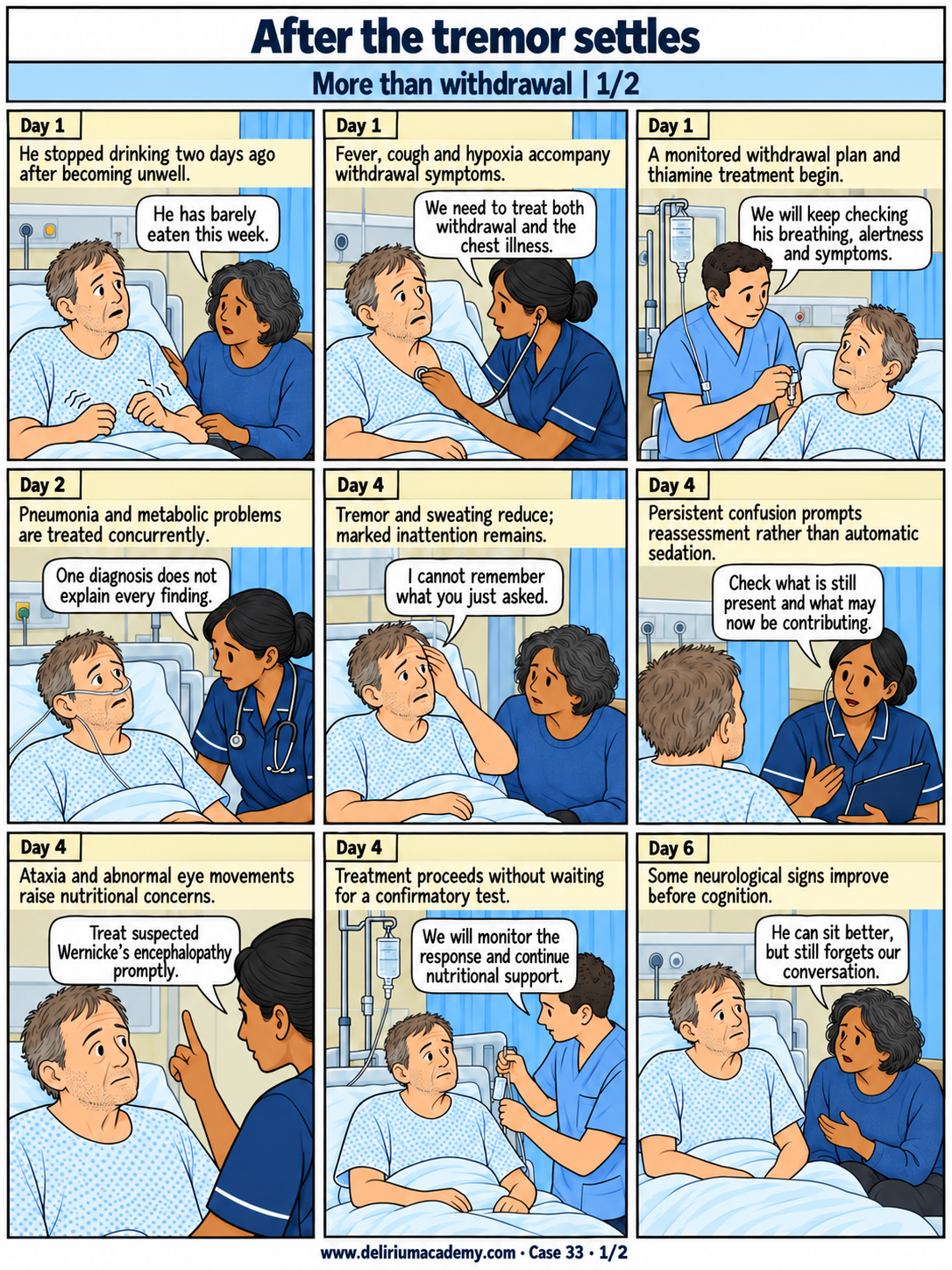
Panel 1: Day 1
He stopped drinking two days ago after becoming unwell.
Mina: He has barely eaten this week.
Panel 2: Day 1
Fever, cough and hypoxia accompany withdrawal symptoms.
Ward doctor Amira: We need to treat both withdrawal and the chest illness.
Panel 3: Day 1
A monitored withdrawal plan and thiamine treatment begin.
Nurse Tom: We will keep checking his breathing, alertness and symptoms.
Panel 4: Day 2
Pneumonia and metabolic problems are treated concurrently.
Ward doctor Amira: One diagnosis does not explain every finding.
Panel 5: Day 4
Tremor and sweating reduce; marked inattention remains.
Andrew: I cannot remember what you just asked.
Panel 6: Day 4
Persistent confusion prompts reassessment rather than automatic sedation.
Ward doctor Amira: Check what is still present and what may now be contributing.
Panel 7: Day 4
Ataxia and abnormal eye movements raise nutritional concerns.
Ward doctor Amira: Treat suspected Wernicke's encephalopathy promptly.
Panel 8: Day 4
Treatment proceeds without waiting for a confirmatory test.
Nurse Tom: We will monitor the response and continue nutritional support.
Panel 9: Day 6
Some neurological signs improve before cognition.
Mina: He can sit better, but still forgets our conversation.
Page 2
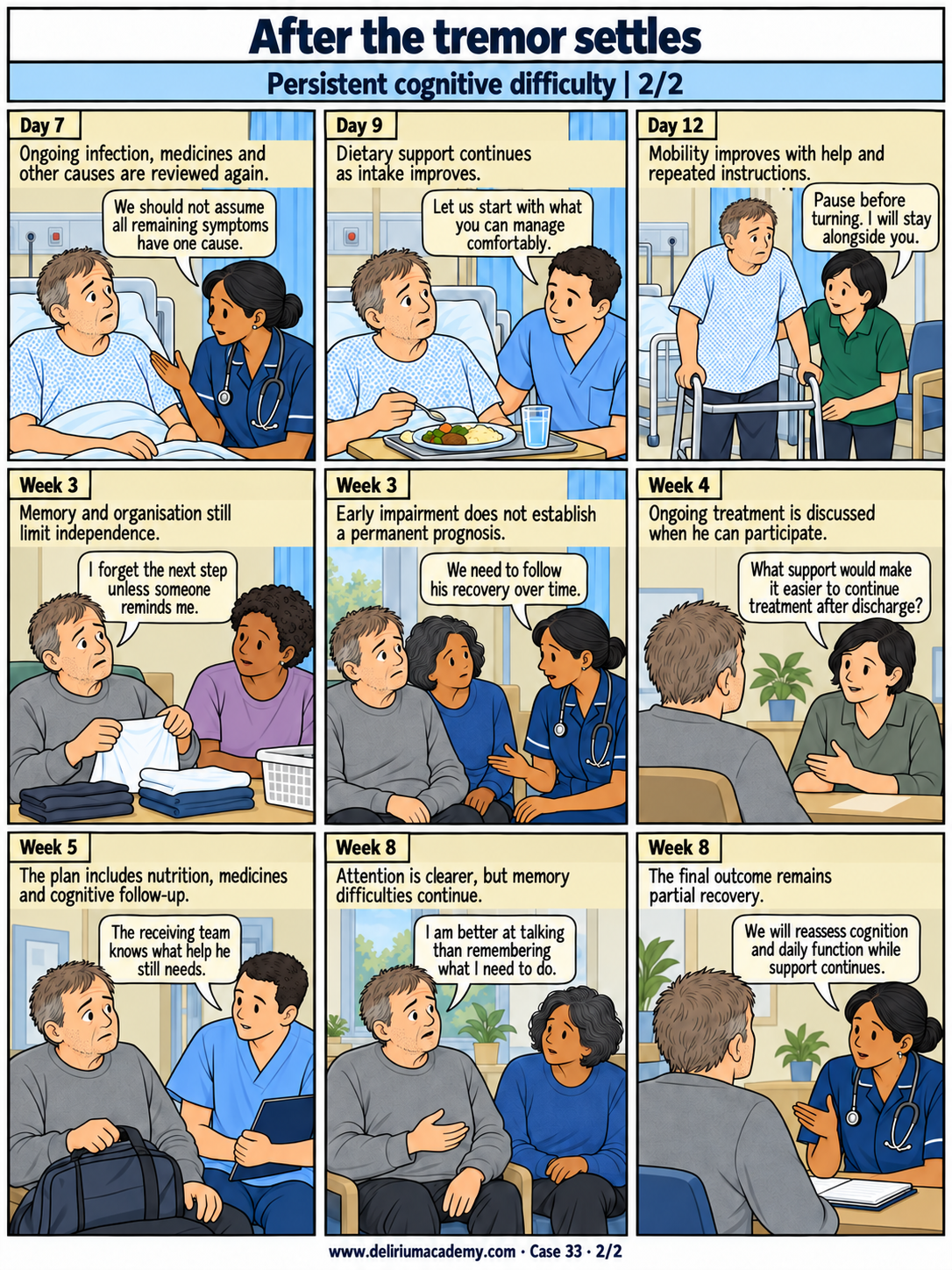
Panel 10: Day 7
Ongoing infection, medicines and other causes are reviewed again.
Ward doctor Amira: We should not assume all remaining symptoms have one cause.
Panel 11: Day 9
Dietary support continues as intake improves.
Nurse Tom: Let us start with what you can manage comfortably.
Panel 12: Day 12
Mobility improves with help and repeated instructions.
Physiotherapist Lin: Pause before turning. I will stay alongside you.
Panel 13: Week 3
Memory and organisation still limit independence.
Andrew: I forget the next step unless someone reminds me.
Panel 14: Week 3
Early impairment does not establish a permanent prognosis.
Ward doctor Amira: We need to follow his recovery over time.
Panel 15: Week 4
Ongoing treatment is discussed when he can participate.
Alcohol liaison clinician Jo: What support would make it easier to continue treatment after discharge?
Panel 16: Week 5
The plan includes nutrition, medicines and cognitive follow-up.
Nurse Tom: The receiving team knows what help he still needs.
Panel 17: Week 8
Attention is clearer, but memory difficulties continue.
Andrew: I am better at talking than remembering what I need to do.
Panel 18: Week 8
The final outcome remains partial recovery.
Ward doctor Amira: We will reassess cognition and daily function while support continues.
Sources
- [S17] Jith, A., Mathew, K.A., Narayanan, D. and Jacob, S.M. (2021) ‘CASPR2 positive autoimmune encephalitis presenting as delirium in an alcohol dependent patient: a diagnostic dilemma’, Kerala Journal of Psychiatry, 34(1), pp. 54–56.
- [S22] Thukral, P., Sonavane, S., Shah, N., Kalra, G. and Desousa, A. (2013) ‘The conundrum of prolonged delirium’, The National Medical Journal of India, 26(3), pp. 150–151.
- [G05] National Institute for Health and Care Excellence. Alcohol-use disorders: diagnosis and management of physical complications. CG100.
- [G01] National Institute for Health and Care Excellence. Delirium: prevention, diagnosis and management in hospital and long-term care. CG103.
Commentary
Andrew has a credible alcohol-withdrawal history, but he also has pneumonia and poor nutrition. Those problems are assessed and treated concurrently. The presence of one explanation should not prevent action on another. Treatment includes a monitored withdrawal regimen and thiamine appropriate to the clinical assessment [G05].
By day four, tremor and autonomic symptoms have reduced. Continuing inattention is therefore assessed directly rather than prompting automatic escalation of sedative treatment. Sedation, infection, metabolic disturbance and nutritional disease remain relevant. New ataxia and ocular findings raise concern about Wernicke's encephalopathy, prompting parenteral treatment without waiting for a confirmatory test. Improvement in those signs does not establish that the entire cognitive syndrome has resolved.
The supplied case reports show how a withdrawal label can persist despite a course requiring further investigation [S17, S22]. Their uncommon diagnoses are not copied into Andrew's case. The teaching aim is to review timing, observed signs and response to treatment, then broaden assessment when necessary.
The final page includes continuing memory and daily-function difficulties. A permanent alcohol-related cognitive diagnosis is not assigned during this early recovery. Support, nutritional care and alcohol-treatment follow-up are arranged alongside cognitive reassessment. Discussion can focus on which findings are actually signs of withdrawal, which suggest other illness, and how treatment harms would be recognised in a person already confused.
An anonymised composite case that does not describe one identifiable person and is not research evidence.