Example case 34 of 40
The medicine missing from the list
Reconstruct actual medication exposure and identify withdrawal after an unintentional interruption.
Click or tap each illustration to enlarge it. The commentary and text transcript follow below.
Read the text transcript
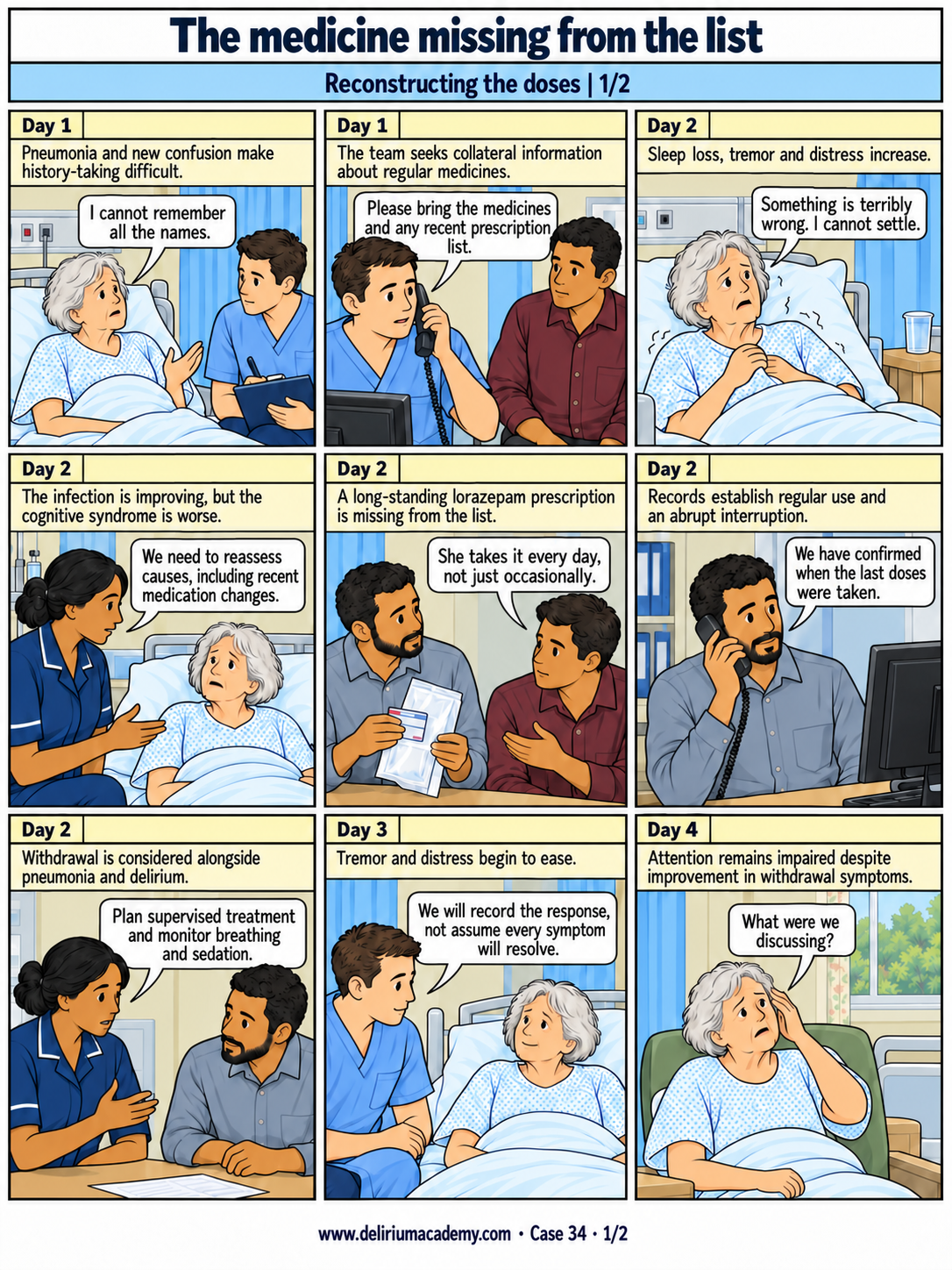
Page 1
Panel 1: Day 1
Pneumonia and new confusion make history-taking difficult.
Joan: I cannot remember all the names.
Panel 2: Day 1
The team seeks collateral information about regular medicines.
Nurse Tom: Please bring the medicines and any recent prescription list.
Panel 3: Day 2
Sleep loss, tremor and distress increase.
Joan: Something is terribly wrong. I cannot settle.
Panel 4: Day 2
The infection is improving, but the cognitive syndrome is worse.
Ward doctor Amira: We need to reassess causes, including recent medication changes.
Panel 5: Day 2
A long-standing lorazepam prescription is missing from the list.
Salim: She takes it every day, not just occasionally.
Panel 6: Day 2
Records establish regular use and an abrupt interruption.
Pharmacist Samir: We have confirmed when the last doses were taken.
Panel 7: Day 2
Withdrawal is considered alongside pneumonia and delirium.
Ward doctor Amira: Plan supervised treatment and monitor breathing and sedation.
Panel 8: Day 3
Tremor and distress begin to ease.
Nurse Tom: We will record the response, not assume every symptom will resolve.
Panel 9: Day 4
Attention remains impaired despite improvement in withdrawal symptoms.
Joan: What were we discussing?
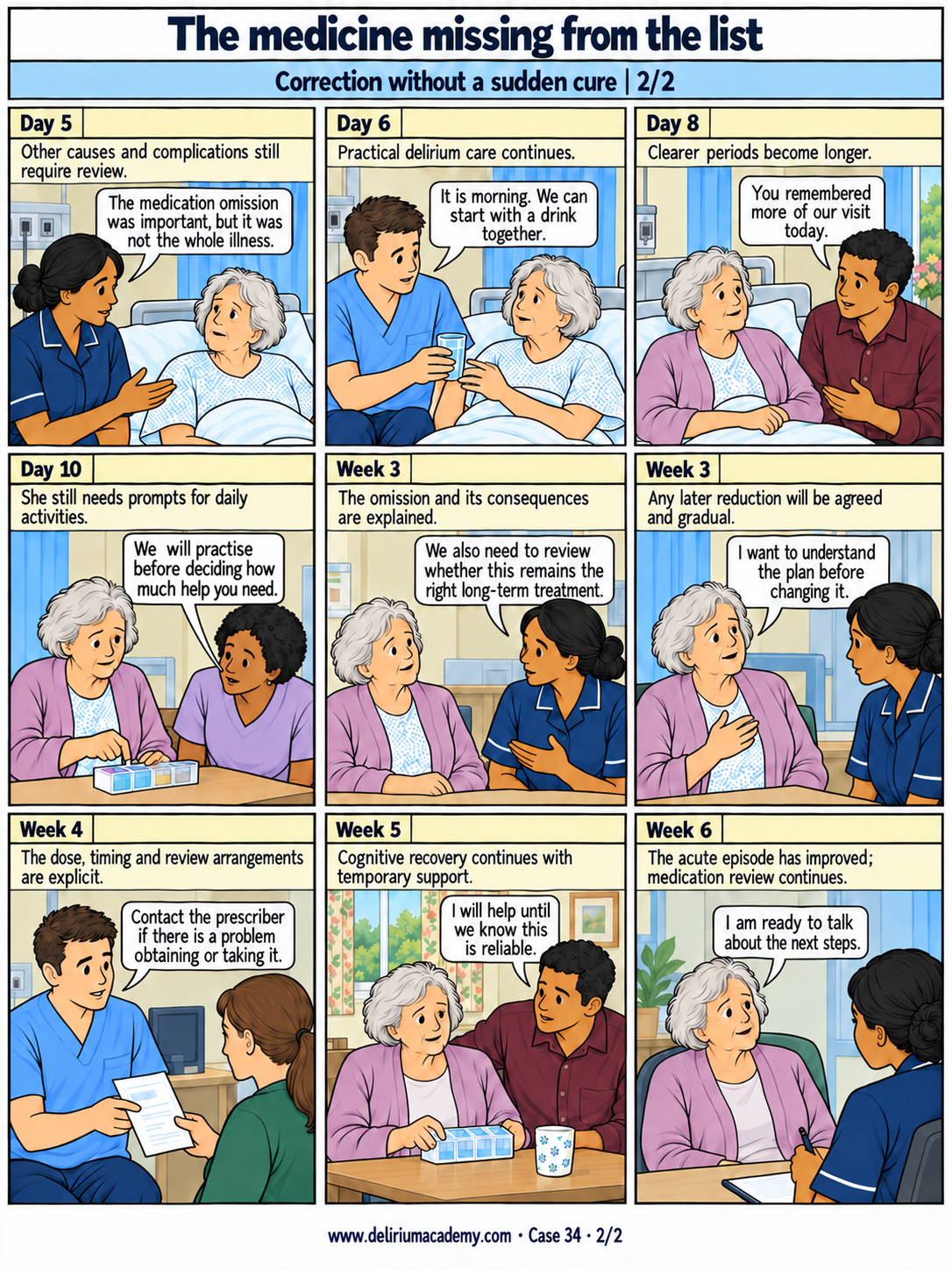
Page 2
Panel 10: Day 5
Other causes and complications still require review.
Ward doctor Amira: The medication omission was important, but it was not the whole illness.
Panel 11: Day 6
Practical delirium care continues.
Nurse Tom: It is morning. We can start with a drink together.
Panel 12: Day 8
Clearer periods become longer.
Salim: You remembered more of our visit today.
Panel 13: Day 10
She still needs prompts for daily activities.
Occupational therapist Ruth: We will practise before deciding how much help you need.
Panel 14: Week 3
The omission and its consequences are explained.
Ward doctor Amira: We also need to review whether this remains the right long-term treatment.
Panel 15: Week 3
Any later reduction will be agreed and gradual.
Joan: I want to understand the plan before changing it.
Panel 16: Week 4
The dose, timing and review arrangements are explicit.
Nurse Tom: Contact the prescriber if there is a problem obtaining or taking it.
Panel 17: Week 5
Cognitive recovery continues with temporary support.
Salim: I will help until we know this is reliable.
Panel 18: Week 6
The acute episode has improved; medication review continues.
Joan: I am ready to talk about the next steps.
Sources
- [T02] MacLullich AMJ. Persistent delirium. CHG Singapore teaching presentation, 2025. Supplied slides.
- [S25] Sanders, B.J. and Ali, Z.A. (2021) ‘Oral Baclofen Withdrawal Resulting in Hyperactive Delirium: A Case Report’, Cureus, 13(5), e14979.
- [G06] National Institute for Health and Care Excellence. Medicines associated with dependence or withdrawal symptoms: safe prescribing and withdrawal management for adults. NG215.
- [G01] National Institute for Health and Care Excellence. Delirium: prevention, diagnosis and management in hospital and long-term care. CG103.
Commentary
Joan's admission list omits a medicine she has taken regularly for years. Her inability to give a complete history makes collateral information and pharmacy records particularly important. The timing and sequence of actual doses are clinically relevant: a drug can contribute to problems while being taken, but stopping it abruptly can create a different problem.
The clinical picture includes pneumonia, disrupted sleep, tremor and new severe anxiety with delirium. Withdrawal becomes a plausible additional contributor after the omitted lorazepam is confirmed. Treatment is planned with appropriate clinical supervision, considering current respiratory illness and sedation risk. The case does not prescribe a standard restart dose or suggest that every omitted medicine should simply be resumed unchanged [G06].
The supplied talk and baclofen report illustrate the value of reconstructing medication exposure, although they involve different drugs and circumstances [T02, S25]. Joan's chronology and response are newly constructed. Her tremor and distress improve before attention, making it clear that correcting the omission does not explain away the remaining delirium.
After acute recovery, the long-term prescription is reviewed with Joan. Any agreed reduction is planned rather than abrupt. This later discussion is separate from the emergency response to withdrawal. Learners can identify where reconciliation failed, how the missing history was recovered, and what information must accompany transfer so that the same interruption does not recur.
An anonymised composite case that does not describe one identifiable person and is not research evidence.