Example case 35 of 40
Comfort and the chance to speak
Combine assessment of reversible contributors with goals of care, symptom relief and an uncertain end-of-life course.
Click or tap each illustration to enlarge it. The commentary and text transcript follow below.
Read the text transcript
Page 1
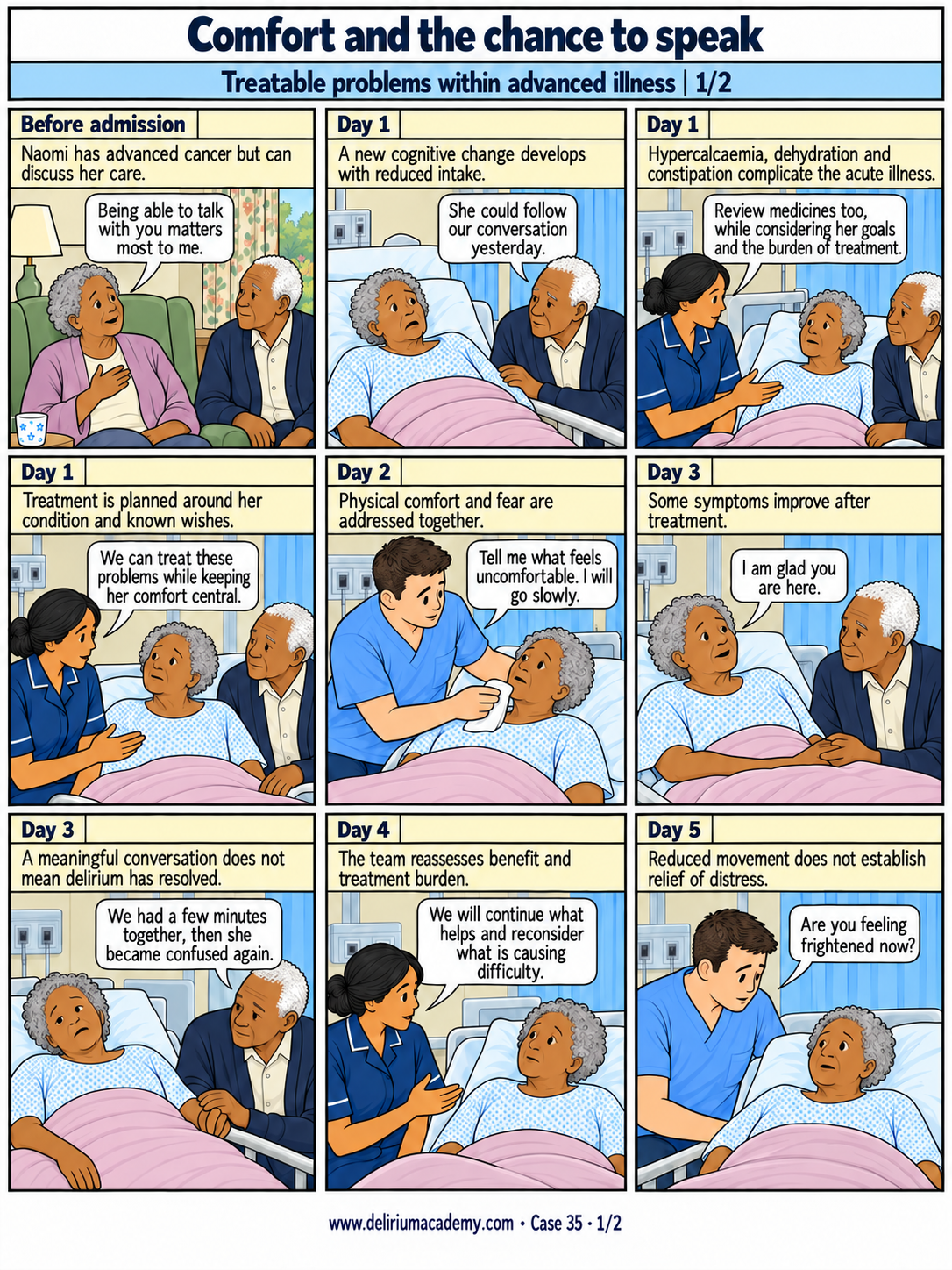
Panel 1: Before admission
Naomi has advanced cancer but can discuss her care.
Naomi: Being able to talk with you matters most to me.
Panel 2: Day 1
A new cognitive change develops with reduced intake.
Joel: She could follow our conversation yesterday.
Panel 3: Day 1
Hypercalcaemia, dehydration and constipation complicate the acute illness.
Ward doctor Amira: Review medicines too, while considering her goals and the burden of treatment.
Panel 4: Day 1
Treatment is planned around her condition and known wishes.
Ward doctor Amira: We can treat these problems while keeping her comfort central.
Panel 5: Day 2
Physical comfort and fear are addressed together.
Nurse Tom: Tell me what feels uncomfortable. I will go slowly.
Panel 6: Day 3
Some symptoms improve after treatment.
Naomi: I am glad you are here.
Panel 7: Day 3
A meaningful conversation does not mean delirium has resolved.
Joel: We had a few minutes together, then she became confused again.
Panel 8: Day 4
The team reassesses benefit and treatment burden.
Ward doctor Amira: We will continue what helps and reconsider what is causing difficulty.
Panel 9: Day 5
Reduced movement does not establish relief of distress.
Nurse Tom: Are you feeling frightened now?
Page 2
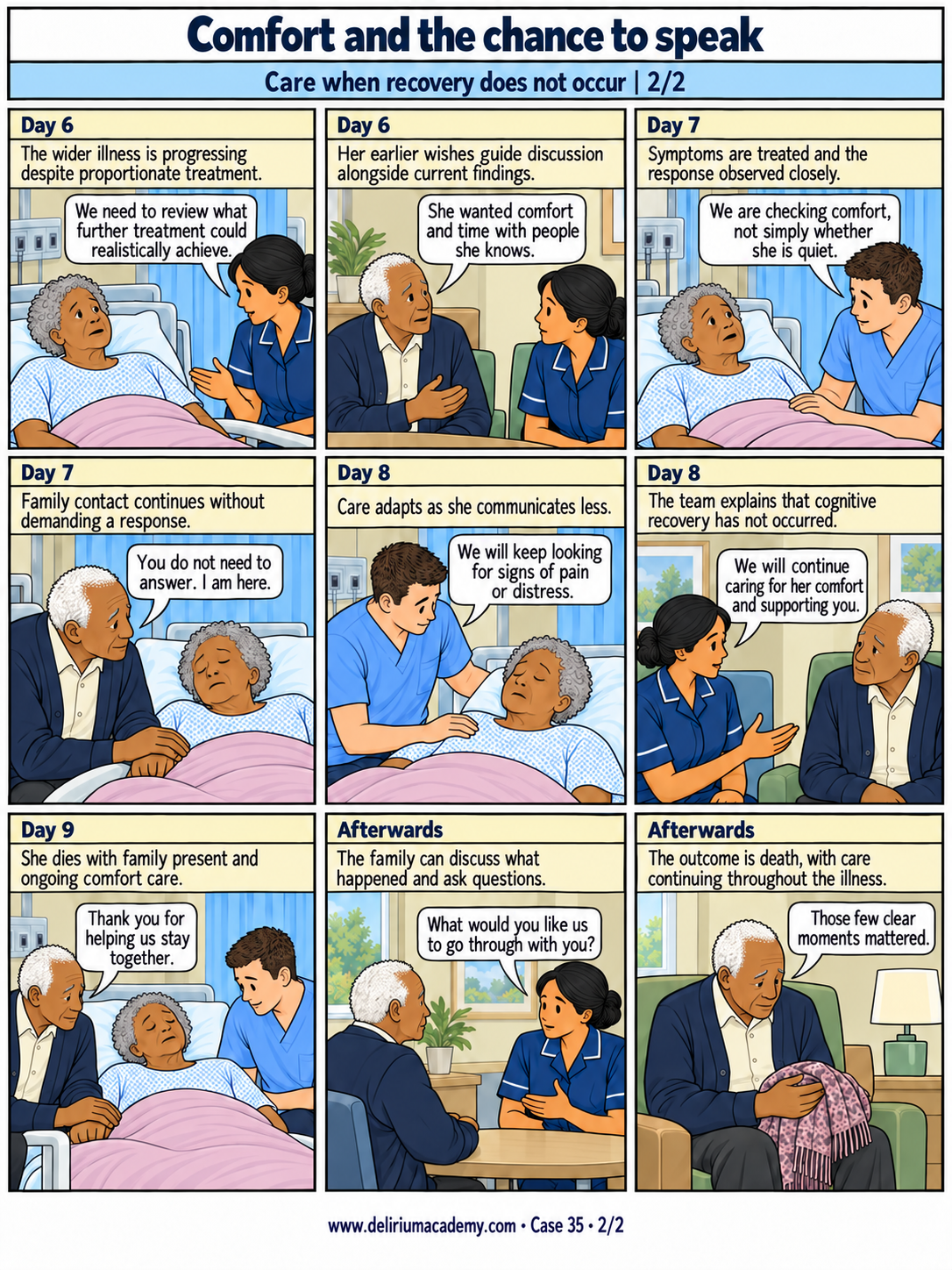
Panel 10: Day 6
The wider illness is progressing despite proportionate treatment.
Ward doctor Amira: We need to review what further treatment could realistically achieve.
Panel 11: Day 6
Her earlier wishes guide discussion alongside current findings.
Joel: She wanted comfort and time with people she knows.
Panel 12: Day 7
Symptoms are treated and the response observed closely.
Nurse Tom: We are checking comfort, not simply whether she is quiet.
Panel 13: Day 7
Family contact continues without demanding a response.
Joel: You do not need to answer. I am here.
Panel 14: Day 8
Care adapts as she communicates less.
Nurse Tom: We will keep looking for signs of pain or distress.
Panel 15: Day 8
The team explains that cognitive recovery has not occurred.
Ward doctor Amira: We will continue caring for her comfort and supporting you.
Panel 16: Day 9
She dies with family present and ongoing comfort care.
Joel: Thank you for helping us stay together.
Panel 17: Afterwards
The family can discuss what happened and ask questions.
Ward doctor Amira: What would you like us to go through with you?
Panel 18: Afterwards
The outcome is death, with care continuing throughout the illness.
Joel: Those few clear moments mattered.
Sources
- [S09] Dunphy, L., Akin-Komolafe, T. and Etheridge, Z. (2021) ‘Mixed dementia and hyperactive delirium: a diagnostic challenge’, BMJ Case Reports, 14(5), e238542.
- [S10] Lou, K., Minhas, S. and Nayar, S. (2022) ‘Dermatomyositis Related Paraneoplastic Encephalitis Presenting as Terminal Delirium in the Palliative Care Unit – A Case Report’, Journal of Palliative Care, 37(3), pp. 270–272.
- [S14] Silva, T.O., Angeli-Faez, B., Paixão, L.C.F., Maraldi, E. de O. and Moreira-Almeida, A. (2026) ‘End-of-life dreams and visions in a patient with delirium: A Brazilian case report and narrative review’, Palliative and Supportive Care, 24, e4, pp. 1–10.
- [S15] Breitbart, W. and Alici, Y. (2008) ‘Agitation and delirium at the end of life: “We couldn't manage him”’, JAMA, 300(24), pp. 2898–2910, E1.
- [T01] MacLullich AMJ. Conceptualising distress in delirium. Usher teaching presentation, May 2026. Supplied slides.
Commentary
Naomi has advanced cancer, but the acute change still prompts assessment. Hypercalcaemia, dehydration, constipation and medication effects are considered in relation to her goals and the burdens of treatment. The plan offers proportionate treatment of plausible contributors while also addressing fear and discomfort. Delirium is not labelled terminal merely because the patient is agitated or has cancer.
The first response is partial: Naomi becomes comfortable enough for a short conversation with Joel, but attention remains inconsistent. That conversation is meaningful without being evidence of full cognitive recovery. The palliative case literature includes similarly distinct goals, such as contact with family or relief of particular symptoms [S10, S14, S15]. It does not justify assigning the same treatment response to every patient.
Later deterioration is assessed in the context of progressive illness, previous wishes and the clinical trajectory. The decision to focus on comfort is made after that review, rather than because delirium has lasted an arbitrary number of days. Medicines used for severe symptoms are monitored for their intended effect and burdens; reduced activity alone is insufficient evidence of successful symptom control [T01].
Naomi dies with Joel present. The case includes no complete delirium recovery, but it does include active care, communication and attention to suffering. Discussion can examine which treatments remain proportionate, how to recognise distress in someone communicating less, and how to explain uncertainty to relatives without promising either recovery or inevitable rapid deterioration.
An anonymised composite case that does not describe one identifiable person and is not research evidence.