Example case 36 of 40
The ward is quieter now
Separate active delirium, weakness and distressing memories across ICU transfer and recovery.
Click or tap each illustration to enlarge it. The commentary and text transcript follow below.
Read the text transcript
Page 1
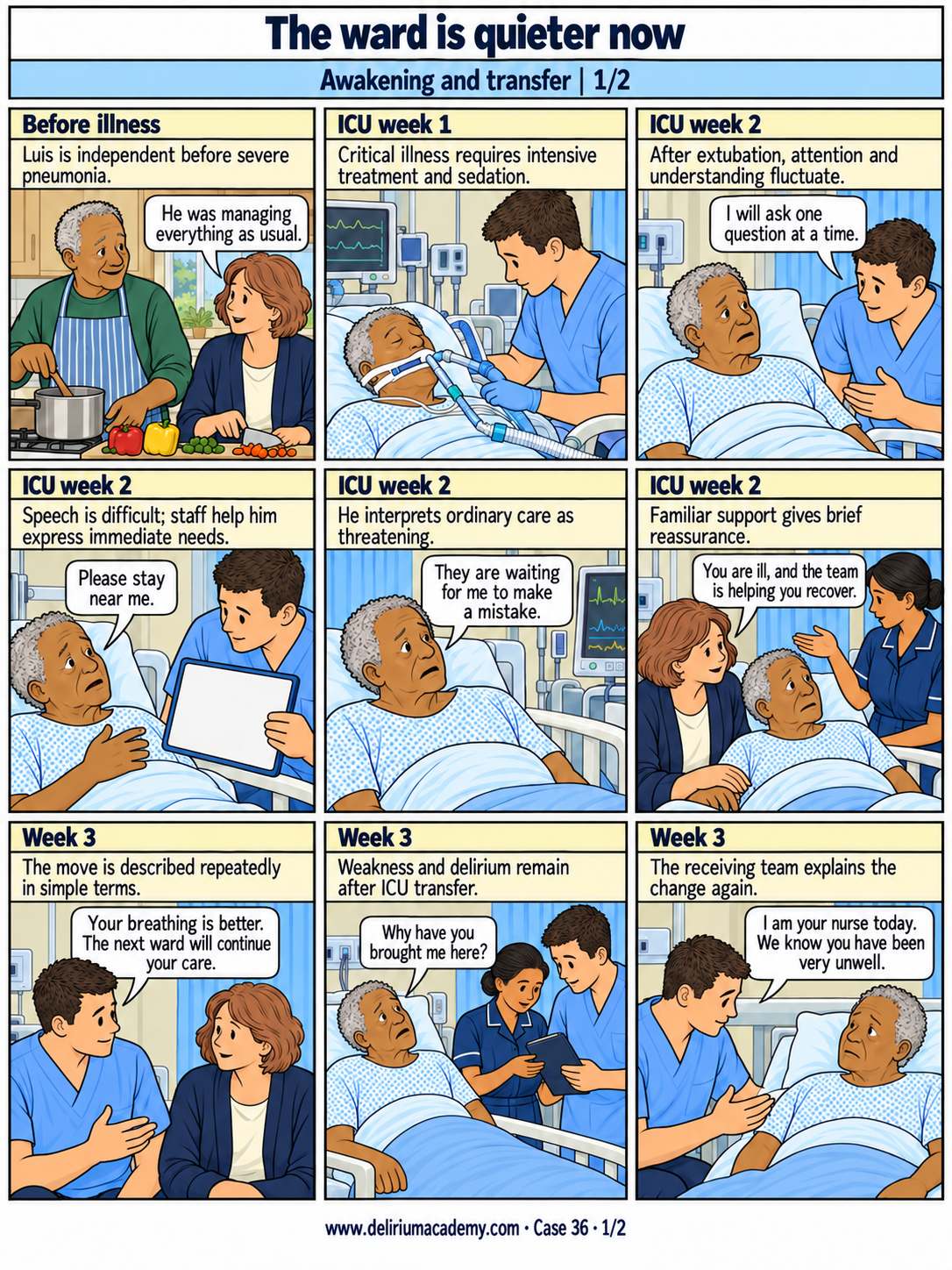
Panel 1: Before illness
Luis is independent before severe pneumonia.
Emma: He was managing everything as usual.
Panel 2: ICU week 1
Critical illness requires intensive treatment and sedation.
Panel 3: ICU week 2
After extubation, attention and understanding fluctuate.
Nurse Tom: I will ask one question at a time.
Panel 4: ICU week 2
Speech is difficult; staff help him express immediate needs.
Luis: Please stay near me.
Panel 5: ICU week 2
He interprets ordinary care as threatening.
Luis: They are waiting for me to make a mistake.
Panel 6: ICU week 2
Familiar support gives brief reassurance.
Emma: You are ill, and the team is helping you recover.
Panel 7: Week 3
The move is described repeatedly in simple terms.
Nurse Tom: Your breathing is better. The next ward will continue your care.
Panel 8: Week 3
Weakness and delirium remain after ICU transfer.
Luis: Why have you brought me here?
Panel 9: Week 3
The receiving team explains the change again.
Nurse Tom: I am your nurse today. We know you have been very unwell.
Page 2
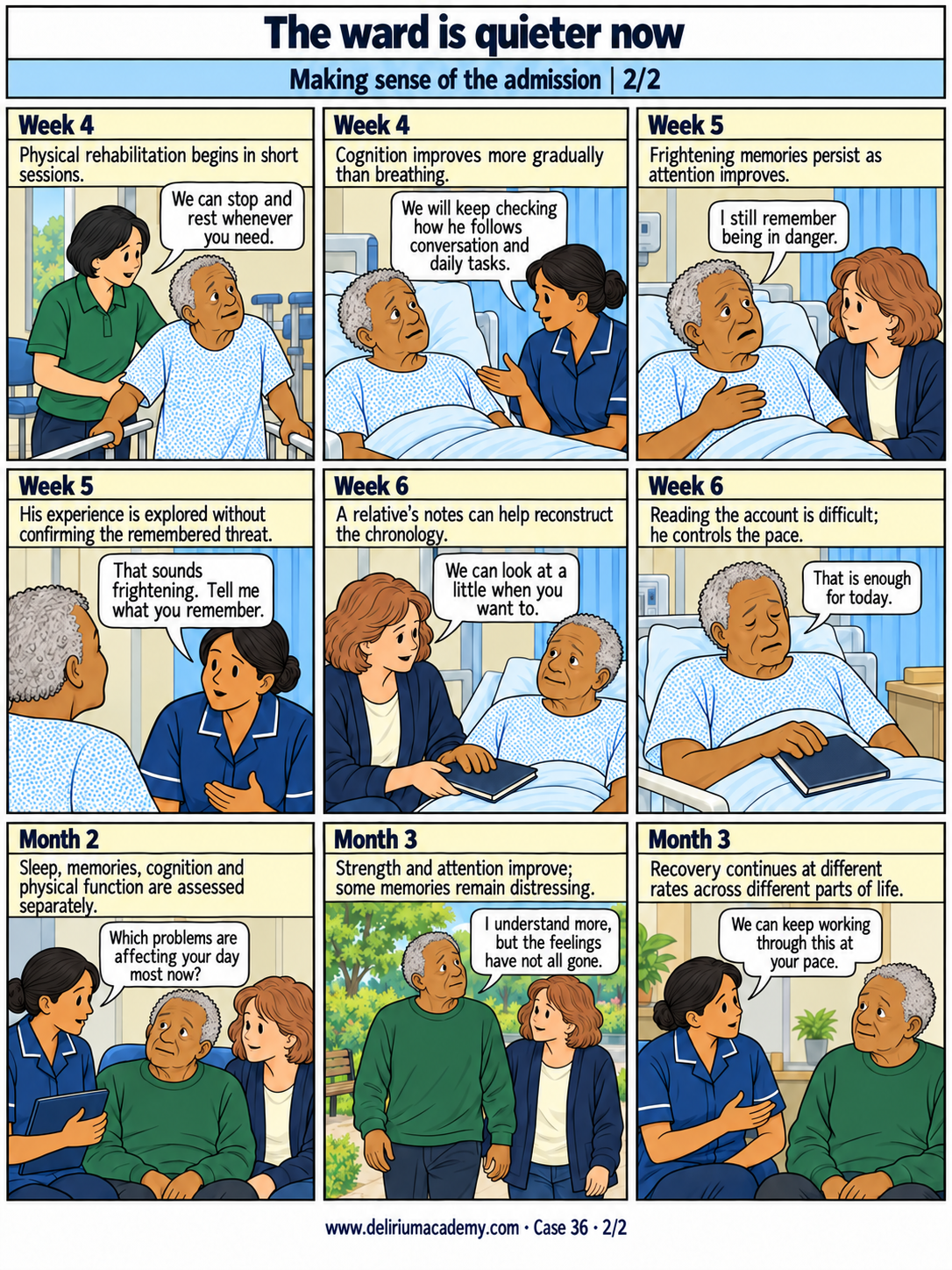
Panel 10: Week 4
Physical rehabilitation begins in short sessions.
Physiotherapist Lin: We can stop and rest whenever you need.
Panel 11: Week 4
Cognition improves more gradually than breathing.
Ward doctor Amira: We will keep checking how he follows conversation and daily tasks.
Panel 12: Week 5
Frightening memories persist as attention improves.
Luis: I still remember being in danger.
Panel 13: Week 5
His experience is explored without confirming the remembered threat.
Ward doctor Amira: That sounds frightening. Tell me what you remember.
Panel 14: Week 6
A relative's notes can help reconstruct the chronology.
Emma: We can look at a little when you want to.
Panel 15: Week 6
Reading the account is difficult; he controls the pace.
Luis: That is enough for today.
Panel 16: Month 2
Sleep, memories, cognition and physical function are assessed separately.
Ward doctor Amira: Which problems are affecting your day most now?
Panel 17: Month 3
Strength and attention improve; some memories remain distressing.
Luis: I understand more, but the feelings have not all gone.
Panel 18: Month 3
Recovery continues at different rates across different parts of life.
Ward doctor Amira: We can keep working through this at your pace.
Sources
- [S34] Brice, A.E. and Brice, R.G. (2024) ‘A Case Report and Review of the Literature of ICU Delirium’, Healthcare, 12(15), 1506.
- [S35] Gallie, L. (2024) ‘Delirium: name it, say it: loud and clear’, Intensive Care Medicine, 50(2), pp. 314–316.
- [S36] Richards, D. (2023) ‘Transitioning to reality: the diary of an ARDS survivor’, Intensive Care Medicine, 49(12), pp. 1571–1575.
- [S37] Stańska, A., Klapkowski, A., Karolak, W. and Brzeziński, M. (2026) ‘Case Report: Persistent delusional memories after postoperative delirium in a woman with complex cardiac surgical history’, Frontiers in Psychiatry, 16, 1743329.
- [T01] MacLullich AMJ. Conceptualising distress in delirium. Usher teaching presentation, May 2026. Supplied slides.
Commentary
Luis's course includes critical illness, sedation and delirium during awakening. The case separates memories of the admission from events observed during delirium. It shows the difficulty of communicating while weak and confused, followed by the work of understanding memories after attention has improved.
Transfer to a general ward changes the environment and the amount of immediate support. A clear handover and repeated explanation are needed because the patient may not understand the reason for the move. Physical rehabilitation, cognitive assessment and discussion of fear continue together. Patient accounts describe these transitions as important parts of recovery, rather than a simple boundary between illness and wellness [S34–S36].
Emma's notes provide an external chronology, which Luis reads gradually and with support. The case makes no claim that the diary reliably corrects beliefs or prevents trauma. Richards describes finding such material difficult to confront, while Gallie emphasises the need for an explanation of delirium and access to follow-up [S35, S36].
By month three, Luis can hold a coherent conversation and manage more activity, but some memories remain distressing. Distressing memories after a coherent conversation do not by themselves indicate continuing delirium. The assessment considers current attention, arousal, function, sleep and psychological symptoms separately [S37, T01]. Follow-up continues because recovery differs across domains.
An anonymised composite case that does not describe one identifiable person and is not research evidence.