Example case 37 of 40
Two explanations can both be true
Investigate neurological concern despite a plausible systemic cause, and follow residual delirium after treatment.
Click or tap each illustration to enlarge it. The commentary and text transcript follow below.
Read the text transcript
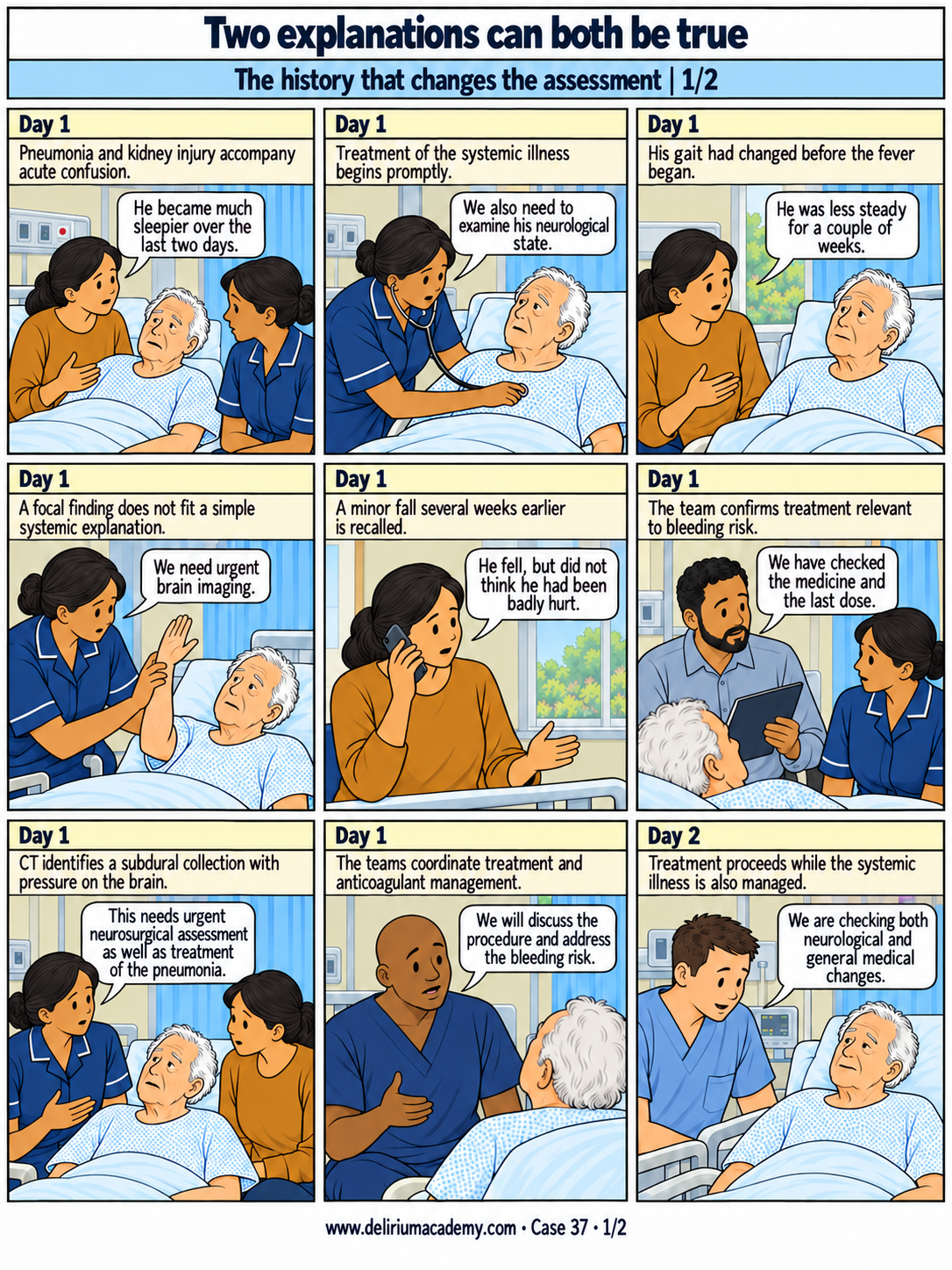
Page 1
Panel 1: Day 1
Pneumonia and kidney injury accompany acute confusion.
Priya: He became much sleepier over the last two days.
Panel 2: Day 1
Treatment of the systemic illness begins promptly.
Ward doctor Amira: We also need to examine his neurological state.
Panel 3: Day 1
His gait had changed before the fever began.
Priya: He was less steady for a couple of weeks.
Panel 4: Day 1
A focal finding does not fit a simple systemic explanation.
Ward doctor Amira: We need urgent brain imaging.
Panel 5: Day 1
A minor fall several weeks earlier is recalled.
Priya: He fell, but did not think he had been badly hurt.
Panel 6: Day 1
The team confirms treatment relevant to bleeding risk.
Pharmacist Samir: We have checked the medicine and the last dose.
Panel 7: Day 1
CT identifies a subdural collection with pressure on the brain.
Ward doctor Amira: This needs urgent neurosurgical assessment as well as treatment of the pneumonia.
Panel 8: Day 1
The teams coordinate treatment and anticoagulant management.
Neurosurgeon Leon: We will discuss the procedure and address the bleeding risk.
Panel 9: Day 2
Treatment proceeds while the systemic illness is also managed.
Nurse Tom: We are checking both neurological and general medical changes.
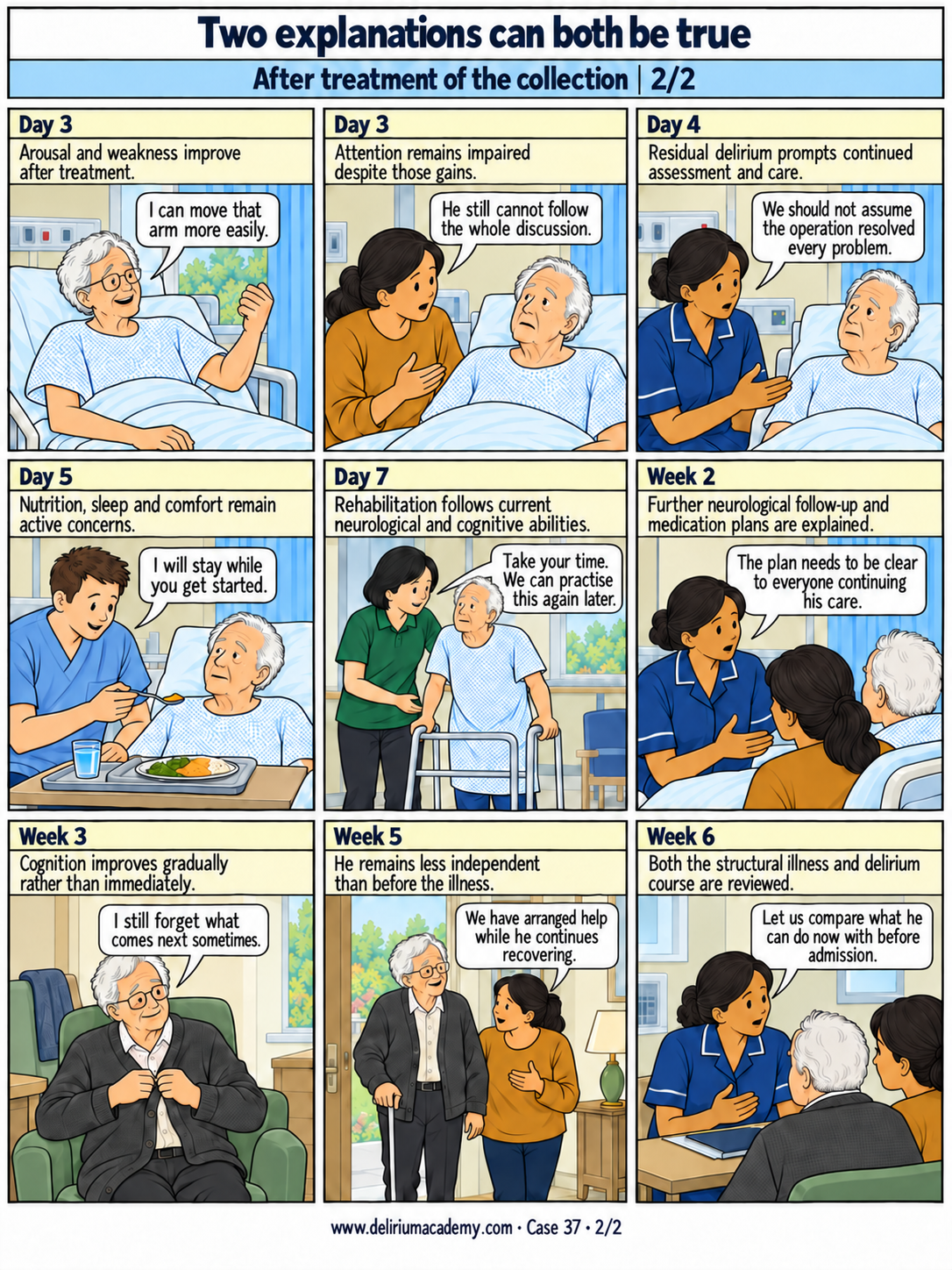
Page 2
Panel 10: Day 3
Arousal and weakness improve after treatment.
Walter: I can move that arm more easily.
Panel 11: Day 3
Attention remains impaired despite those gains.
Priya: He still cannot follow the whole discussion.
Panel 12: Day 4
Residual delirium prompts continued assessment and care.
Ward doctor Amira: We should not assume the operation resolved every problem.
Panel 13: Day 5
Nutrition, sleep and comfort remain active concerns.
Nurse Tom: I will stay while you get started.
Panel 14: Day 7
Rehabilitation follows current neurological and cognitive abilities.
Physiotherapist Lin: Take your time. We can practise this again later.
Panel 15: Week 2
Further neurological follow-up and medication plans are explained.
Ward doctor Amira: The plan needs to be clear to everyone continuing his care.
Panel 16: Week 3
Cognition improves gradually rather than immediately.
Walter: I still forget what comes next sometimes.
Panel 17: Week 5
He remains less independent than before the illness.
Priya: We have arranged help while he continues recovering.
Panel 18: Week 6
Both the structural illness and delirium course are reviewed.
Ward doctor Amira: Let us compare what he can do now with before admission.
Sources
- [S07] Erdoğan, T., Bahat, G., İlhan, B. and Karan, M.A. (2019) ‘A Challenging Hypoactive Delirium Case with Multiple Etiological Considerations’, European Journal of Geriatrics and Gerontology, 1(2), pp. 67–69.
- [S31] Temple, M. (2003) ‘Use of atypical anti-psychotics in the management of post-traumatic confusional states in traumatic brain injury’, Journal of the Royal Army Medical Corps, 149(1), pp. 54–55.
- [G01] National Institute for Health and Care Excellence. Delirium: prevention, diagnosis and management in hospital and long-term care. CG103.
Commentary
Walter has pneumonia and kidney injury, both plausible contributors to delirium. He also has a change that is not adequately explained by those findings: progressive gait difficulty before the acute infection, anticoagulant exposure and subtle new asymmetry. Collateral history adds a minor fall several weeks earlier. These findings prompt urgent imaging while the systemic illness is treated.
The scan identifies a subdural haematoma. Pneumonia remains a concurrent diagnosis; both conditions can contribute, and urgent neurosurgical assessment proceeds alongside treatment of the medical illness. Anticoagulant management is handled by the relevant teams according to the intracranial bleeding and intervention plan; the comic does not give a generic reversal instruction.
Erdogan and colleagues reported a patient with several competing causes and a clinically important subdural collection [S07]. The composite includes structural and systemic illness, but changes the biography, history and course. Temple's report reinforces the need to reassess when neurological findings change, even after one explanation has been found [S31].
Following drainage, Walter becomes more alert and the weakness improves, but attention and daily function recover more slowly. Discussion can focus on which findings triggered imaging, how history obtained from relatives altered the assessment, and why improvement after a procedure still requires continued delirium care and rehabilitation.
An anonymised composite case that does not describe one identifiable person and is not research evidence.