Example case 38 of 40
The same pause, again
Recognise stereotyped episodes within an apparently fluctuating delirium course and obtain appropriate EEG assessment.
Click or tap each illustration to enlarge it. The commentary and text transcript follow below.
Read the text transcript
Page 1
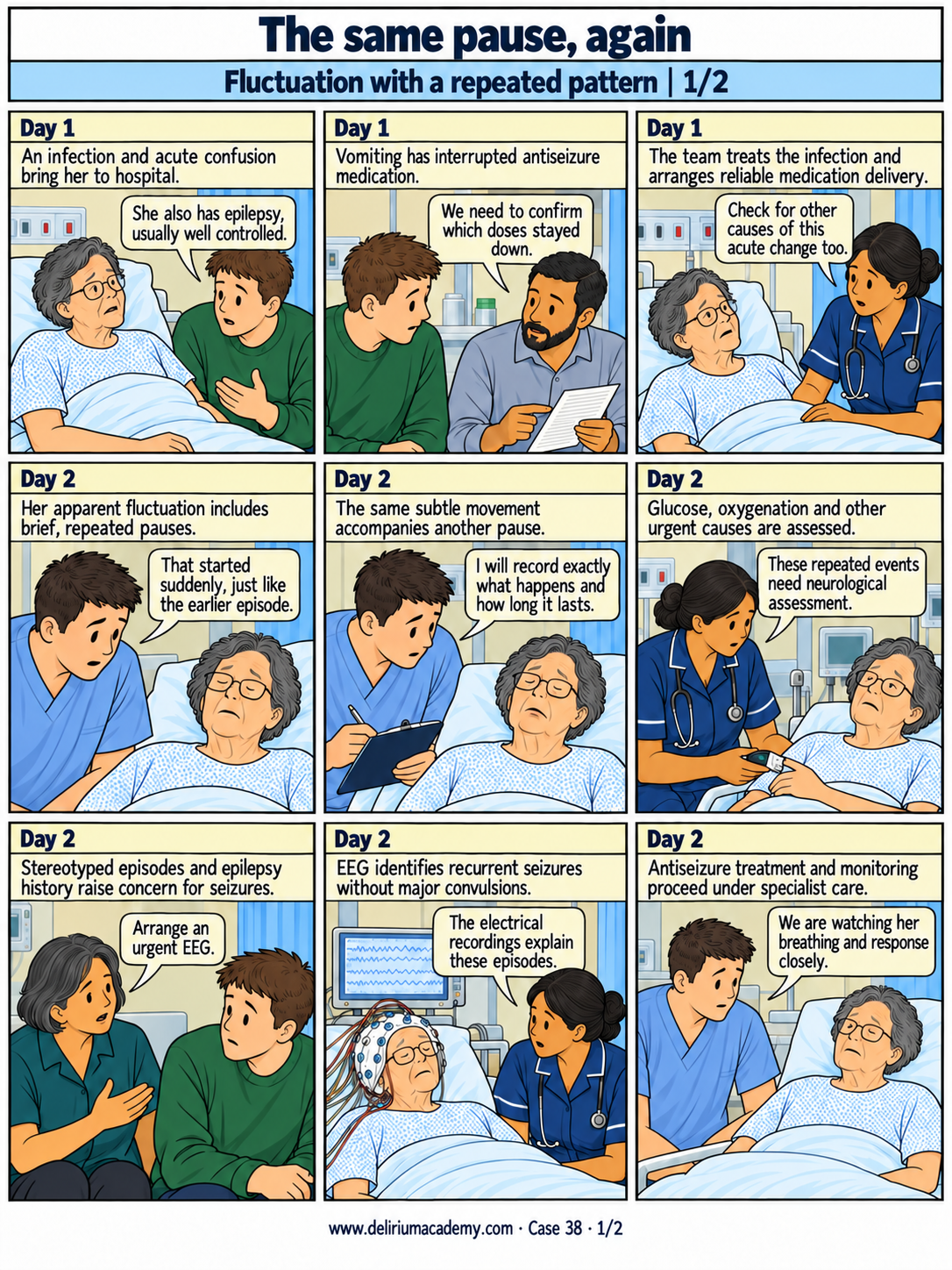
Panel 1: Day 1
An infection and acute confusion bring her to hospital.
Dan: She also has epilepsy, usually well controlled.
Panel 2: Day 1
Vomiting has interrupted antiseizure medication.
Pharmacist Samir: We need to confirm which doses stayed down.
Panel 3: Day 1
The team treats the infection and arranges reliable medication delivery.
Ward doctor Amira: Check for other causes of this acute change too.
Panel 4: Day 2
Her apparent fluctuation includes brief, repeated pauses.
Nurse Tom: That started suddenly, just like the earlier episode.
Panel 5: Day 2
The same subtle movement accompanies another pause.
Nurse Tom: I will record exactly what happens and how long it lasts.
Panel 6: Day 2
Glucose, oxygenation and other urgent causes are assessed.
Ward doctor Amira: These repeated events need neurological assessment.
Panel 7: Day 2
Stereotyped episodes and epilepsy history raise concern for seizures.
Neurologist Mira: Arrange an urgent EEG.
Panel 8: Day 2
EEG identifies recurrent seizures without major convulsions.
Ward doctor Amira: The electrical recordings explain these episodes.
Panel 9: Day 2
Antiseizure treatment and monitoring proceed under specialist care.
Nurse Tom: We are watching her breathing and response closely.
Page 2
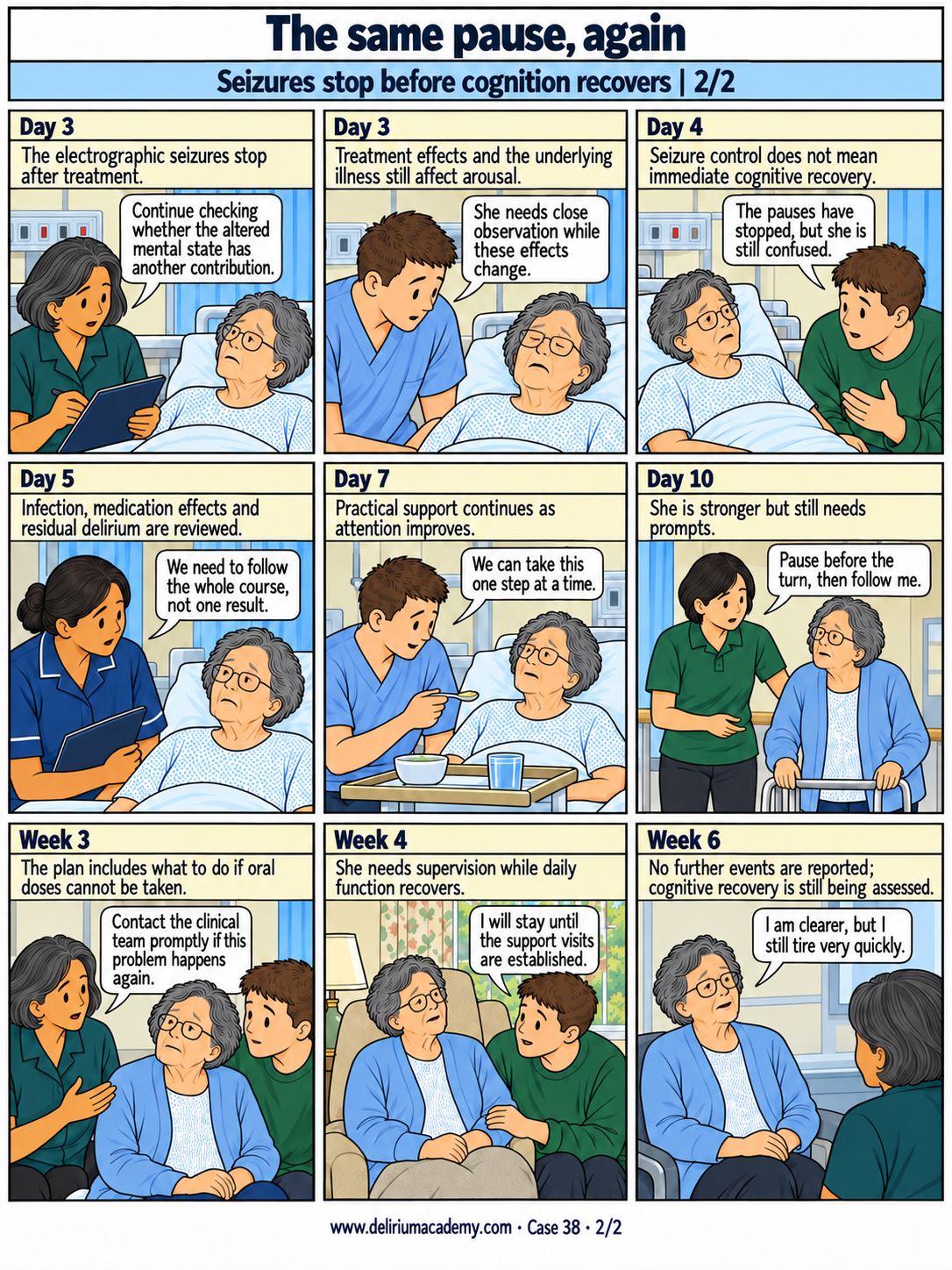
Panel 10: Day 3
The electrographic seizures stop after treatment.
Neurologist Mira: Continue checking whether the altered mental state has another contribution.
Panel 11: Day 3
Treatment effects and the underlying illness still affect arousal.
Nurse Tom: She needs close observation while these effects change.
Panel 12: Day 4
Seizure control does not mean immediate cognitive recovery.
Dan: The pauses have stopped, but she is still confused.
Panel 13: Day 5
Infection, medication effects and residual delirium are reviewed.
Ward doctor Amira: We need to follow the whole course, not one result.
Panel 14: Day 7
Practical support continues as attention improves.
Nurse Tom: We can take this one step at a time.
Panel 15: Day 10
She is stronger but still needs prompts.
Physiotherapist Lin: Pause before the turn, then follow me.
Panel 16: Week 3
The plan includes what to do if oral doses cannot be taken.
Neurologist Mira: Contact the clinical team promptly if this problem happens again.
Panel 17: Week 4
She needs supervision while daily function recovers.
Dan: I will stay until the support visits are established.
Panel 18: Week 6
No further events are reported; cognitive recovery is still being assessed.
Vera: I am clearer, but I still tire very quickly.
Sources
- [G03] Herman ST, Abend NS, Bleck TP, et al. Consensus statement on continuous EEG in critically ill adults and children, part I: indications. Journal of Clinical Neurophysiology. 2015;32:87–95.
- [S21] Whittam, D., Matthews, R., Nimeri, R. and Shaik, S. (2024) ‘Antibiomania: clarithromycin-induced neurotoxicity mimicking autoimmune limbic encephalitis’, Practical Neurology, 24(3), pp. 226–230.
- [S31] Temple, M. (2003) ‘Use of atypical anti-psychotics in the management of post-traumatic confusional states in traumatic brain injury’, Journal of the Royal Army Medical Corps, 149(1), pp. 54–55.
- [G01] National Institute for Health and Care Excellence. Delirium: prevention, diagnosis and management in hospital and long-term care. CG103.
Commentary
Fluctuation is common in delirium, but Vera's repeated events have an additional pattern: abrupt pauses, similar duration and the same small facial movement. A history of epilepsy and missed doses increases concern. The team records the events precisely, checks immediate physiological causes and seeks neurological assessment.
An urgent EEG identifies recurrent electrographic seizures. Treatment and continued monitoring stop the events, while the wider cognitive syndrome improves more slowly. Seizure control, drug-related sedation and residual delirium can all affect the bedside appearance, so the team assesses them separately. Continued EEG assessment is used according to the neurological findings and clinical response [G03].
The American Clinical Neurophysiology Society consensus statement addresses continuous EEG in critically ill patients with relevant altered mental states. It does not recommend EEG for every uncomplicated delirium episode. Vera's recurrent stereotyped events and seizure history provide the additional clinical reasons in this composite. The source reports provide related examples of acute neurological and psychiatric presentations, without supplying Vera's biography [S21, S31].
Learners can discuss how to describe the event without prematurely naming it: onset, responsiveness, eye or facial movements, duration, recurrence and the state between events. The final outcome is improving cognition with continuing support. Absence of another visible event alone would not establish that all seizures had stopped or that delirium had resolved.
An anonymised composite case that does not describe one identifiable person and is not research evidence.