Example case 40 of 40
More than being withdrawn
Identify specific catatonic signs coexisting with delirium and assess separate responses to treatment.
Click or tap each illustration to enlarge it. The commentary and text transcript follow below.
Read the text transcript
Page 1
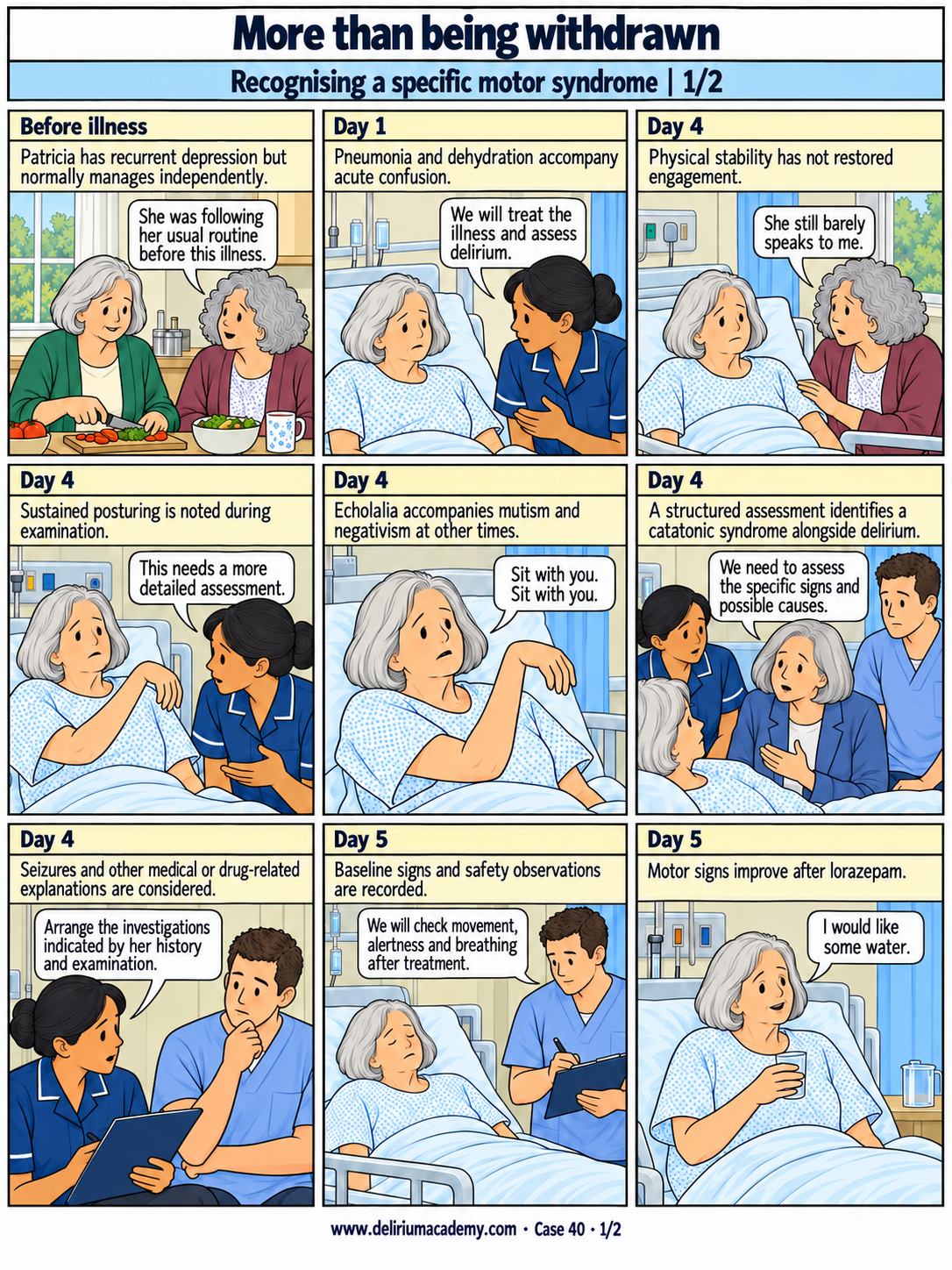
Panel 1: Before illness
Patricia has recurrent depression but normally manages independently.
Helen: She was following her usual routine before this illness.
Panel 2: Day 1
Pneumonia and dehydration accompany acute confusion.
Ward doctor Amira: We will treat the illness and assess delirium.
Panel 3: Day 4
Physical stability has not restored engagement.
Helen: She still barely speaks to me.
Panel 4: Day 4
Sustained posturing is noted during examination.
Ward doctor Amira: This needs a more detailed assessment.
Panel 5: Day 4
Echolalia accompanies mutism and negativism at other times.
Patricia: Sit with you. Sit with you.
Panel 6: Day 4
A structured assessment identifies a catatonic syndrome alongside delirium.
Liaison psychiatrist Clare: We need to assess the specific signs and possible causes.
Panel 7: Day 4
Seizures and other medical or drug-related explanations are considered.
Ward doctor Amira: Arrange the investigations indicated by her history and examination.
Panel 8: Day 5
Baseline signs and safety observations are recorded.
Nurse Tom: We will check movement, alertness and breathing after treatment.
Panel 9: Day 5
Motor signs improve after lorazepam.
Patricia: I would like some water.
Page 2
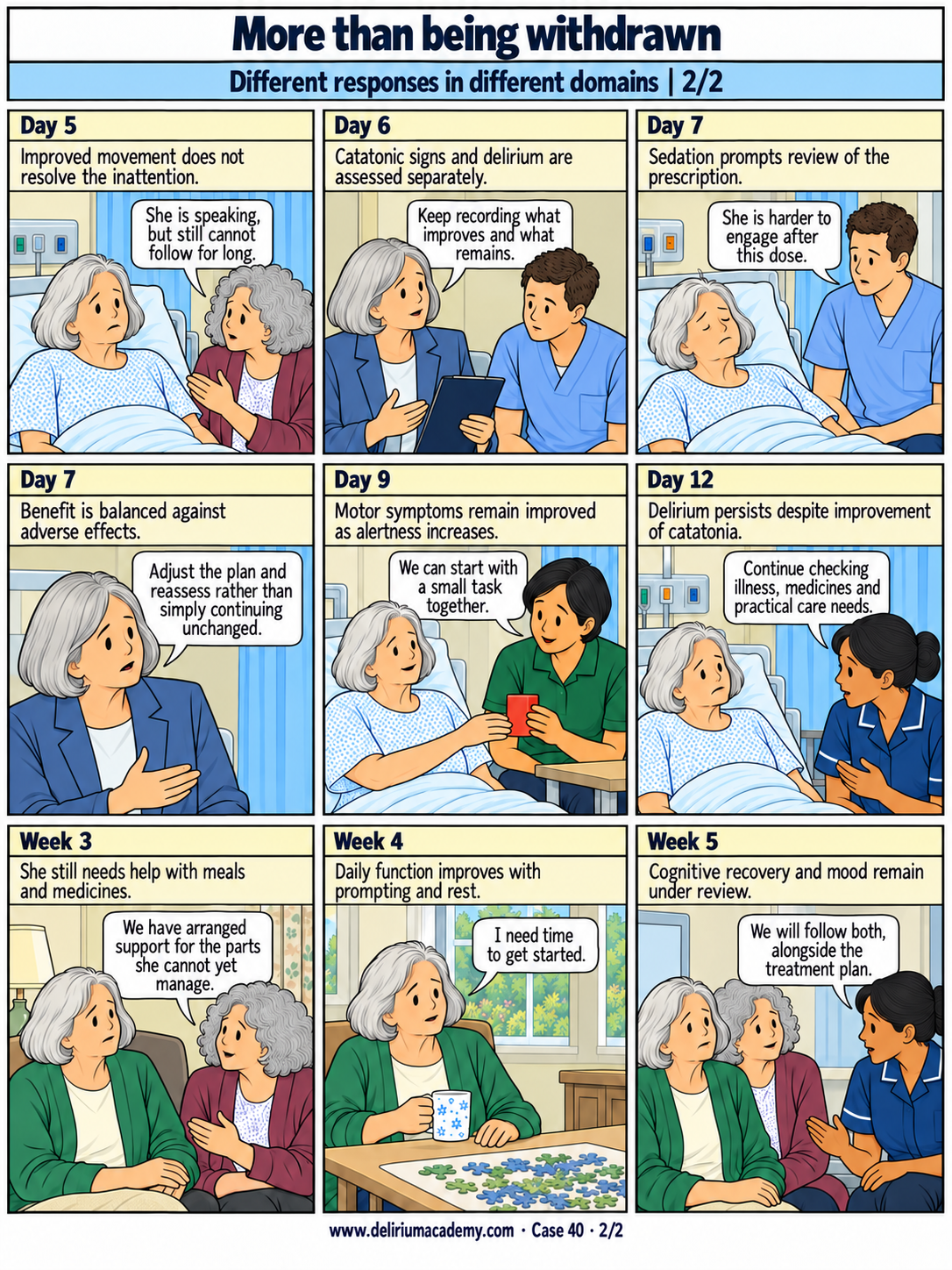
Panel 10: Day 5
Improved movement does not resolve the inattention.
Helen: She is speaking, but still cannot follow for long.
Panel 11: Day 6
Catatonic signs and delirium are assessed separately.
Liaison psychiatrist Clare: Keep recording what improves and what remains.
Panel 12: Day 7
Sedation prompts review of the prescription.
Nurse Tom: She is harder to engage after this dose.
Panel 13: Day 7
Benefit is balanced against adverse effects.
Liaison psychiatrist Clare: Adjust the plan and reassess rather than simply continuing unchanged.
Panel 14: Day 9
Motor symptoms remain improved as alertness increases.
Physiotherapist Lin: We can start with a small task together.
Panel 15: Day 12
Delirium persists despite improvement of catatonia.
Ward doctor Amira: Continue checking illness, medicines and practical care needs.
Panel 16: Week 3
She still needs help with meals and medicines.
Helen: We have arranged support for the parts she cannot yet manage.
Panel 17: Week 4
Daily function improves with prompting and rest.
Patricia: I need time to get started.
Panel 18: Week 5
Cognitive recovery and mood remain under review.
Ward doctor Amira: We will follow both, alongside the treatment plan.
Sources
- [S23] Lesko, A., Kalafat, N., Enoh, K. and Teltser, W.K. (2022) ‘The Importance of Diagnosing Concomitant Delirium and Catatonia: A Case Report’, Cureus, 14(1), e21662.
- [S24] Amouri, J., Andrews, P.S., Heckers, S., Ely, E.W. and Wilson, J.E. (2021) ‘A Case of Concurrent Delirium and Catatonia in a Woman With Coronavirus Disease 2019’, Journal of the Academy of Consultation-Liaison Psychiatry, 62(1), pp. 109–114.
- [G04] Rogers JP, Oldham MA, Fricchione G, et al. Evidence-based consensus guidelines for the management of catatonia: Recommendations from the British Association for Psychopharmacology. Journal of Psychopharmacology. 2023;37:327–369.
- [G01] National Institute for Health and Care Excellence. Delirium: prevention, diagnosis and management in hospital and long-term care. CG103.
Commentary
Patricia's reduced speech and activity could occur in hypoactive delirium, severe depression or several neurological conditions. The additional signs change the assessment: sustained posturing, echolalia and negativism form a specific cluster. Liaison psychiatry and the medical team assess these findings together, while considering seizures, medication effects and other medical causes.
The BAP guideline supports structured examination of catatonic signs and a monitored lorazepam challenge when clinically appropriate [G04]. A response is supportive rather than completely specific. The comic therefore includes a baseline assessment, a safety plan and separate observation of motor signs, breathing, arousal and attention. The indication is the specific cluster of catatonic signs. Benzodiazepines are not recommended for delirium generally, and reduced speech or activity during delirium does not by itself establish catatonia.
The motor syndrome improves while inattention continues, consistent with the separation reported by Amouri and colleagues [S24]. Later sedation prompts treatment adjustment, consistent with the need to observe harms as well as benefit. If the response were inadequate or the syndrome became medically dangerous, urgent specialist reassessment and further treatment options would be required; the clinical plan is not limited to repeating the same challenge.
By week five, Patricia can engage more but still needs help with everyday tasks. Her depressive history remains part of follow-up without being used to explain away the acute illness. Discussion can focus on which observed signs justified the specialist assessment, how response was measured, and why resolution of catatonia did not establish full recovery from delirium.
An anonymised composite case that does not describe one identifiable person and is not research evidence.