Example case 16 of 40
The fear remains
Listening after delirium in intensive care
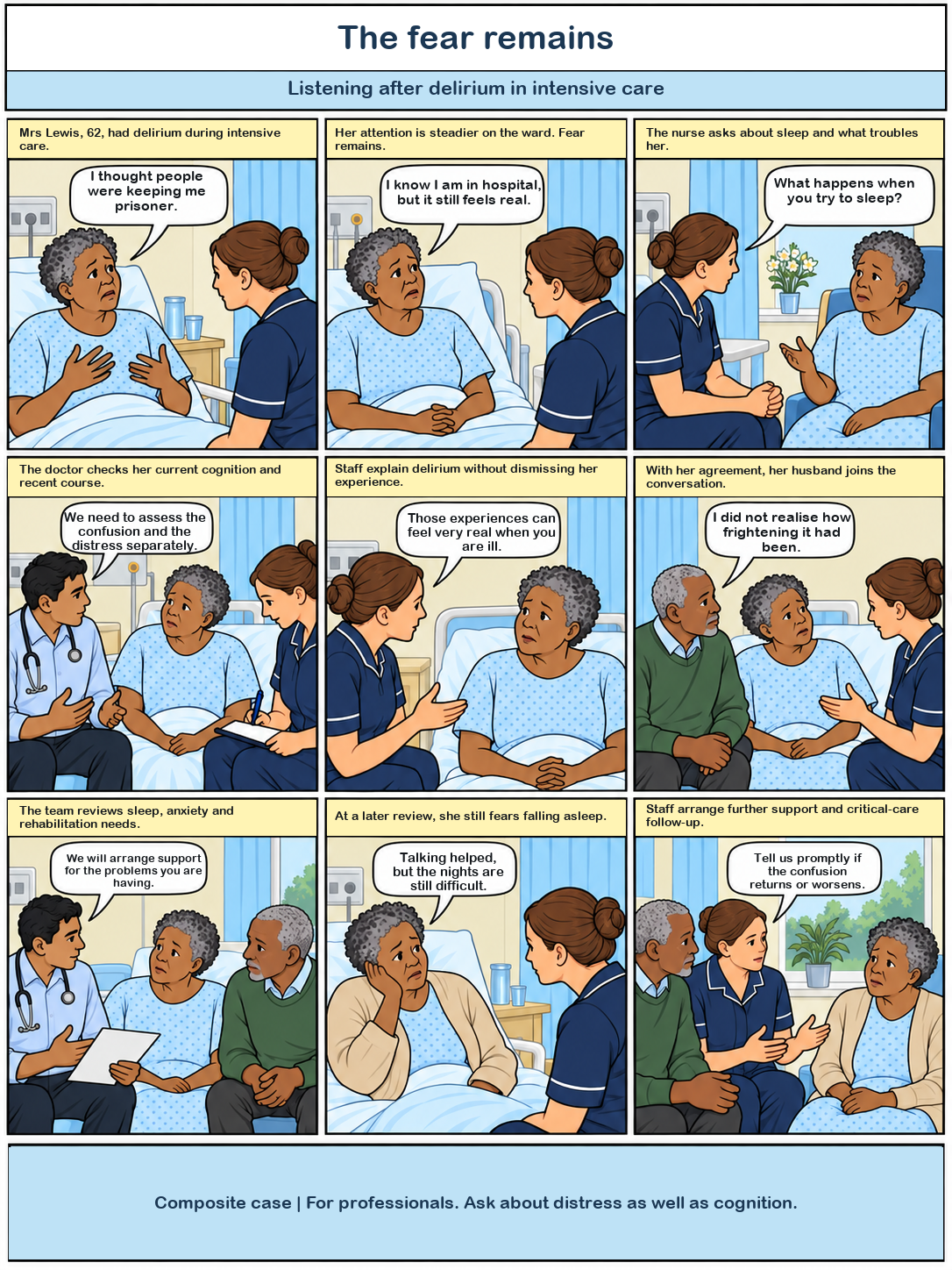
Mrs Lewis, 62, had delirium during intensive care.
Click or tap each illustration to enlarge it. The commentary and text transcript follow below.
Read the text transcript
Page 1
Panel 1
Mrs Lewis, 62, had delirium during intensive care.
Mrs Lewis: I thought people were keeping me prisoner.
Panel 2
Her attention is steadier on the ward. Fear remains.
Mrs Lewis: I know I am in hospital, but it still feels real.
Panel 3
The nurse asks about sleep and what troubles her.
Nurse Green: What happens when you try to sleep?
Panel 4
The doctor checks her current cognition and recent course.
Doctor Khan: We need to assess the confusion and the distress separately.
Panel 5
Staff explain delirium without dismissing her experience.
Nurse Green: Those experiences can feel very real when you are ill.
Panel 6
With her agreement, her husband joins the conversation.
Husband: I did not realise how frightening it had been.
Panel 7
The team reviews sleep, anxiety and rehabilitation needs.
Doctor Khan: We will arrange support for the problems you are having.
Panel 8
At a later review, she still fears falling asleep.
Mrs Lewis: Talking helped, but the nights are still difficult.
Panel 9
Staff arrange further support and critical-care follow-up.
Nurse Green: Tell us promptly if the confusion returns or worsens.
Commentary
After critical illness and delirium, assess current cognition and distress. Frightening memories need explanation, support and appropriate follow-up.
An anonymised composite case that does not describe one identifiable person and is not research evidence.