Example case 19 of 40
A week later, still not herself
Review persistent symptoms
Mrs Douglas, 79, remains confused a week after delirium began.
Click or tap each illustration to enlarge it. The commentary and text transcript follow below.
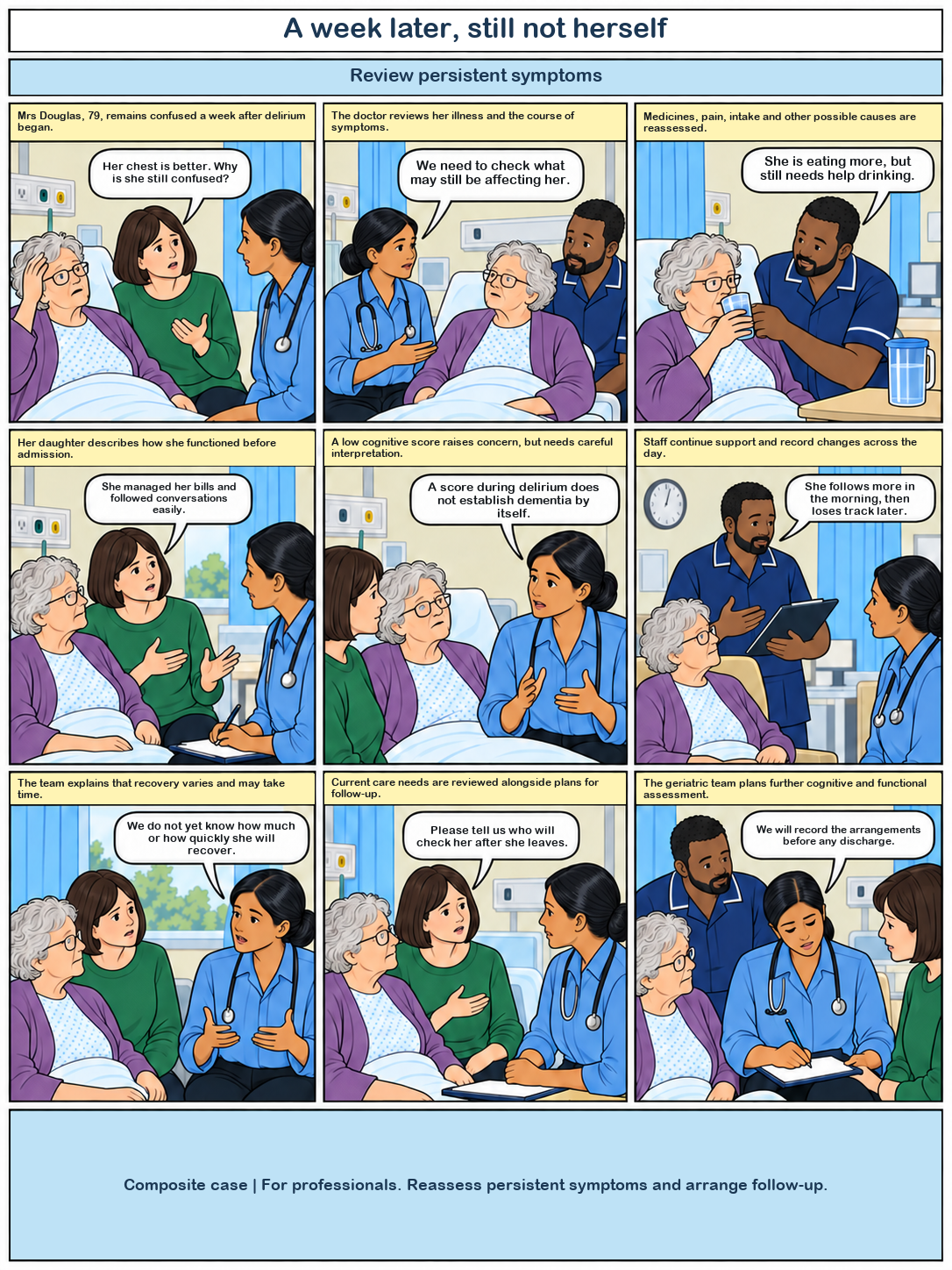
Read the text transcript
Page 1
Panel 1
Mrs Douglas, 79, remains confused a week after delirium began.
Daughter: Her chest is better. Why is she still confused?
Panel 2
The doctor reviews her illness and the course of symptoms.
Doctor Rahman: We need to check what may still be affecting her.
Panel 3
Medicines, pain, intake and other possible causes are reassessed.
Nurse: She is eating more, but still needs help drinking.
Panel 4
Her daughter describes how she functioned before admission.
Daughter: She managed her bills and followed conversations easily.
Panel 5
A low cognitive score raises concern, but needs careful interpretation.
Doctor Rahman: A score during delirium does not establish dementia by itself.
Panel 6
Staff continue support and record changes across the day.
Nurse: She follows more in the morning, then loses track later.
Panel 7
The team explains that recovery varies and may take time.
Doctor Rahman: We do not yet know how much or how quickly she will recover.
Panel 8
Current care needs are reviewed alongside plans for follow-up.
Daughter: Please tell us who will check her after she leaves.
Panel 9
The geriatric team plans further cognitive and functional assessment.
Doctor Rahman: We will record the arrangements before any discharge.
Commentary
Persistent delirium requires reassessment of causes and continued support. A low cognitive score during delirium does not establish dementia on its own; arrange further cognitive and functional assessment.
An anonymised composite case that does not describe one identifiable person and is not research evidence.