Example case 24 of 40
Fluids are only part of the answer
Manage dehydration and kidney injury without overlooking fluid overload, drug accumulation or continuing cognitive needs.
Click or tap each illustration to enlarge it. The commentary and text transcript follow below.
Read the text transcript
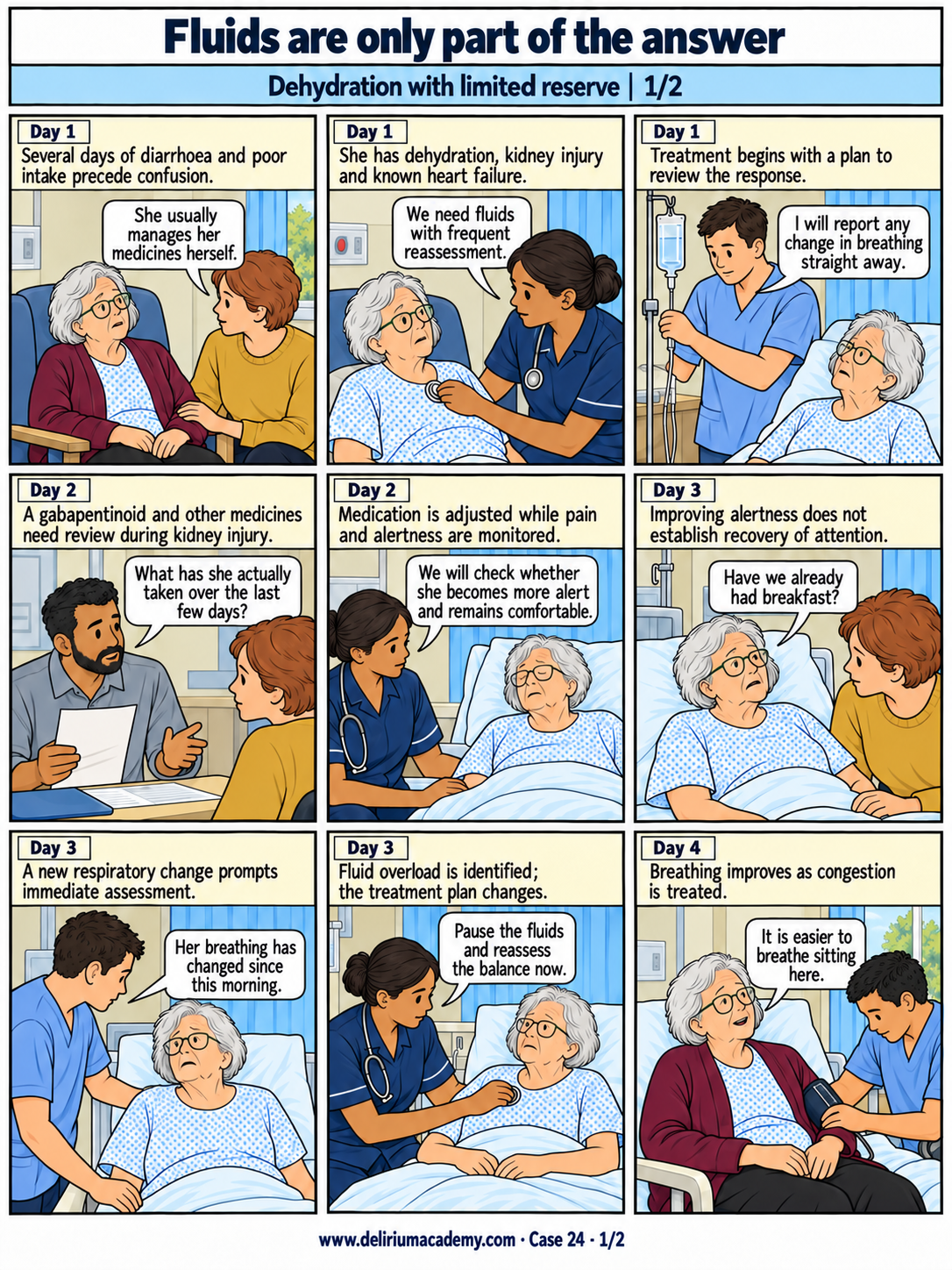
Page 1
Panel 1: Day 1
Several days of diarrhoea and poor intake precede confusion.
Ellis: She usually manages her medicines herself.
Panel 2: Day 1
She has dehydration, kidney injury and known heart failure.
Ward doctor Amira: We need fluids with frequent reassessment.
Panel 3: Day 1
Treatment begins with a plan to review the response.
Nurse Tom: I will report any change in breathing straight away.
Panel 4: Day 2
A gabapentinoid and other medicines need review during kidney injury.
Pharmacist Samir: What has she actually taken over the last few days?
Panel 5: Day 2
Medication is adjusted while pain and alertness are monitored.
Ward doctor Amira: We will check whether she becomes more alert and remains comfortable.
Panel 6: Day 3
Improving alertness does not establish recovery of attention.
June: Have we already had breakfast?
Panel 7: Day 3
A new respiratory change prompts immediate assessment.
Nurse Tom: Her breathing has changed since this morning.
Panel 8: Day 3
Fluid overload is identified; the treatment plan changes.
Ward doctor Amira: Pause the fluids and reassess the balance now.
Panel 9: Day 4
Breathing improves as congestion is treated.
June: It is easier to breathe sitting here.
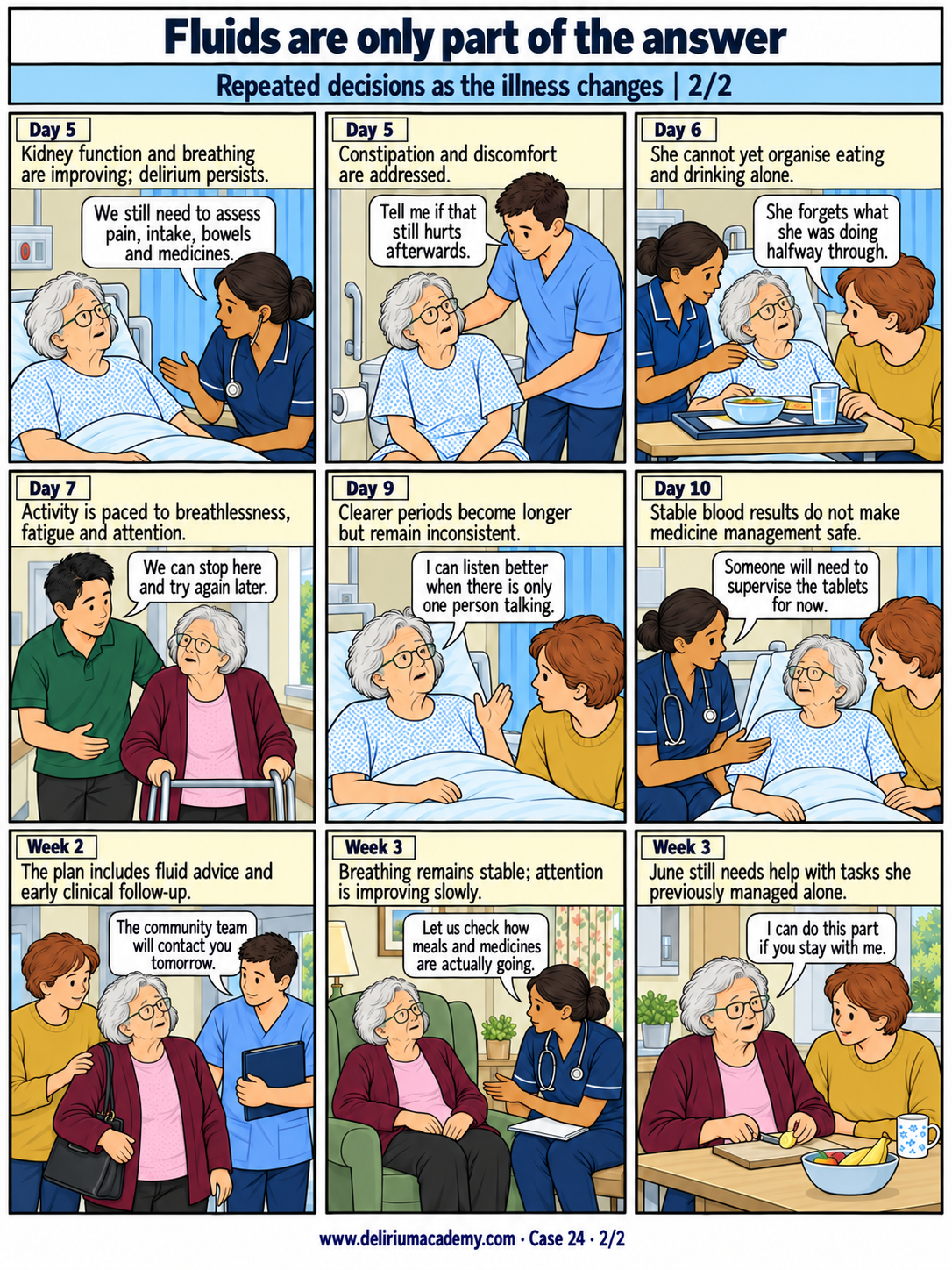
Page 2
Panel 10: Day 5
Kidney function and breathing are improving; delirium persists.
Ward doctor Amira: We still need to assess pain, intake, bowels and medicines.
Panel 11: Day 5
Constipation and discomfort are addressed.
Nurse Tom: Tell me if that still hurts afterwards.
Panel 12: Day 6
She cannot yet organise eating and drinking alone.
Ellis: She forgets what she was doing halfway through.
Panel 13: Day 7
Activity is paced to breathlessness, fatigue and attention.
Physiotherapist Lin: We can stop here and try again later.
Panel 14: Day 9
Clearer periods become longer but remain inconsistent.
June: I can listen better when there is only one person talking.
Panel 15: Day 10
Stable blood results do not make medicine management safe.
Ward doctor Amira: Someone will need to supervise the tablets for now.
Panel 16: Week 2
The plan includes fluid advice and early clinical follow-up.
Nurse Tom: The community team will contact you tomorrow.
Panel 17: Week 3
Breathing remains stable; attention is improving slowly.
Ward doctor Amira: Let us check how meals and medicines are actually going.
Panel 18: Week 3
June still needs help with tasks she previously managed alone.
June: I can do this part if you stay with me.
Sources
- [T02] MacLullich AMJ. Persistent delirium. CHG Singapore teaching presentation, 2025. Supplied slides.
- [P43] Dharmarajan K, Swami S, Gou RY, Jones RN, Inouye SK. Pathway from Delirium to Death: Potential In-Hospital Mediators of Excess Mortality. Journal of the American Geriatrics Society. 2017;65:1026–1033.
- [G01] National Institute for Health and Care Excellence. Delirium: prevention, diagnosis and management in hospital and long-term care. CG103.
Commentary
June has both evidence of volume depletion and conditions that make indiscriminate fluid replacement hazardous. The comic therefore shows repeated examination and response to treatment, rather than a single fluid prescription. Improving kidney function is useful information, but it does not replace review of breathing, circulation, intake and cognition.
The medication history includes a gabapentinoid whose effects may be greater during renal impairment. Drowsiness has several plausible contributors, so the team adjusts treatment with monitoring rather than assigning the whole syndrome to that medicine. Pain management remains part of the plan. Later breathlessness prompts assessment for congestion; it is not explained away as anxiety or delirium.
These events are a constructed example of ordinary clinical complexity, supported by the broader recommendation to identify and treat combinations of causes [G01]. The sources do not describe June or establish the effect of her individual treatment changes. The sequence requires medication, renal function and fluid balance to be considered together.
By the second week, physiological measures are stable while attention and task organisation remain impaired. Rehabilitation and discharge support are based on that remaining impairment. Ask learners which observations would justify changing the current treatment, and how they would recognise a fresh deterioration. The case ends with improvement, but continued dependence for medicines and meals. The outcome records clinical progress without claiming complete recovery [P43].
An anonymised composite case that does not describe one identifiable person and is not research evidence.