Example case 26 of 40
A late change for the better
Continue assessment and rehabilitation when a prolonged course has prompted an assumption of permanent decline.
Click or tap each illustration to enlarge it. The commentary and text transcript follow below.
Read the text transcript
Page 1
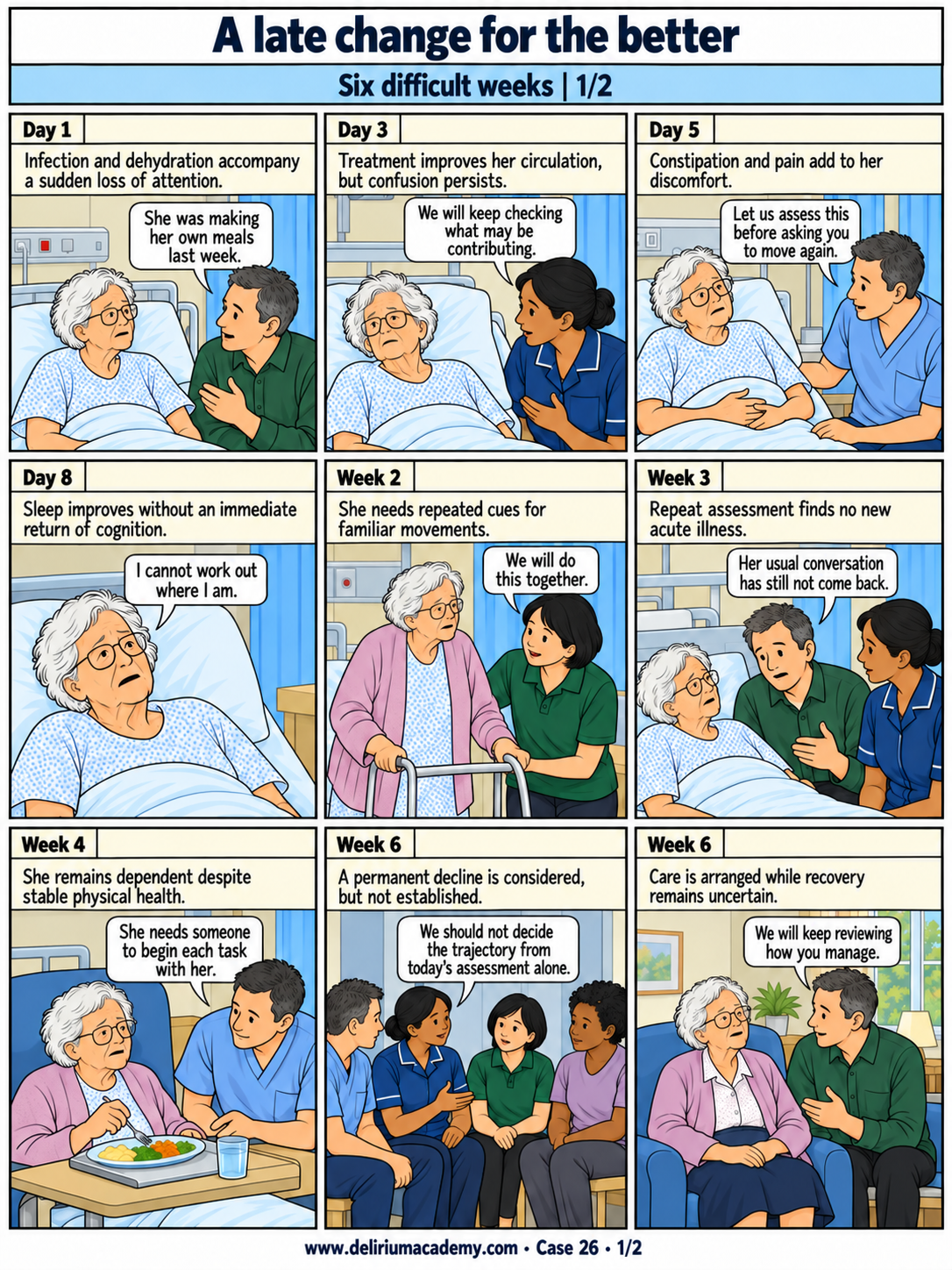
Panel 1: Day 1
Infection and dehydration accompany a sudden loss of attention.
Neil: She was making her own meals last week.
Panel 2: Day 3
Treatment improves her circulation, but confusion persists.
Ward doctor Amira: We will keep checking what may be contributing.
Panel 3: Day 5
Constipation and pain add to her discomfort.
Nurse Tom: Let us assess this before asking you to move again.
Panel 4: Day 8
Sleep improves without an immediate return of cognition.
Agnes: I cannot work out where I am.
Panel 5: Week 2
She needs repeated cues for familiar movements.
Physiotherapist Lin: We will do this together.
Panel 6: Week 3
Repeat assessment finds no new acute illness.
Neil: Her usual conversation has still not come back.
Panel 7: Week 4
She remains dependent despite stable physical health.
Nurse Tom: She needs someone to begin each task with her.
Panel 8: Week 6
A permanent decline is considered, but not established.
Ward doctor Amira: We should not decide the trajectory from today's assessment alone.
Panel 9: Week 6
Care is arranged while recovery remains uncertain.
Neil: We will keep reviewing how you manage.
Page 2
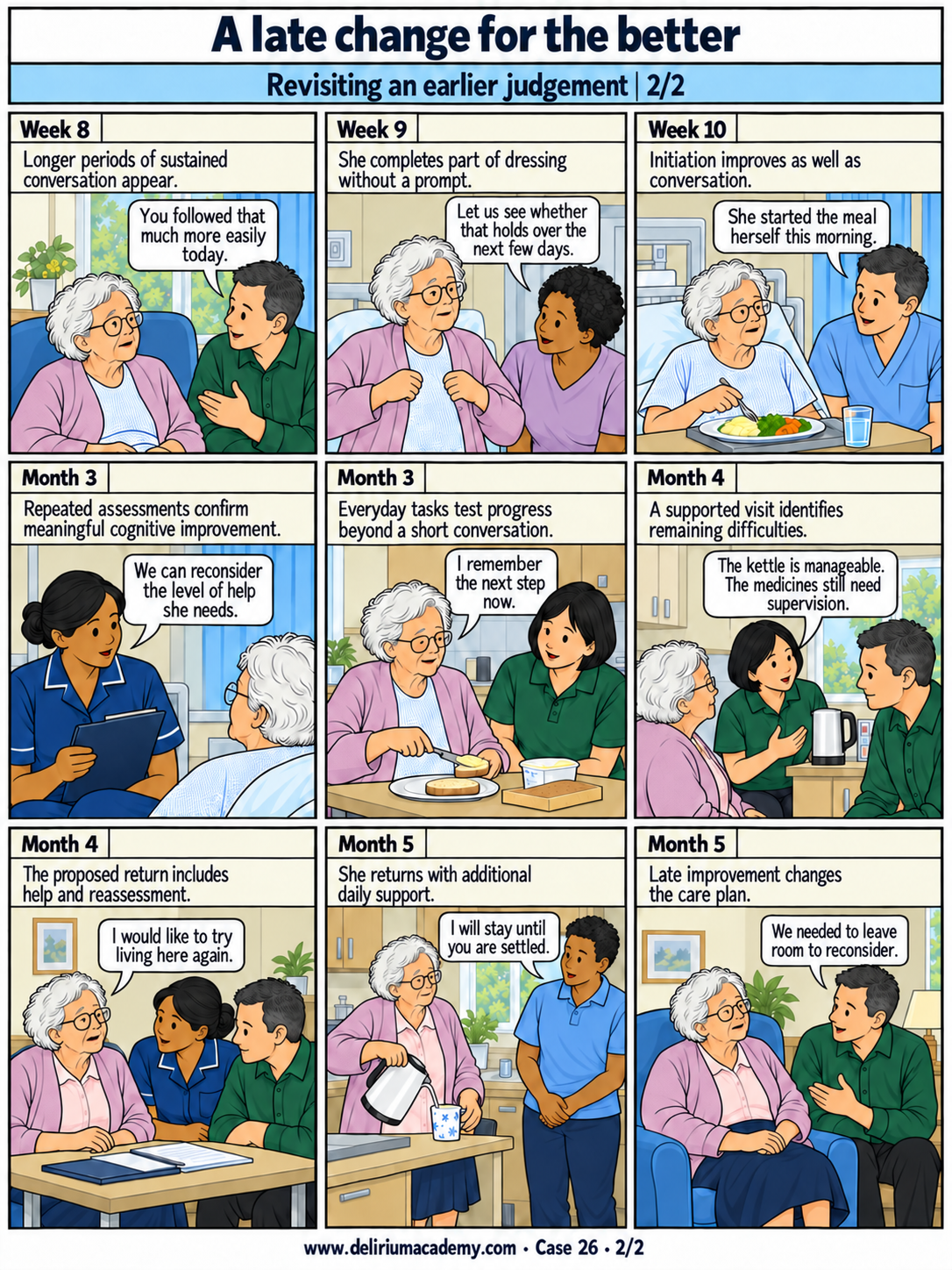
Panel 10: Week 8
Longer periods of sustained conversation appear.
Neil: You followed that much more easily today.
Panel 11: Week 9
She completes part of dressing without a prompt.
Occupational therapist Ruth: Let us see whether that holds over the next few days.
Panel 12: Week 10
Initiation improves as well as conversation.
Nurse Tom: She started the meal herself this morning.
Panel 13: Month 3
Repeated assessments confirm meaningful cognitive improvement.
Ward doctor Amira: We can reconsider the level of help she needs.
Panel 14: Month 3
Everyday tasks test progress beyond a short conversation.
Agnes: I remember the next step now.
Panel 15: Month 4
A supported visit identifies remaining difficulties.
Physiotherapist Lin: The kettle is manageable. The medicines still need supervision.
Panel 16: Month 4
The proposed return includes help and reassessment.
Agnes: I would like to try living here again.
Panel 17: Month 5
She returns with additional daily support.
Support worker Alex: I will stay until you are settled.
Panel 18: Month 5
Late improvement changes the care plan.
Neil: We needed to leave room to reconsider.
Sources
- [P41] Cole MG. Persistent delirium in older hospital patients. Current Opinion in Psychiatry. 2010;23:250–254.
- [T02] MacLullich AMJ. Persistent delirium. CHG Singapore teaching presentation, 2025. Supplied slides.
- [S39] Spitz, J.J. (2016) ‘I watched, terrified, as hospital delirium stole my sharp-as-a-tack mom from me’, Arizona Daily Star / This Is Tucson, 16 October (updated 1 November).
- [G01] National Institute for Health and Care Excellence. Delirium: prevention, diagnosis and management in hospital and long-term care. CG103.
Commentary
Agnes's prolonged confusion follows several common problems: infection, dehydration, constipation, pain and disrupted sleep. Each is assessed and treated, but the cognitive course does not track the blood results. By six weeks, the team is discussing whether she has reached a lasting new level of function. Learners should consider what evidence would justify that conclusion.
Persistent delirium can continue beyond hospital discharge [P41]. Absence of a newly identified trigger does not itself establish irreversible impairment. Equally, the possibility of later improvement does not remove the need to organise adequate care now. Agnes receives a supported placement and continuing reassessment rather than either an unsupported return home or a promise of recovery.
The later gains are gradual: following a conversation, completing part of dressing, initiating a meal, and sustaining these abilities across different days. Her improvement is not attributed to one change of setting. The supplied talk and family account describe later recovery in different circumstances [T02, S39]; this composite preserves that possibility while avoiding a copied biography or a transfer presented as a cure.
By month five, Agnes returns to sheltered housing with additional help. The endpoint is a practical gain, not proof that every cognitive domain is normal. Discussion can consider how to document progress without repeatedly administering a long test, how to increase activity safely, and how to revisit a care decision when the person's abilities change.
An anonymised composite case that does not describe one identifiable person and is not research evidence.