Example case 27 of 40
She has stopped calling out
Assess subjective distress when agitation reduces but fear and inattention continue.
Click or tap each illustration to enlarge it. The commentary and text transcript follow below.
Read the text transcript
Page 1
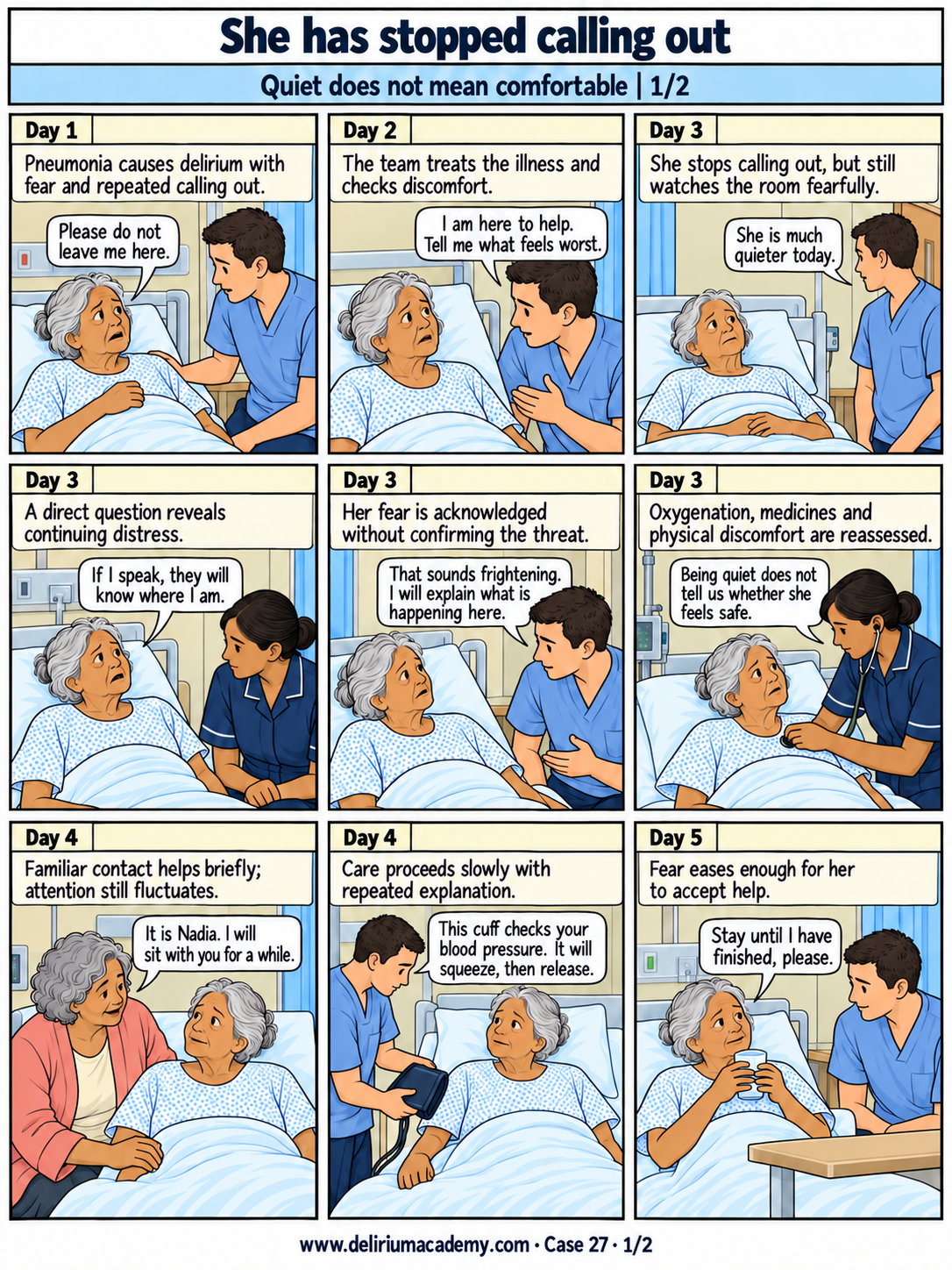
Panel 1: Day 1
Pneumonia causes delirium with fear and repeated calling out.
Farah: Please do not leave me here.
Panel 2: Day 2
The team treats the illness and checks discomfort.
Nurse Tom: I am here to help. Tell me what feels worst.
Panel 3: Day 3
She stops calling out, but still watches the room fearfully.
Nurse Tom: She is much quieter today.
Panel 4: Day 3
A direct question reveals continuing distress.
Farah: If I speak, they will know where I am.
Panel 5: Day 3
Her fear is acknowledged without confirming the threat.
Nurse Tom: That sounds frightening. I will explain what is happening here.
Panel 6: Day 3
Oxygenation, medicines and physical discomfort are reassessed.
Ward doctor Amira: Being quiet does not tell us whether she feels safe.
Panel 7: Day 4
Familiar contact helps briefly; attention still fluctuates.
Nadia: It is Nadia. I will sit with you for a while.
Panel 8: Day 4
Care proceeds slowly with repeated explanation.
Nurse Tom: This cuff checks your blood pressure. It will squeeze, then release.
Panel 9: Day 5
Fear eases enough for her to accept help.
Farah: Stay until I have finished, please.
Page 2
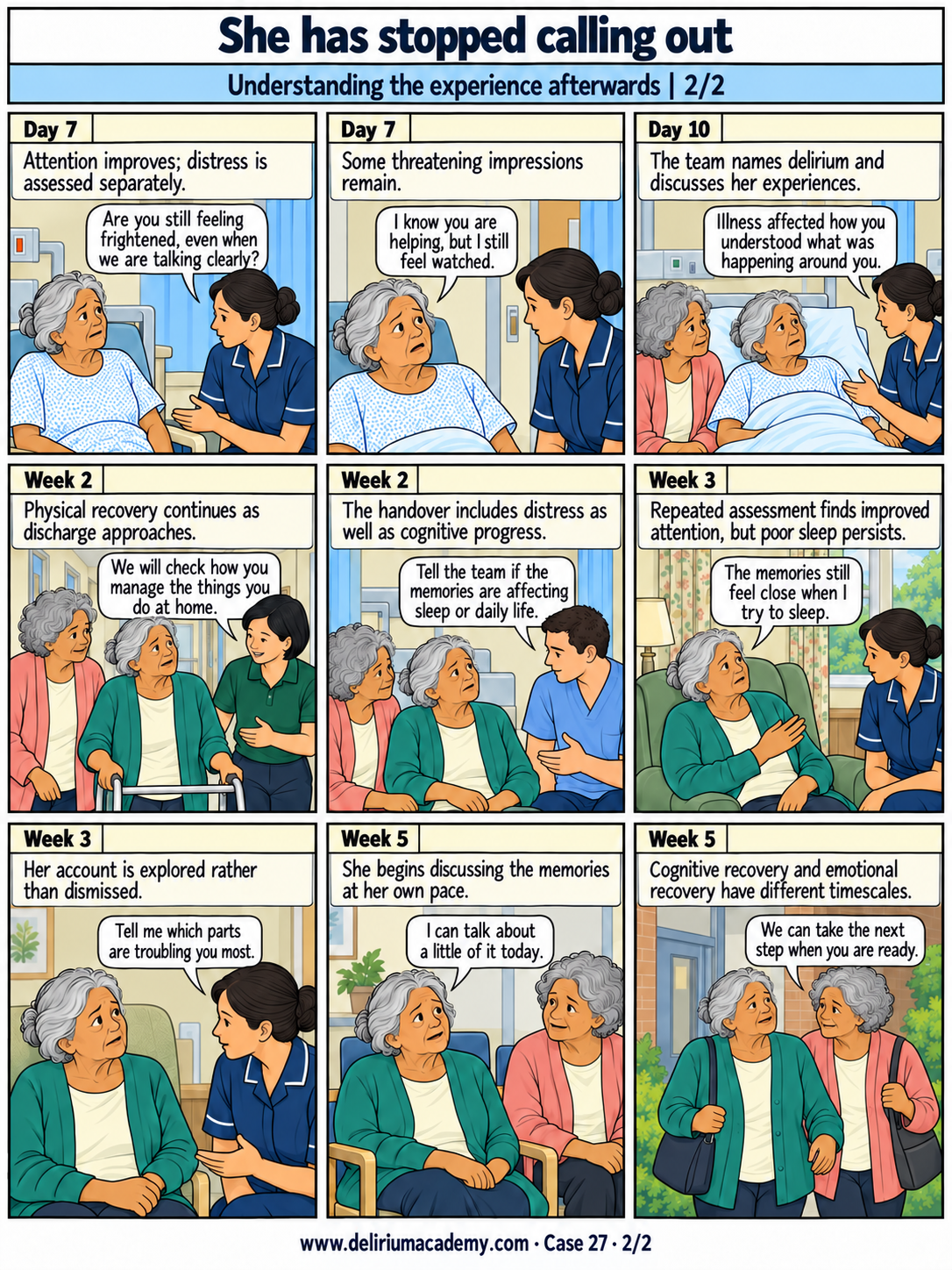
Panel 10: Day 7
Attention improves; distress is assessed separately.
Ward doctor Amira: Are you still feeling frightened, even when we are talking clearly?
Panel 11: Day 7
Some threatening impressions remain.
Farah: I know you are helping, but I still feel watched.
Panel 12: Day 10
The team names delirium and discusses her experiences.
Ward doctor Amira: Illness affected how you understood what was happening around you.
Panel 13: Week 2
Physical recovery continues as discharge approaches.
Physiotherapist Lin: We will check how you manage the things you do at home.
Panel 14: Week 2
The handover includes distress as well as cognitive progress.
Nurse Tom: Tell the team if the memories are affecting sleep or daily life.
Panel 15: Week 3
Repeated assessment finds improved attention, but poor sleep persists.
Farah: The memories still feel close when I try to sleep.
Panel 16: Week 3
Her account is explored rather than dismissed.
Ward doctor Amira: Tell me which parts are troubling you most.
Panel 17: Week 5
She begins discussing the memories at her own pace.
Farah: I can talk about a little of it today.
Panel 18: Week 5
Cognitive recovery and emotional recovery have different timescales.
Nadia: We can take the next step when you are ready.
Sources
- [T01] MacLullich AMJ. Conceptualising distress in delirium. Usher teaching presentation, May 2026. Supplied slides.
- [S12] Yamaguchi, J., Hirayama, T., Sadahiro, R., Nakahara, R. and Matsuoka, H. (2023) ‘Delirium due to Trousseau syndrome treated with memantine and perospirone: A case report’, Psychiatry and Clinical Neurosciences Reports, 2(4), e159.
- [S35] Gallie, L. (2024) ‘Delirium: name it, say it: loud and clear’, Intensive Care Medicine, 50(2), pp. 314–316.
- [G01] National Institute for Health and Care Excellence. Delirium: prevention, diagnosis and management in hospital and long-term care. CG103.
Commentary
Farah has stopped calling out, which initially appears to be improvement. Direct conversation shows that she remains frightened and is unable to follow what is happening. She believes that speaking may make the situation more dangerous, so reduced agitation does not indicate reduced distress.
Both pages use the distress talk to distinguish the patient's experience from visible agitation [T01]. Staff ask about fear and bodily discomfort, explain what they are doing and allow time for a response. They neither argue aggressively with Farah nor confirm the threatening belief. Clinical assessment continues, including oxygenation, medicines, pain, retention and other causes of discomfort [G01].
The case also separates distress from the delirium syndrome. By week three, repeated assessment suggests that the acute inattention has resolved, but Farah still experiences fear linked to memories of the admission. Those memories require discussion on their own terms. An explanation may help without immediately removing their emotional force. Gallie's account illustrates how difficult the aftermath can be when delirium has not been clearly named and explained [S35].
For teaching, ask how the team would measure progress. Less shouting, better attention, willingness to drink, reported fear and the ability to sleep are related but distinct outcomes. Farah's eventual participation in follow-up is one practical step. Some distress remains at the end, without any claim that a single reassuring conversation completes psychological recovery.
An anonymised composite case that does not describe one identifiable person and is not research evidence.