Example case 28 of 40
A quieter ward round
Observe benefit and harm after symptom-directed medication; reassess cognition and movement separately.
Click or tap each illustration to enlarge it. The commentary and text transcript follow below.
Read the text transcript
Page 1
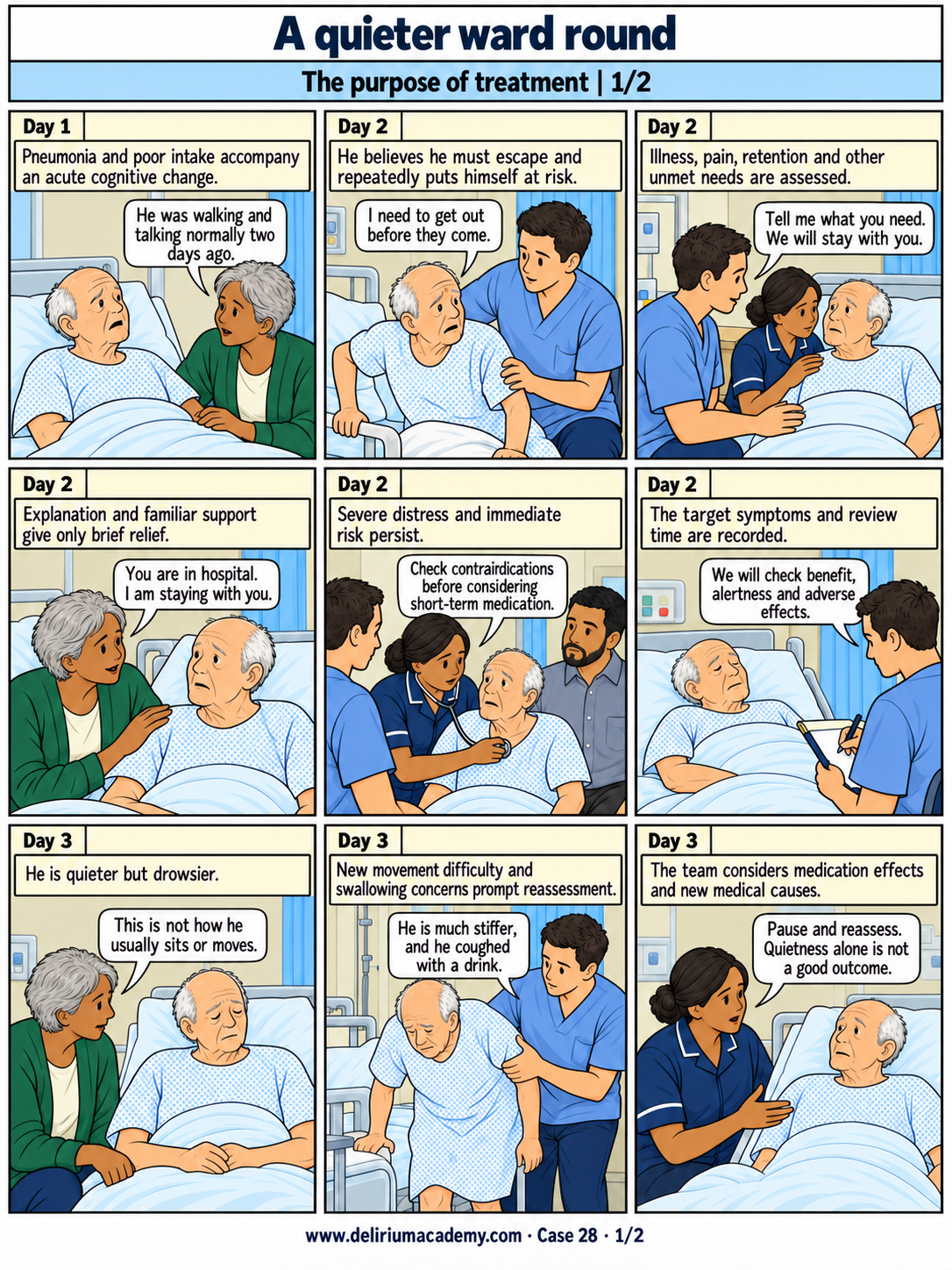
Panel 1: Day 1
Pneumonia and poor intake accompany an acute cognitive change.
Anita: He was walking and talking normally two days ago.
Panel 2: Day 2
He believes he must escape and repeatedly puts himself at risk.
George: I need to get out before they come.
Panel 3: Day 2
Illness, pain, retention and other unmet needs are assessed.
Nurse Tom: Tell me what you need. We will stay with you.
Panel 4: Day 2
Explanation and familiar support give only brief relief.
Anita: You are in hospital. I am staying with you.
Panel 5: Day 2
Severe distress and immediate risk persist.
Ward doctor Amira: Check contraindications before considering short-term medication.
Panel 6: Day 2
The target symptoms and review time are recorded.
Nurse Tom: We will check benefit, alertness and adverse effects.
Panel 7: Day 3
He is quieter but drowsier.
Anita: This is not how he usually sits or moves.
Panel 8: Day 3
New movement difficulty and swallowing concerns prompt reassessment.
Nurse Tom: He is much stiffer, and he coughed with a drink.
Panel 9: Day 3
The team considers medication effects and new medical causes.
Ward doctor Amira: Pause and reassess. Quietness alone is not a good outcome.
Page 2
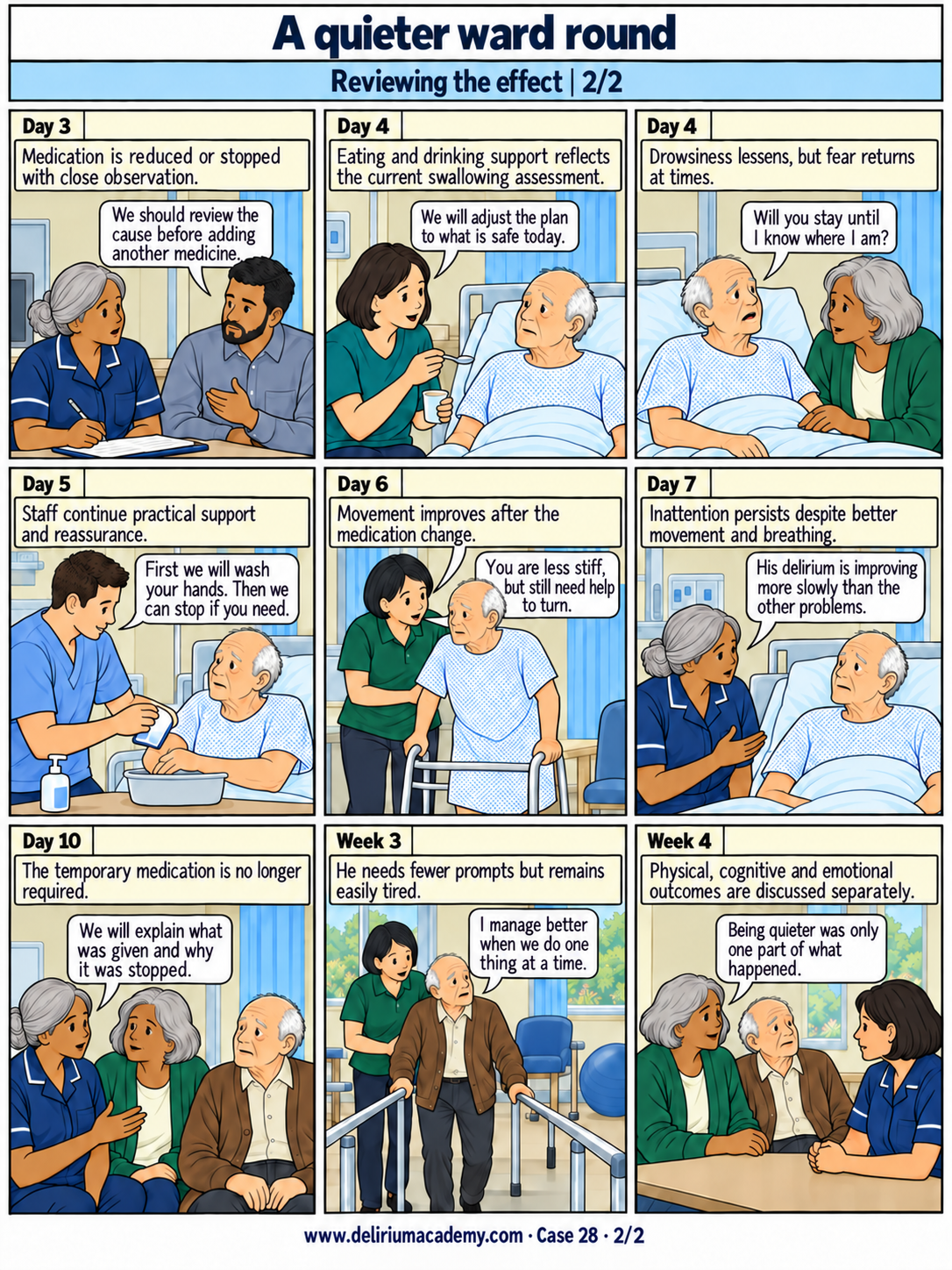
Panel 10: Day 3
Medication is reduced or stopped with close observation.
Pharmacist Samir: We should review the cause before adding another medicine.
Panel 11: Day 4
Eating and drinking support reflects the current swallowing assessment.
Speech and language therapist Eva: We will adjust the plan to what is safe today.
Panel 12: Day 4
Drowsiness lessens, but fear returns at times.
George: Will you stay until I know where I am?
Panel 13: Day 5
Staff continue practical support and reassurance.
Nurse Tom: First we will wash your hands. Then we can stop if you need.
Panel 14: Day 6
Movement improves after the medication change.
Physiotherapist Lin: You are less stiff, but still need help to turn.
Panel 15: Day 7
Inattention persists despite better movement and breathing.
Ward doctor Amira: His delirium is improving more slowly than the other problems.
Panel 16: Day 10
The temporary medication is no longer required.
Ward doctor Amira: We will explain what was given and why it was stopped.
Panel 17: Week 3
He needs fewer prompts but remains easily tired.
George: I manage better when we do one thing at a time.
Panel 18: Week 4
Physical, cognitive and emotional outcomes are discussed separately.
Anita: Being quieter was only one part of what happened.
Sources
- [S12] Yamaguchi, J., Hirayama, T., Sadahiro, R., Nakahara, R. and Matsuoka, H. (2023) ‘Delirium due to Trousseau syndrome treated with memantine and perospirone: A case report’, Psychiatry and Clinical Neurosciences Reports, 2(4), e159.
- [S31] Temple, M. (2003) ‘Use of atypical anti-psychotics in the management of post-traumatic confusional states in traumatic brain injury’, Journal of the Royal Army Medical Corps, 149(1), pp. 54–55.
- [S32] Stocker, L., Jellestad, L., Jenewein, J. and Boettger, S. (2015) ‘Challenges in the management of delirium: a case of augmentation with donepezil following inadequate response and adverse effects with risperidone’, Psychiatria Danubina, 27(1), pp. 64–66.
- [T01] MacLullich AMJ. Conceptualising distress in delirium. Usher teaching presentation, May 2026. Supplied slides.
- [G01] National Institute for Health and Care Excellence. Delirium: prevention, diagnosis and management in hospital and long-term care. CG103.
Commentary
George develops severe distress and immediate risk while delirious. The team first addresses illness, discomfort and communication. A short course of symptom-directed medication follows an individual clinical assessment when those measures have not sufficiently reduced the immediate danger. The script makes the reason for treatment explicit and includes review of contraindications and adverse effects [G01].
The following morning, reduced agitation is accompanied by drowsiness, stiffness and difficulty swallowing. Those changes are not counted as successful treatment simply because he is easier to manage. The team reassesses him promptly, including possible acute medical causes, and identifies medication effects as contributing. It reduces the relevant treatment and continues monitoring rather than adding another medicine automatically.
The supplied reports illustrate different examples of motor adverse effects and additional prescribing during delirium [S12, S31, S32]. They do not establish a general drug sequence to copy. The relevant clinical relationship is that an intervention may reduce one symptom and worsen another while the original delirium continues.
Discussion should distinguish agitation, subjective fear, arousal, attention and mobility. Improvement in one domain does not guarantee improvement in the others. The final page shows withdrawal of the temporary drug, recovery from its adverse effects and slower improvement in cognition. Rehabilitation and explanation remain necessary after the immediate crisis has passed.
An anonymised composite case that does not describe one identifiable person and is not research evidence.