Example case 29 of 40
Before the next attempt
Interpret resistance during personal care through acute change, pain, hearing and fear.
Click or tap each illustration to enlarge it. The commentary and text transcript follow below.
Read the text transcript
Page 1
Panel 1: Before illness
Evelyn has dementia but usually accepts help with washing.
Moira: She normally enjoys choosing what to wear.
Panel 2: Morning
Today she is newly confused and resists care.
Evelyn: Stop. I do not know what you are doing.
Panel 3: Morning
The attempt stops while staff assess the change.
Nurse Tom: We will pause and find out what is upsetting you.
Panel 4: Morning
She cannot hear the explanation clearly.
Nurse Tom: Can you hear me better now?
Panel 5: Morning
Movement causes pain that she had not described.
Evelyn: It hurts when you lift that arm.
Panel 6: Morning
Acute inattention prompts delirium assessment and a search for causes.
Ward doctor Amira: This is a new change, not simply her dementia.
Panel 7: Later
One person explains one step at a time.
Nurse Tom: May I help you wash this hand first?
Panel 8: Later
Adapted care reduces fear and discomfort.
Evelyn: That is easier. Go slowly.
Panel 9: Evening
Delirium remains; the successful approach and review plan are shared.
Nurse Tom: Report any further change. The clinician will reassess her tomorrow.
Sources
- [T01] MacLullich AMJ. Conceptualising distress in delirium. Usher teaching presentation, May 2026. Supplied slides.
- [S05] Teodorczyk, P. and Różańska-Walędziak, A. (2026) ‘From Sensory Deprivation to Psychosis: Environmental Mechanisms of Delirium in Dementia: An Eight-Year Retrospective Longitudinal Case Report and Narrative Review’, Healthcare, 14(17), 2705.
- [S30] Hughes, L.D. and McKay, E. (2013) ‘Can donepezil hydrochloride reduce the role of neuroleptic drugs in delirium? A case report’, Medical Student Research Journal, 2(Winter), pp. 11–16.
- [G01] National Institute for Health and Care Excellence. Delirium: prevention, diagnosis and management in hospital and long-term care. CG103.
Commentary
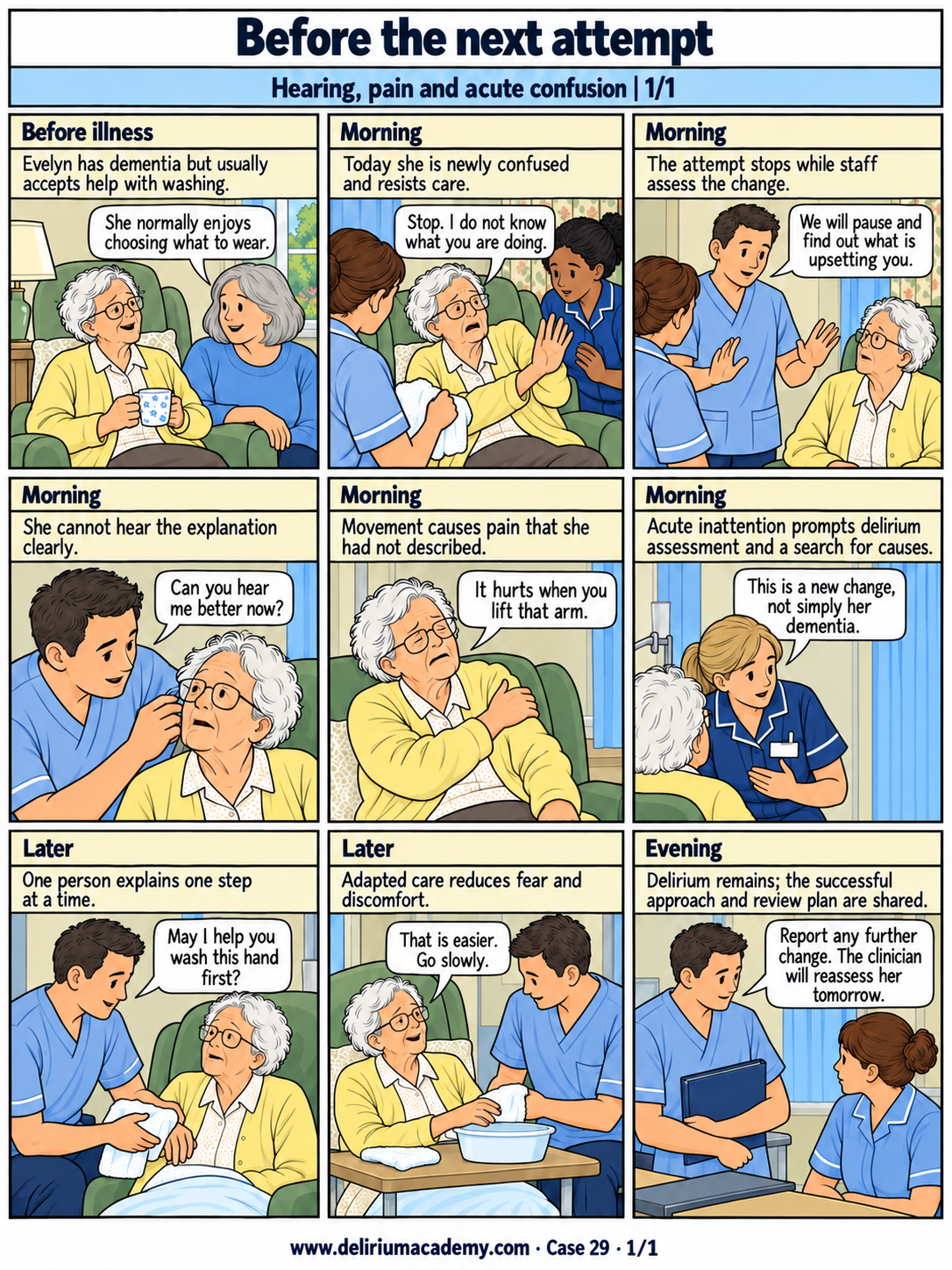
Evelyn's resistance is a new change from her usual response to care. That history makes it necessary to assess delirium and possible illness rather than record behaviour alone. The episode also has immediate, understandable contributors: she does not hear the explanation, movement hurts and several people approaching together feel threatening.
Staff stop the attempt and assess those problems before necessary care resumes. The nurse checks hearing, explains the next action and seeks clinical assessment of the new change and pain. Subsequent care is timed to the revised analgesic plan and carried out with fewer simultaneous demands. These actions follow the distress framework in T01 and the recommendation to address causes and provide effective communication [G01].
The closing panel deliberately retains delirium. Better cooperation with one wash does not establish cognitive recovery or show that hearing impairment was the whole explanation. One successful care episode does not predict that every future attempt will succeed. Staff need to continue using the successful approach and report renewed or worsening symptoms.
This shorter case has one tightly defined educational purpose: before repeating a failed care interaction, ask what the person may be experiencing and what has changed. The accompanying sources provide related clinical patterns, not Evelyn's biography or exact sequence [S05, S30].
An anonymised composite case that does not describe one identifiable person and is not research evidence.