Example case 30 of 40
A new change within delirium
Avoid attributing fresh drowsiness or rigidity to established delirium; check new illness and medication delivery.
Click or tap each illustration to enlarge it. The commentary and text transcript follow below.
Read the text transcript
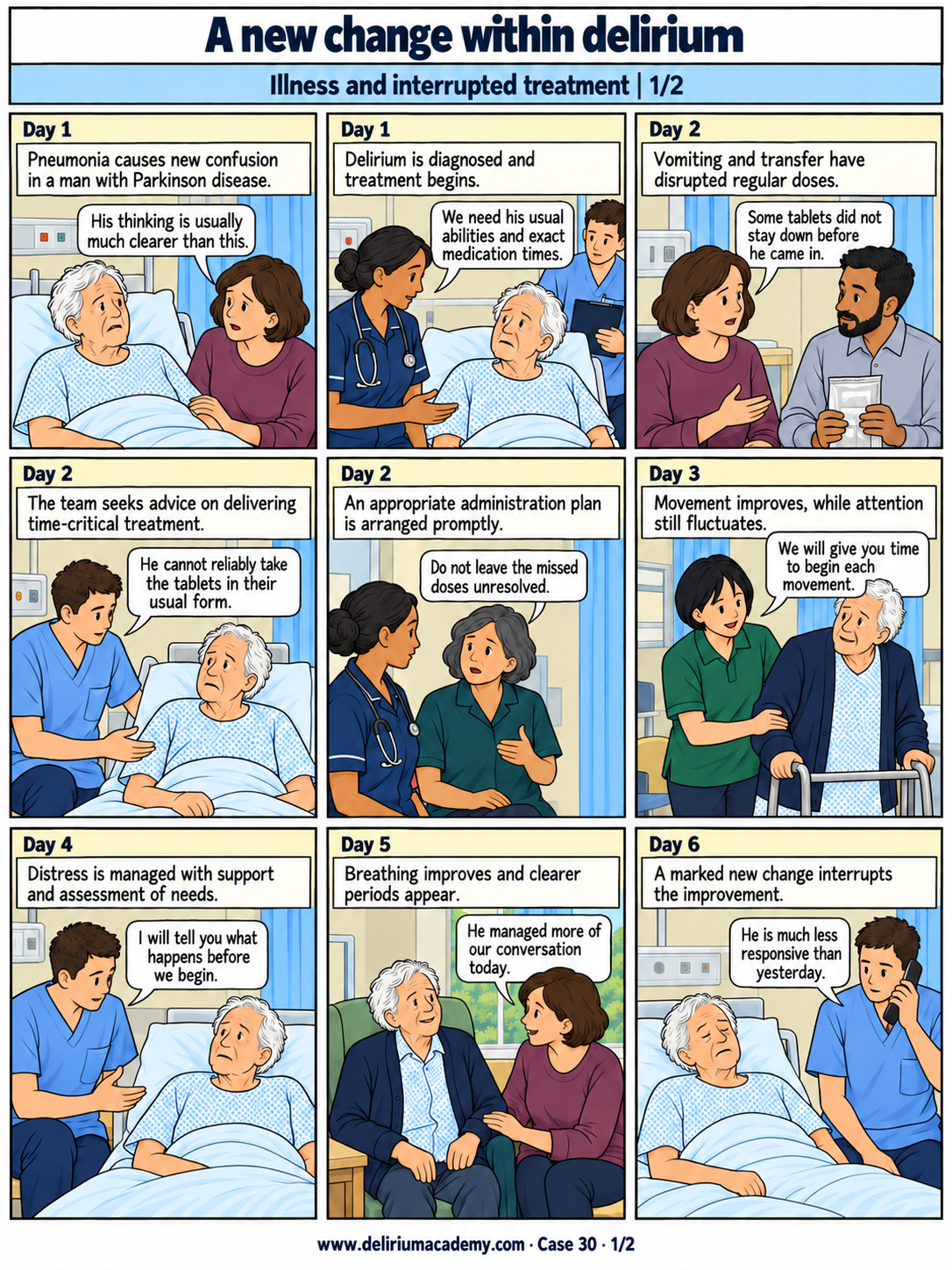
Page 1
Panel 1: Day 1
Pneumonia causes new confusion in a man with Parkinson disease.
Kelly: His thinking is usually much clearer than this.
Panel 2: Day 1
Delirium is diagnosed and treatment begins.
Ward doctor Amira: We need his usual abilities and exact medication times.
Panel 3: Day 2
Vomiting and transfer have disrupted regular doses.
Kelly: Some tablets did not stay down before he came in.
Panel 4: Day 2
The team seeks advice on delivering time-critical treatment.
Nurse Tom: He cannot reliably take the tablets in their usual form.
Panel 5: Day 2
An appropriate administration plan is arranged promptly.
Neurologist Mira: Do not leave the missed doses unresolved.
Panel 6: Day 3
Movement improves, while attention still fluctuates.
Physiotherapist Lin: We will give you time to begin each movement.
Panel 7: Day 4
Distress is managed with support and assessment of needs.
Nurse Tom: I will tell you what happens before we begin.
Panel 8: Day 5
Breathing improves and clearer periods appear.
Kelly: He managed more of our conversation today.
Panel 9: Day 6
A marked new change interrupts the improvement.
Nurse Tom: He is much less responsive than yesterday.
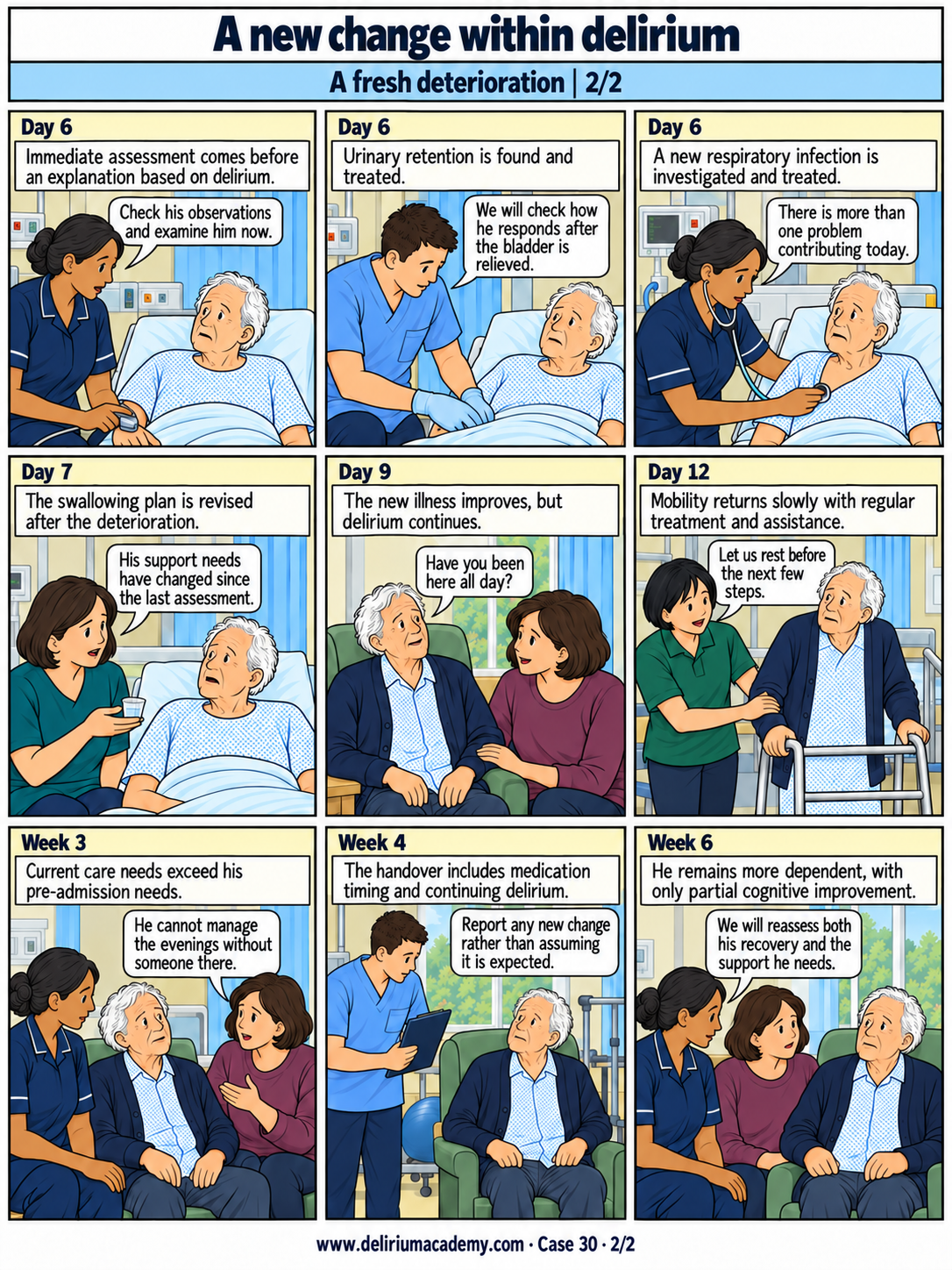
Page 2
Panel 10: Day 6
Immediate assessment comes before an explanation based on delirium.
Ward doctor Amira: Check his observations and examine him now.
Panel 11: Day 6
Urinary retention is found and treated.
Nurse Tom: We will check how he responds after the bladder is relieved.
Panel 12: Day 6
A new respiratory infection is investigated and treated.
Ward doctor Amira: There is more than one problem contributing today.
Panel 13: Day 7
The swallowing plan is revised after the deterioration.
Speech and language therapist Eva: His support needs have changed since the last assessment.
Panel 14: Day 9
The new illness improves, but delirium continues.
Douglas: Have you been here all day?
Panel 15: Day 12
Mobility returns slowly with regular treatment and assistance.
Physiotherapist Lin: Let us rest before the next few steps.
Panel 16: Week 3
Current care needs exceed his pre-admission needs.
Kelly: He cannot manage the evenings without someone there.
Panel 17: Week 4
The handover includes medication timing and continuing delirium.
Nurse Tom: Report any new change rather than assuming it is expected.
Panel 18: Week 6
He remains more dependent, with only partial cognitive improvement.
Ward doctor Amira: We will reassess both his recovery and the support he needs.
Sources
- [G01] National Institute for Health and Care Excellence. Delirium: prevention, diagnosis and management in hospital and long-term care. CG103.
- [P43] Dharmarajan K, Swami S, Gou RY, Jones RN, Inouye SK. Pathway from Delirium to Death: Potential In-Hospital Mediators of Excess Mortality. Journal of the American Geriatrics Society. 2017;65:1026–1033.
- [T02] MacLullich AMJ. Persistent delirium. CHG Singapore teaching presentation, 2025. Supplied slides.
- [G07] National Institute for Health and Care Excellence. Parkinson's disease in adults. NG71.
Commentary
Douglas has Parkinson disease and delirium, but neither diagnosis explains every new change. Early in the admission, disrupted delivery of his regular medicines contributes to worse movement and swallowing. Medication reconciliation must therefore establish both the prescription and whether each dose was administered at the intended time. Problems taking oral medication require prompt specialist advice, not unsupervised omission or improvised substitution [G07].
Later, after some improvement, Douglas becomes more drowsy. The team compares this with the previous day's function and repeats clinical assessment. Urinary retention and a new respiratory infection are found. The examination and history determine the next investigations; clinicians should not apply the same tests to every deterioration [G01].
Medication decisions also require attention to Parkinson disease. Antipsychotic harms are particularly relevant, and a general agitation prescription should not be applied automatically. The case uses explanation, assessment of needs and specialist input rather than introducing a drug solely because he is difficult to move.
The endpoint is an incomplete recovery with more help required than before admission. The hospital-complication evidence supports continued attention to swallowing, mobility and devices throughout delirium [P43]. Learners can discuss how to describe a new change precisely: what Douglas could do yesterday, what he is unable to do now, and which signs accompany it. A documented delirium diagnosis should prompt more precise observation without closing the assessment.
An anonymised composite case that does not describe one identifiable person and is not research evidence.