Example case 18 of 40
Getting moving again
Assess function during delirium recovery
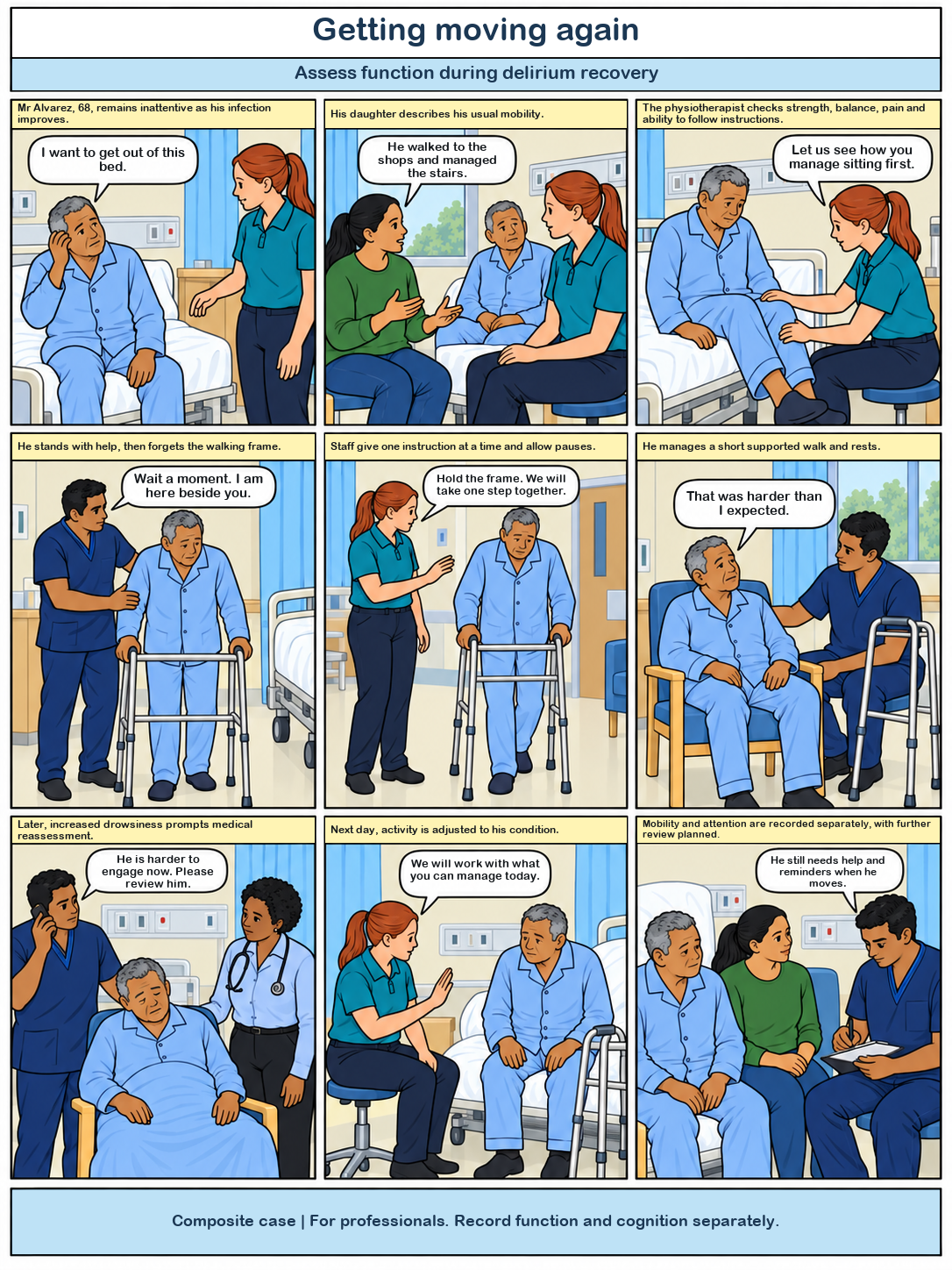
Mr Alvarez, 68, remains inattentive as his infection improves.
Click or tap each illustration to enlarge it. The commentary and text transcript follow below.
Read the text transcript
Page 1
Panel 1
Mr Alvarez, 68, remains inattentive as his infection improves.
Mr Alvarez: I want to get out of this bed.
Panel 2
His daughter describes his usual mobility.
Daughter: He walked to the shops and managed the stairs.
Panel 3
The physiotherapist checks strength, balance, pain and ability to follow instructions.
Physiotherapist: Let us see how you manage sitting first.
Panel 4
He stands with help, then forgets the walking frame.
Nurse Singh: Wait a moment. I am here beside you.
Panel 5
Staff give one instruction at a time and allow pauses.
Physiotherapist: Hold the frame. We will take one step together.
Panel 6
He manages a short supported walk and rests.
Mr Alvarez: That was harder than I expected.
Panel 7
Later, increased drowsiness prompts medical reassessment.
Nurse Singh: He is harder to engage now. Please review him.
Panel 8
Next day, activity is adjusted to his condition.
Physiotherapist: We will work with what you can manage today.
Panel 9
Mobility and attention are recorded separately, with further review planned.
Nurse Singh: He still needs help and reminders when he moves.
Commentary
Assess mobility and daily function alongside delirium. Offer safe, supported activity, adapt instructions and respond to changes in alertness.
An anonymised composite case that does not describe one identifiable person and is not research evidence.