Example case 23 of 40
Problems that develop along the way
Show how poor intake, swallowing difficulty, immobility and device burden complicate delirium.
Click or tap each illustration to enlarge it. The commentary and text transcript follow below.
Read the text transcript
Page 1
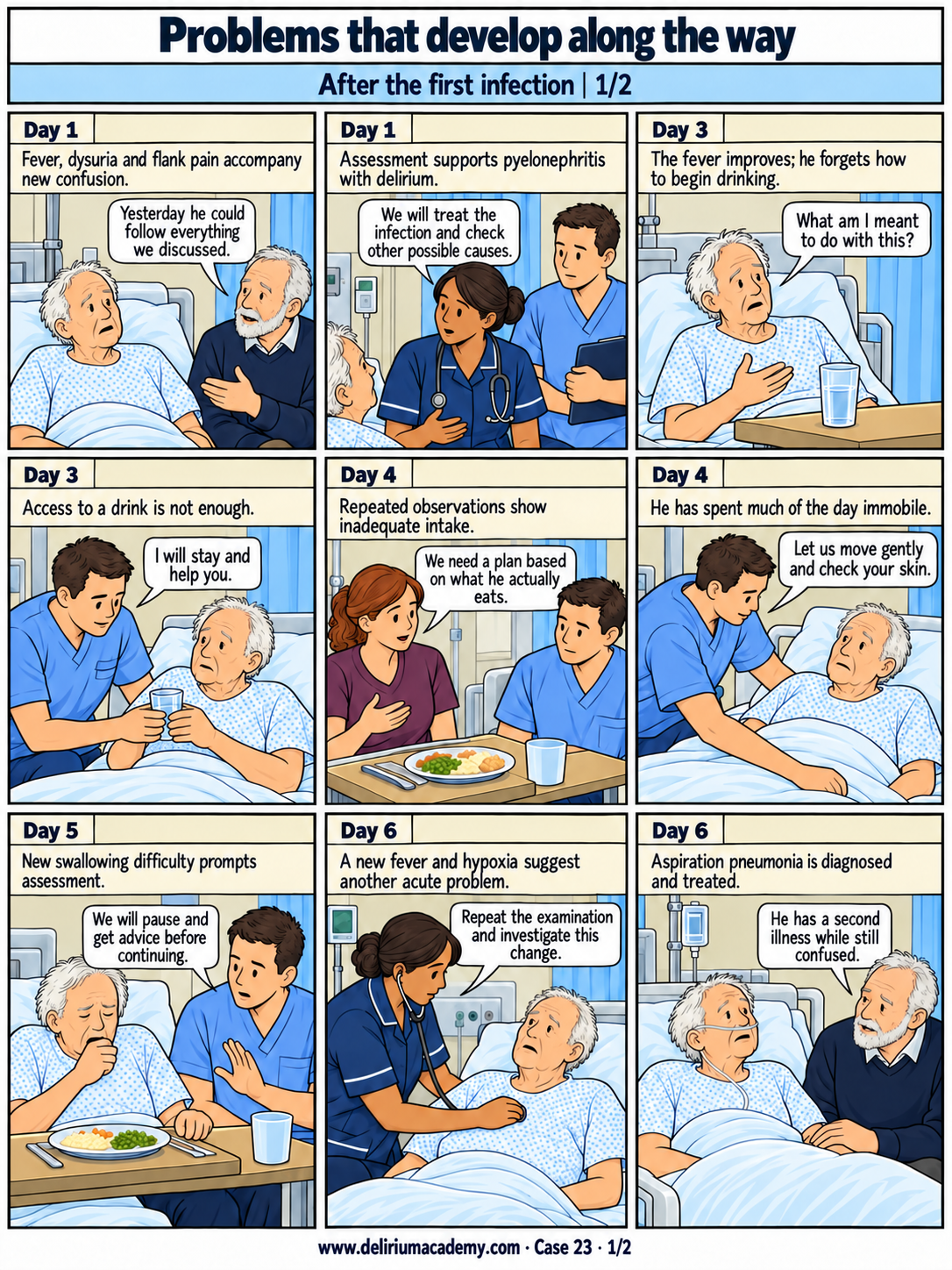
Panel 1: Day 1
Fever, dysuria and flank pain accompany new confusion.
Martin: Yesterday he could follow everything we discussed.
Panel 2: Day 1
Assessment supports pyelonephritis with delirium.
Ward doctor Amira: We will treat the infection and check other possible causes.
Panel 3: Day 3
The fever improves; he forgets how to begin drinking.
Peter: What am I meant to do with this?
Panel 4: Day 3
Access to a drink is not enough.
Nurse Tom: I will stay and help you.
Panel 5: Day 4
Repeated observations show inadequate intake.
Dietitian Beth: We need a plan based on what he actually eats.
Panel 6: Day 4
He has spent much of the day immobile.
Nurse Tom: Let us move gently and check your skin.
Panel 7: Day 5
New swallowing difficulty prompts assessment.
Nurse Tom: We will pause and get advice before continuing.
Panel 8: Day 6
A new fever and hypoxia suggest another acute problem.
Ward doctor Amira: Repeat the examination and investigate this change.
Panel 9: Day 6
Aspiration pneumonia is diagnosed and treated.
Martin: He has a second illness while still confused.
Page 2
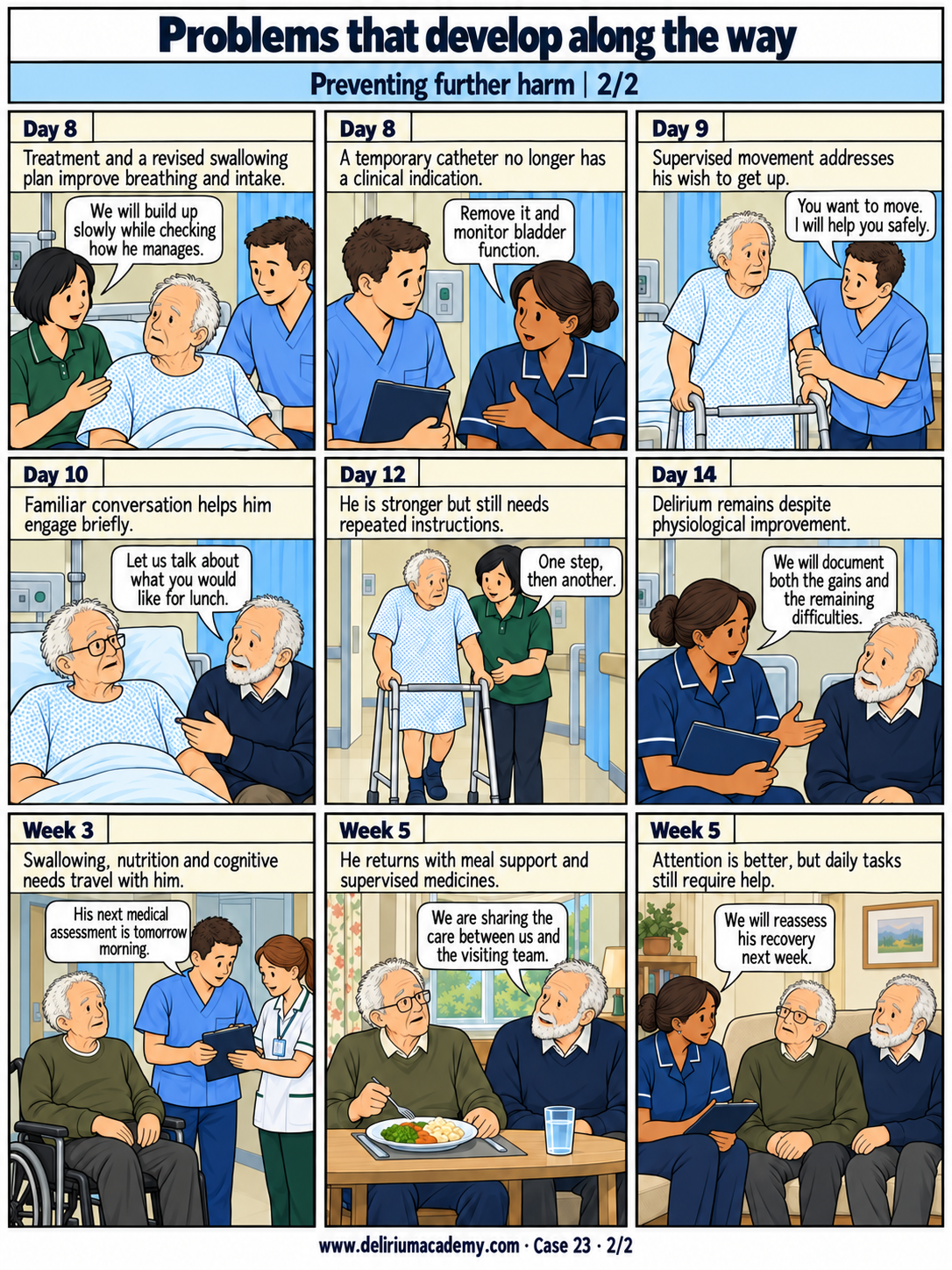
Panel 10: Day 8
Treatment and a revised swallowing plan improve breathing and intake.
Physiotherapist Lin: We will build up slowly while checking how he manages.
Panel 11: Day 8
A temporary catheter no longer has a clinical indication.
Ward doctor Amira: Remove it and monitor bladder function.
Panel 12: Day 9
Supervised movement addresses his wish to get up.
Nurse Tom: You want to move. I will help you safely.
Panel 13: Day 10
Familiar conversation helps him engage briefly.
Martin: Let us talk about what you would like for lunch.
Panel 14: Day 12
He is stronger but still needs repeated instructions.
Physiotherapist Lin: One step, then another.
Panel 15: Day 14
Delirium remains despite physiological improvement.
Ward doctor Amira: We will document both the gains and the remaining difficulties.
Panel 16: Week 3
Swallowing, nutrition and cognitive needs travel with him.
Nurse Tom: His next medical assessment is tomorrow morning.
Panel 17: Week 5
He returns with meal support and supervised medicines.
Martin: We are sharing the care between us and the visiting team.
Panel 18: Week 5
Attention is better, but daily tasks still require help.
Ward doctor Amira: We will reassess his recovery next week.
Sources
- [P43] Dharmarajan K, Swami S, Gou RY, Jones RN, Inouye SK. Pathway from Delirium to Death: Potential In-Hospital Mediators of Excess Mortality. Journal of the American Geriatrics Society. 2017;65:1026–1033.
- [S04] Nair, A., Arfan, S., Holder, S.S., Bacchus, K.I. and Stear, T.J. (2023) ‘Persistent Postoperative Delirium Following Laparoscopic Cholecystectomy’, Cureus, 15(6), e40523.
- [G01] National Institute for Health and Care Excellence. Delirium: prevention, diagnosis and management in hospital and long-term care. CG103.
Commentary
Peter's original infection is treated promptly. The central problem then changes: he is unable to organise drinking or eating, spends long periods immobile and needs repeated help to understand care. These observations create immediate care needs even when inflammatory markers are improving and may coexist with new medical complications.
The paper by Dharmarajan and colleagues found that several adverse hospital exposures were more common in patients who developed delirium [P43]. Its mortality analysis is observational and does not prove that any one event caused a particular death. The comic uses that work to direct attention to everyday clinical tasks, not to attach numerical risks to Peter.
A new cough, fever and hypoxia are assessed as a new illness. The swallowing plan changes after reassessment. His catheter is retained only while there is a clinical need, and mobilisation is adapted to his fluctuating engagement. These are connected decisions rather than a checklist completed once on admission.
The final outcome is partial recovery with continuing support. Peter's ability to walk and eat improves before he can reliably organise daily tasks. The discharge plan therefore specifies assistance and an early reassessment. Discussion can focus on what staff actually observe during meals and transfers, how those findings are handed over, and which new changes should trigger urgent medical review. Delirium care continues after the infection settles [G01].
An anonymised composite case that does not describe one identifiable person and is not research evidence.