Example case 22 of 40
The infection settles
Distinguish physiological stability, persistent delirium and longer-term cognitive disability in dementia.
Click or tap each illustration to enlarge it. The commentary and text transcript follow below.
Read the text transcript
Page 1
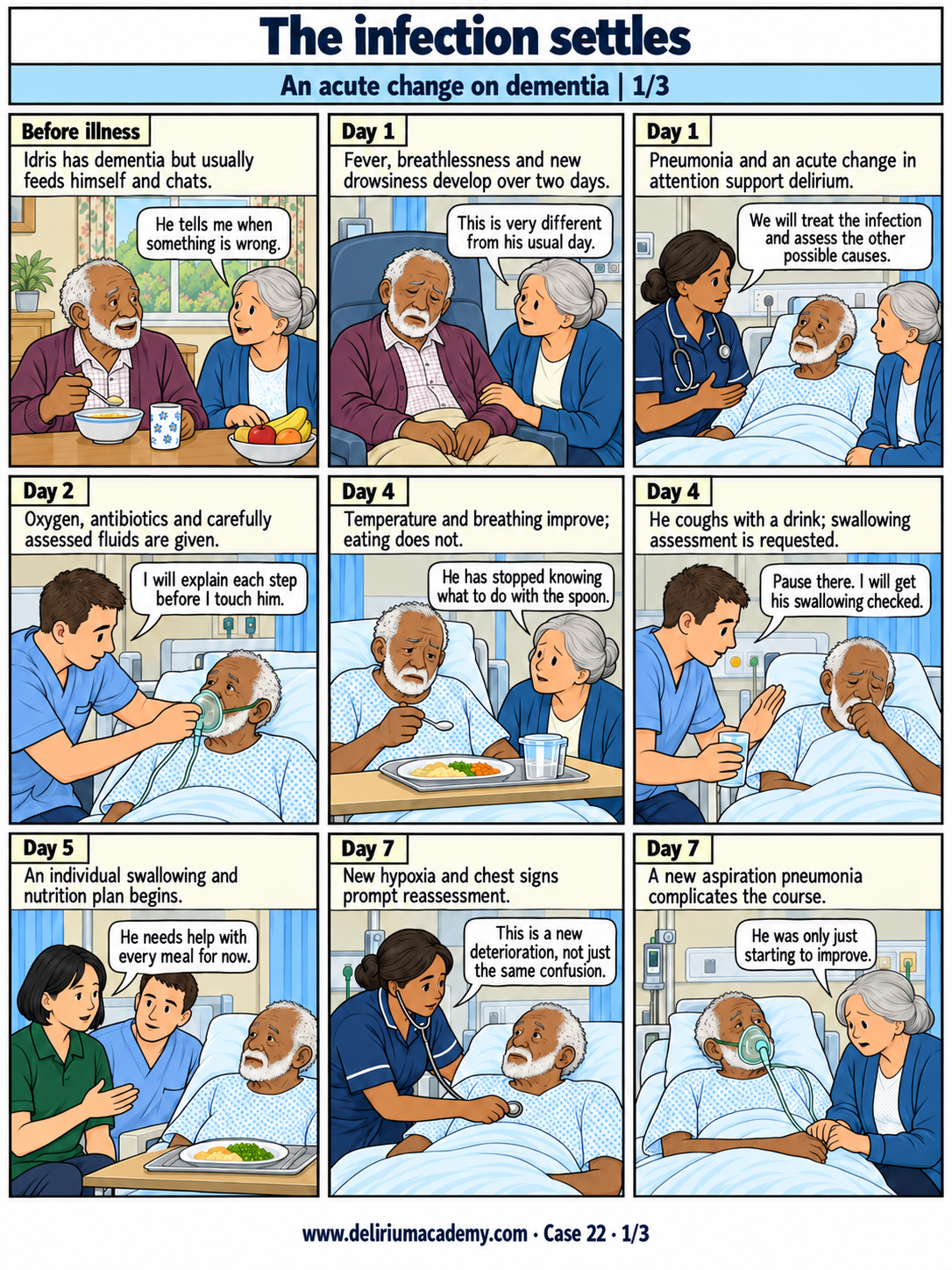
Panel 1: Before illness
Idris has dementia but usually feeds himself and chats.
Sara: He tells me when something is wrong.
Panel 2: Day 1
Fever, breathlessness and new drowsiness develop over two days.
Sara: This is very different from his usual day.
Panel 3: Day 1
Pneumonia and an acute change in attention support delirium.
Ward doctor Amira: We will treat the infection and assess the other possible causes.
Panel 4: Day 2
Oxygen, antibiotics and carefully assessed fluids are given.
Nurse Tom: I will explain each step before I touch him.
Panel 5: Day 4
Temperature and breathing improve; eating does not.
Sara: He has stopped knowing what to do with the spoon.
Panel 6: Day 4
He coughs with a drink; swallowing assessment is requested.
Nurse Tom: Pause there. I will get his swallowing checked.
Panel 7: Day 5
An individual swallowing and nutrition plan begins.
Physiotherapist Lin: He needs help with every meal for now.
Panel 8: Day 7
New hypoxia and chest signs prompt reassessment.
Ward doctor Amira: This is a new deterioration, not just the same confusion.
Panel 9: Day 7
A new aspiration pneumonia complicates the course.
Sara: He was only just starting to improve.
Page 2
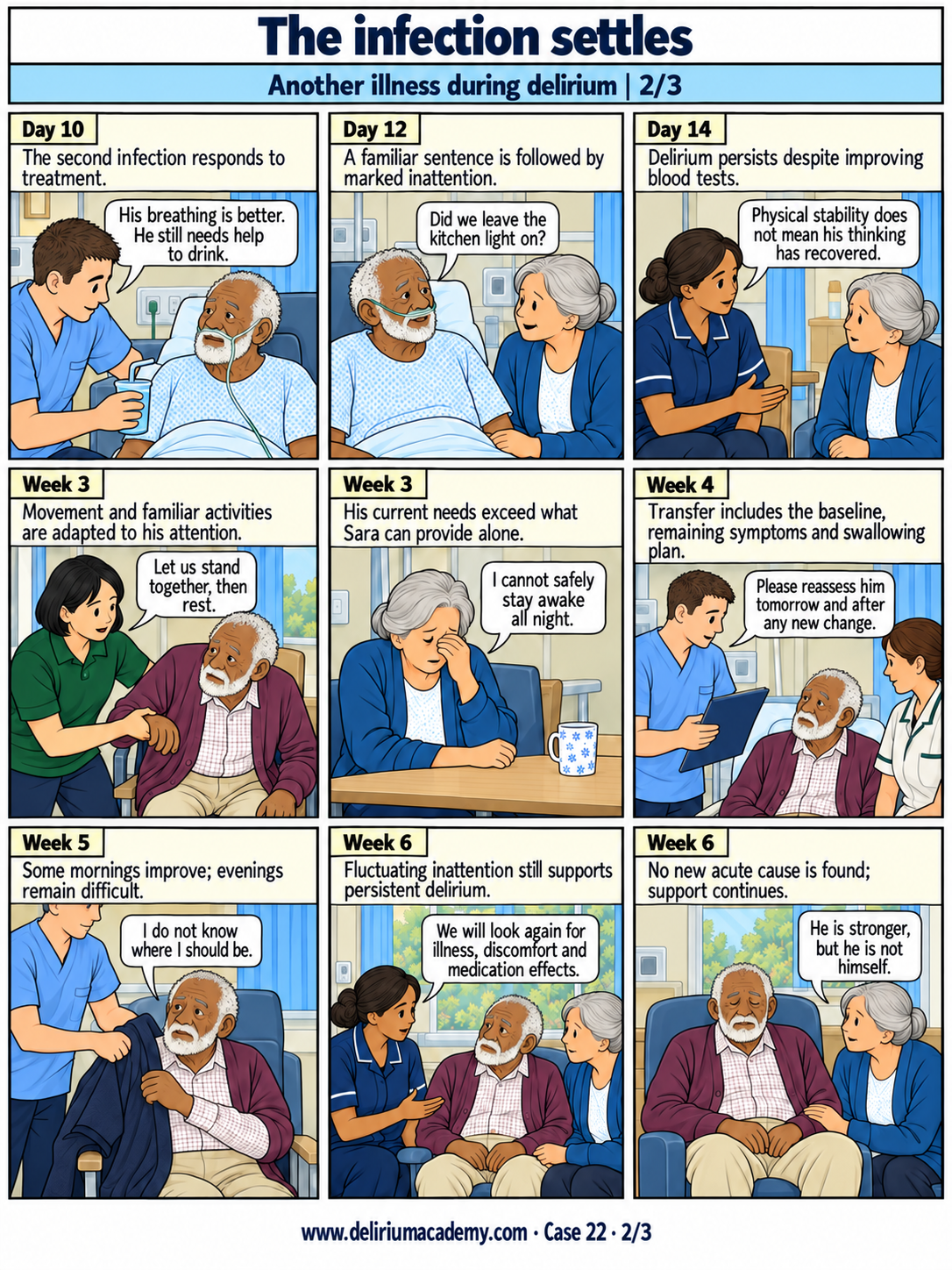
Panel 10: Day 10
The second infection responds to treatment.
Nurse Tom: His breathing is better. He still needs help to drink.
Panel 11: Day 12
A familiar sentence is followed by marked inattention.
Idris: Did we leave the kitchen light on?
Panel 12: Day 14
Delirium persists despite improving blood tests.
Ward doctor Amira: Physical stability does not mean his thinking has recovered.
Panel 13: Week 3
Movement and familiar activities are adapted to his attention.
Physiotherapist Lin: Let us stand together, then rest.
Panel 14: Week 3
His current needs exceed what Sara can provide alone.
Sara: I cannot safely stay awake all night.
Panel 15: Week 4
Transfer includes the baseline, remaining symptoms and swallowing plan.
Nurse Tom: Please reassess him tomorrow and after any new change.
Panel 16: Week 5
Some mornings improve; evenings remain difficult.
Idris: I do not know where I should be.
Panel 17: Week 6
Fluctuating inattention still supports persistent delirium.
Ward doctor Amira: We will look again for illness, discomfort and medication effects.
Panel 18: Week 6
No new acute cause is found; support continues.
Sara: He is stronger, but he is not himself.
Page 3
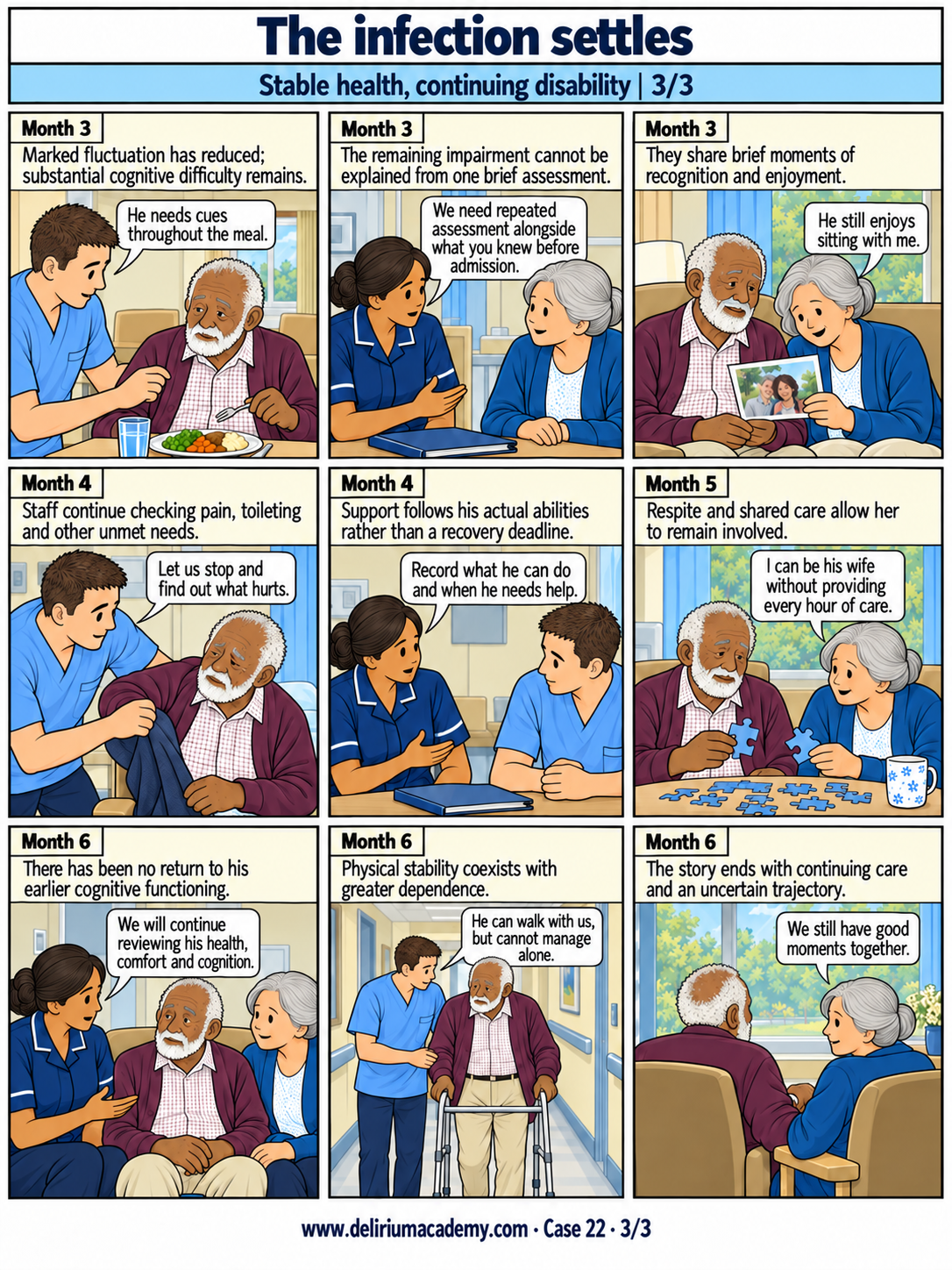
Panel 19: Month 3
Marked fluctuation has reduced; substantial cognitive difficulty remains.
Nurse Tom: He needs cues throughout the meal.
Panel 20: Month 3
The remaining impairment cannot be explained from one brief assessment.
Ward doctor Amira: We need repeated assessment alongside what you knew before admission.
Panel 21: Month 3
They share brief moments of recognition and enjoyment.
Sara: He still enjoys sitting with me.
Panel 22: Month 4
Staff continue checking pain, toileting and other unmet needs.
Nurse Tom: Let us stop and find out what hurts.
Panel 23: Month 4
Support follows his actual abilities rather than a recovery deadline.
Ward doctor Amira: Record what he can do and when he needs help.
Panel 24: Month 5
Respite and shared care allow her to remain involved.
Sara: I can be his wife without providing every hour of care.
Panel 25: Month 6
There has been no return to his earlier cognitive functioning.
Ward doctor Amira: We will continue reviewing his health, comfort and cognition.
Panel 26: Month 6
Physical stability coexists with greater dependence.
Nurse Tom: He can walk with us, but cannot manage alone.
Panel 27: Month 6
The story ends with continuing care and an uncertain trajectory.
Sara: We still have good moments together.
Sources
- [P41] Cole MG. Persistent delirium in older hospital patients. Current Opinion in Psychiatry. 2010;23:250–254.
- [P42] Cole MG, McCusker J, Bailey R, Bonnycastle M, Fung S, Ciampi A, Belzile E. Partial and no recovery from delirium after hospital discharge predict increased adverse events. Age and Ageing. 2017;46:90–95.
- [P43] Dharmarajan K, Swami S, Gou RY, Jones RN, Inouye SK. Pathway from Delirium to Death: Potential In-Hospital Mediators of Excess Mortality. Journal of the American Geriatrics Society. 2017;65:1026–1033.
- [T02] MacLullich AMJ. Persistent delirium. CHG Singapore teaching presentation, 2025. Supplied slides.
- [G01] National Institute for Health and Care Excellence. Delirium: prevention, diagnosis and management in hospital and long-term care. CG103.
Commentary
Idris had dementia before admission, but his earlier abilities still provide a meaningful baseline. New drowsiness, inattention and loss of familiar conversation require assessment as an acute change. Dementia increases vulnerability; it does not explain away that change [G01].
The first improvement is physiological. Antibiotics and supportive care improve the pneumonia, while poor intake and swallowing difficulty remain. A later aspiration illness is a new event requiring fresh assessment. Its treatment does not remove the need for help with drinking, mouth care, mobility and communication. These aspects of care continue across all three pages [P43].
The second page shows why one coherent exchange does not establish recovery. At six weeks, continuing fluctuation and inattention support persistent delirium. By three months, fluctuation has become less evident, but Idris still has substantial cognitive and functional impairment. The final page does not declare whether that remaining impairment is entirely residual delirium, progression of dementia or a combination. Serial assessment and comparison with the pre-illness history are required.
Cole's review and follow-up study distinguish full, partial and absent recovery [P41, P42]. Their categories provide a way to describe the observations, but should not be used to assign an irreversible prognosis to this person. At six months Idris has not regained his previous functioning. His care plan responds to his present abilities and Sara's capacity to help, while retaining clinical follow-up. The case ends with sustained care suited to his current needs while the cognitive outcome remains unresolved.
An anonymised composite case that does not describe one identifiable person and is not research evidence.