Example case 21 of 40
The hip is healing
Reassess pain, medicines and retention while continuing rehabilitation during delirium.
Click or tap each illustration to enlarge it. The commentary and text transcript follow below.
Read the text transcript
Page 1
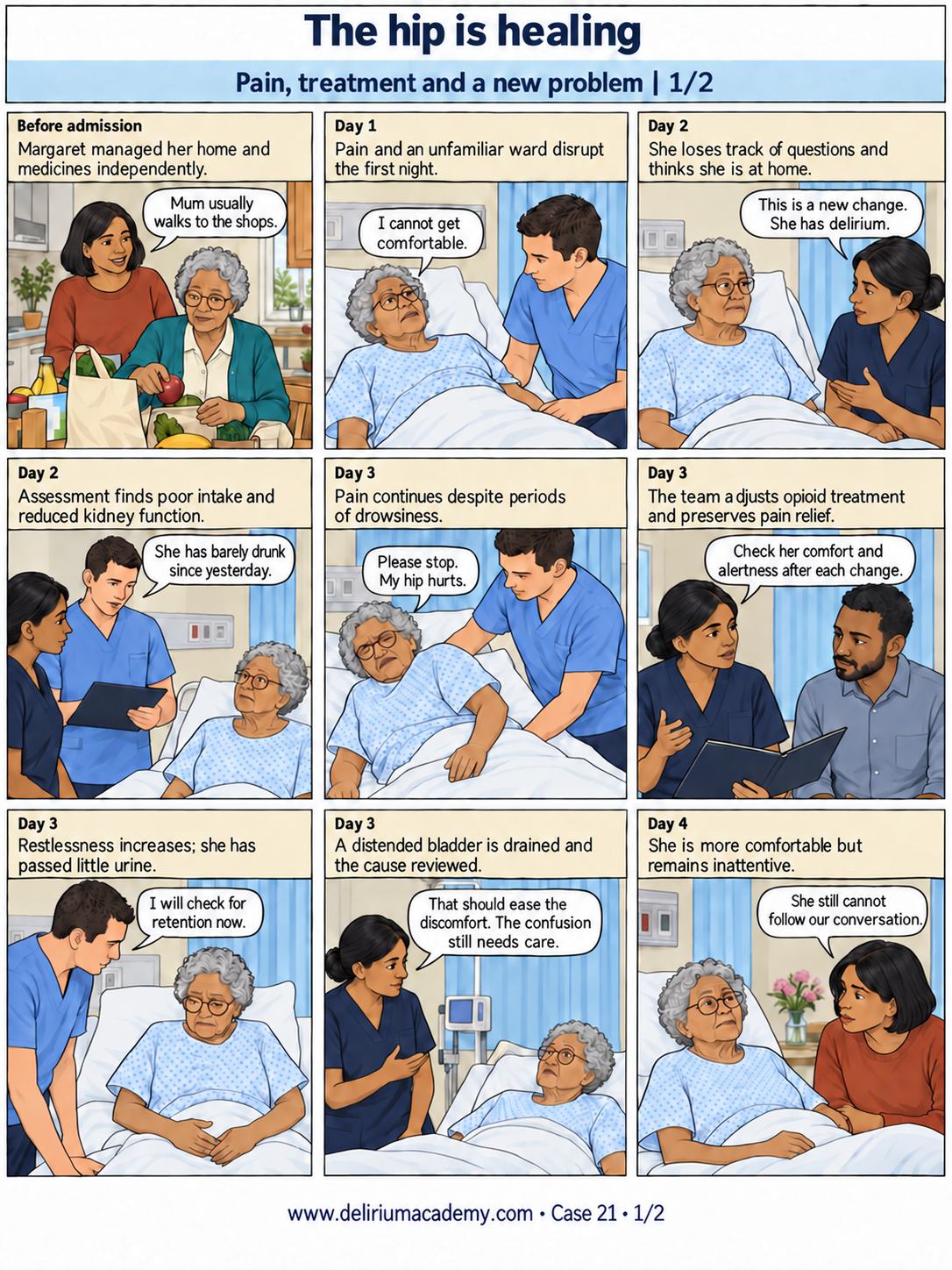
Panel 1: Before admission
Margaret managed her home and medicines independently.
Leah: Mum usually walks to the shops.
Panel 2: Day 1
Pain and an unfamiliar ward disrupt the first night.
Margaret: I cannot get comfortable.
Panel 3: Day 2
She loses track of questions and thinks she is at home.
Ward doctor Amira: This is a new change. She has delirium.
Panel 4: Day 2
Assessment finds poor intake and reduced kidney function.
Nurse Tom: She has barely drunk since yesterday.
Panel 5: Day 3
Pain continues despite periods of drowsiness.
Margaret: Please stop. My hip hurts.
Panel 6: Day 3
The team adjusts opioid treatment and preserves pain relief.
Ward doctor Amira: Check her comfort and alertness after each change.
Panel 7: Day 3
Restlessness increases; she has passed little urine.
Nurse Tom: I will check for retention now.
Panel 8: Day 3
A distended bladder is drained and the cause reviewed.
Ward doctor Amira: That should ease the discomfort. The confusion still needs care.
Panel 9: Day 4
She is more comfortable but remains inattentive.
Leah: She still cannot follow our conversation.
Page 2
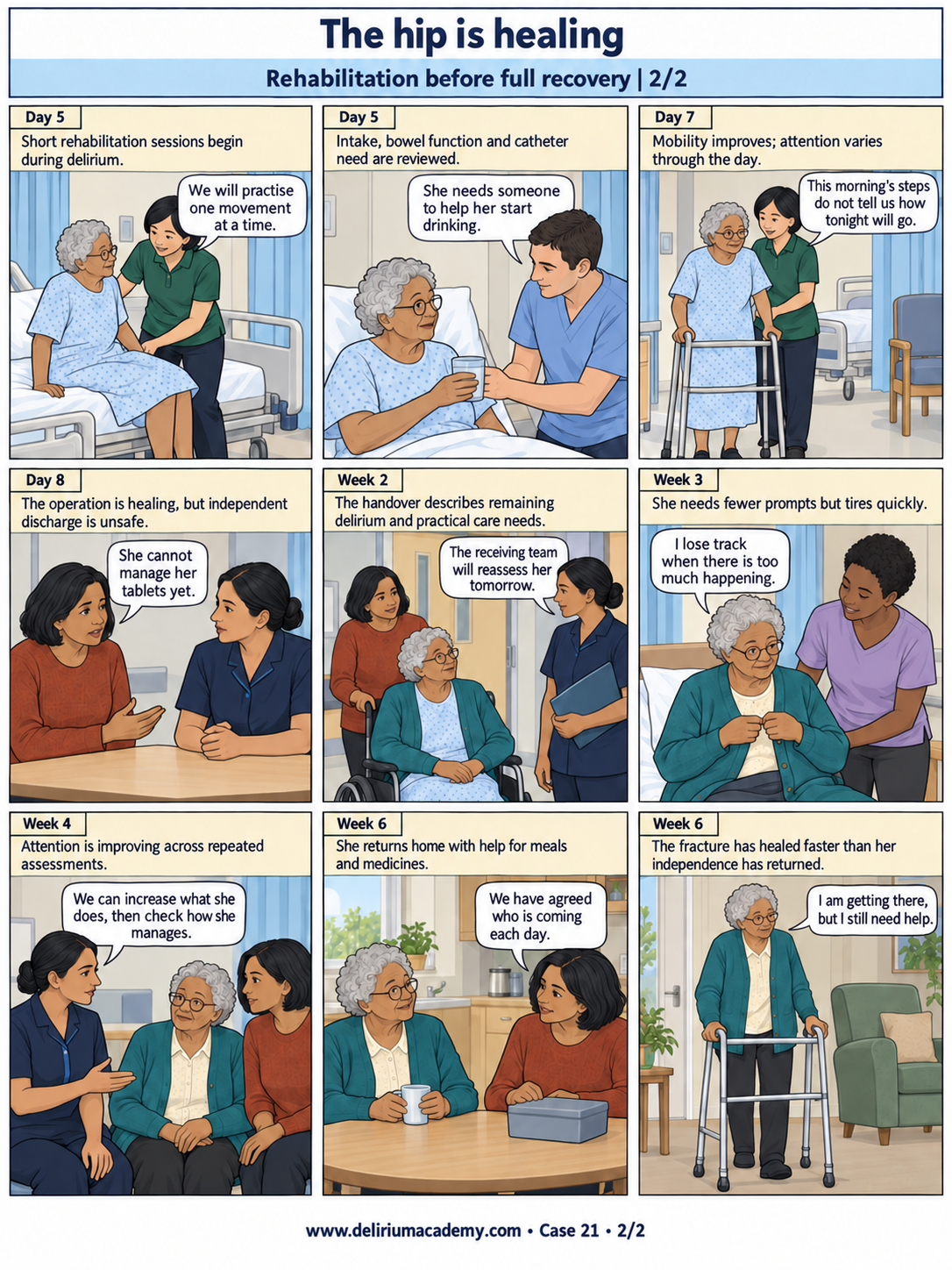
Panel 10: Day 5
Short rehabilitation sessions begin during delirium.
Physiotherapist Lin: We will practise one movement at a time.
Panel 11: Day 5
Intake, bowel function and catheter need are reviewed.
Nurse Tom: She needs someone to help her start drinking.
Panel 12: Day 7
Mobility improves; attention varies through the day.
Physiotherapist Lin: This morning's steps do not tell us how tonight will go.
Panel 13: Day 8
The operation is healing, but independent discharge is unsafe.
Leah: She cannot manage her tablets yet.
Panel 14: Week 2
The handover describes remaining delirium and practical care needs.
Ward doctor Amira: The receiving team will reassess her tomorrow.
Panel 15: Week 3
She needs fewer prompts but tires quickly.
Margaret: I lose track when there is too much happening.
Panel 16: Week 4
Attention is improving across repeated assessments.
Ward doctor Amira: We can increase what she does, then check how she manages.
Panel 17: Week 6
She returns home with help for meals and medicines.
Leah: We have agreed who is coming each day.
Panel 18: Week 6
The fracture has healed faster than her independence has returned.
Margaret: I am getting there, but I still need help.
Sources
- [P44] Hawley S, Inman D, Gregson CL, Whitehouse M, Johansen A, Judge A. Risk Factors and 120-Day Functional Outcomes of Delirium After Hip Fracture Surgery: A Prospective Cohort Study Using the UK National Hip Fracture Database (NHFD). Journal of the American Medical Directors Association. 2023;24:694–701.e7.
- [P43] Dharmarajan K, Swami S, Gou RY, Jones RN, Inouye SK. Pathway from Delirium to Death: Potential In-Hospital Mediators of Excess Mortality. Journal of the American Geriatrics Society. 2017;65:1026–1033.
- [T02] MacLullich AMJ. Persistent delirium. CHG Singapore teaching presentation, 2025. Supplied slides.
- [G01] National Institute for Health and Care Excellence. Delirium: prevention, diagnosis and management in hospital and long-term care. CG103.
Commentary
Margaret's changed attention and conversation are acute departures from a well-described baseline. The fracture, operation and postoperative pain are relevant, but naming these factors does not complete the assessment. Poor intake, reduced renal function and opioid exposure alter the clinical picture. Urinary retention then adds a treatable source of discomfort. The case presents several plausible contributors in sequence and does not attribute delirium to a single tablet.
The team reviews the analgesic plan while maintaining pain relief. Removing all analgesia would leave another important problem untreated. Catheterisation addresses retention but introduces a device whose continuing need must be reviewed. The second page shows that comfort improves before attention, and rehabilitation begins while delirium remains.
Hawley and colleagues found associations between abnormal postoperative 4AT results and later residence and mobility outcomes in a selected hip-fracture population [P44]. Their study does not predict Margaret's outcome or establish that her medication change will restore cognition. Her return home in week six is part of this composite's constructed course, with support still required.
Discussion should address the gap between a healed wound, a manageable pain score and the ability to manage daily life. Ask what Margaret can actually do, at what time of day, and with how much prompting. Record these changes alongside repeated clinical assessment, rather than using surgical progress as the endpoint of delirium care [G01, P43].
An anonymised composite case that does not describe one identifiable person and is not research evidence.