Example case 25 of 40
Home is another stage of care
Plan for residual symptoms, recognise a new acute illness after discharge and reassess longer-term care needs.
Click or tap each illustration to enlarge it. The commentary and text transcript follow below.
Read the text transcript
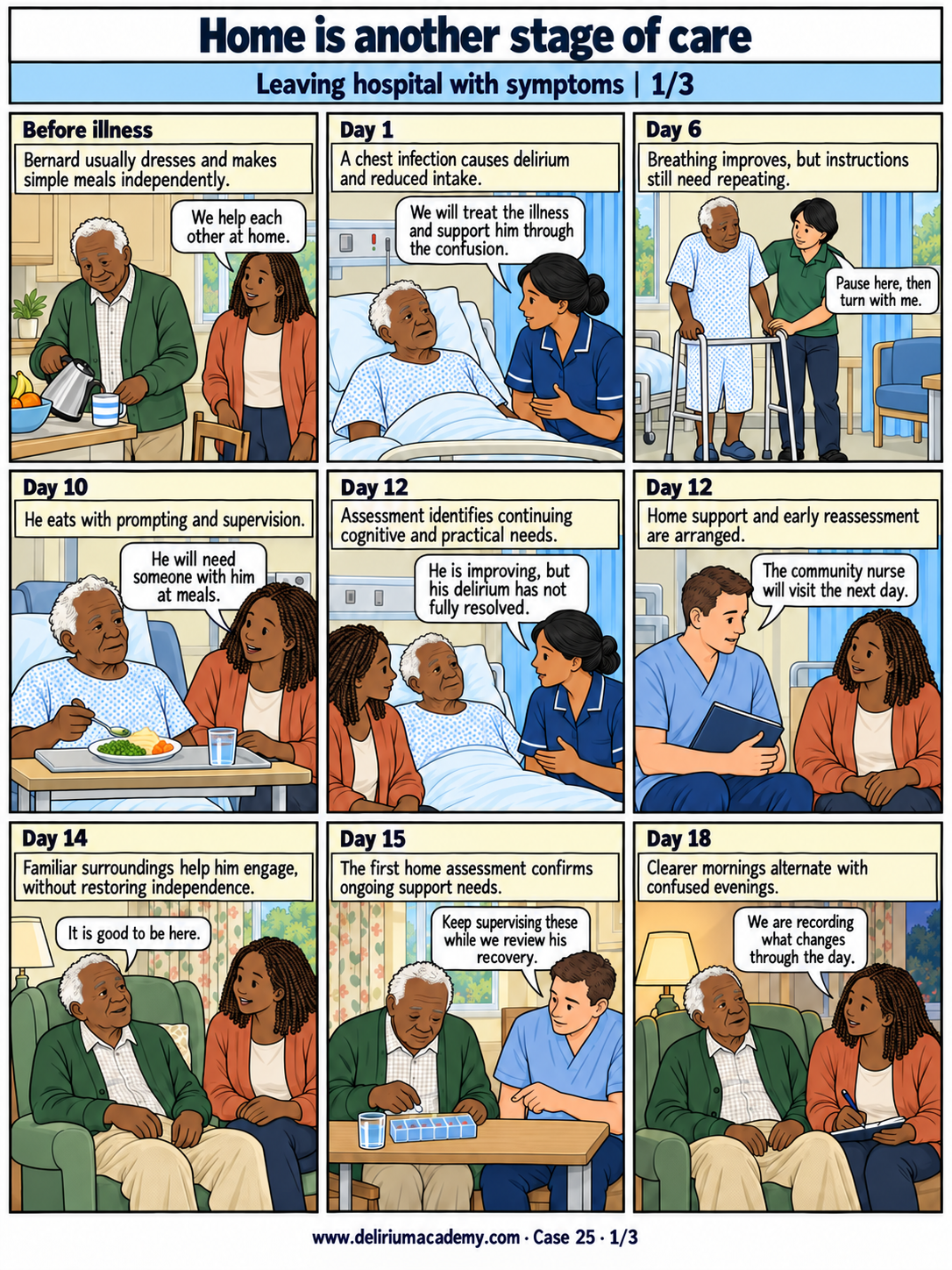
Page 1
Panel 1: Before illness
Bernard usually dresses and makes simple meals independently.
Rosa: We help each other at home.
Panel 2: Day 1
A chest infection causes delirium and reduced intake.
Ward doctor Amira: We will treat the illness and support him through the confusion.
Panel 3: Day 6
Breathing improves, but instructions still need repeating.
Physiotherapist Lin: Pause here, then turn with me.
Panel 4: Day 10
He eats with prompting and supervision.
Rosa: He will need someone with him at meals.
Panel 5: Day 12
Assessment identifies continuing cognitive and practical needs.
Ward doctor Amira: He is improving, but his delirium has not fully resolved.
Panel 6: Day 12
Home support and early reassessment are arranged.
Nurse Tom: The community nurse will visit the next day.
Panel 7: Day 14
Familiar surroundings help him engage, without restoring independence.
Bernard: It is good to be here.
Panel 8: Day 15
The first home assessment confirms ongoing support needs.
Nurse Tom: Keep supervising these while we review his recovery.
Panel 9: Day 18
Clearer mornings alternate with confused evenings.
Rosa: We are recording what changes through the day.
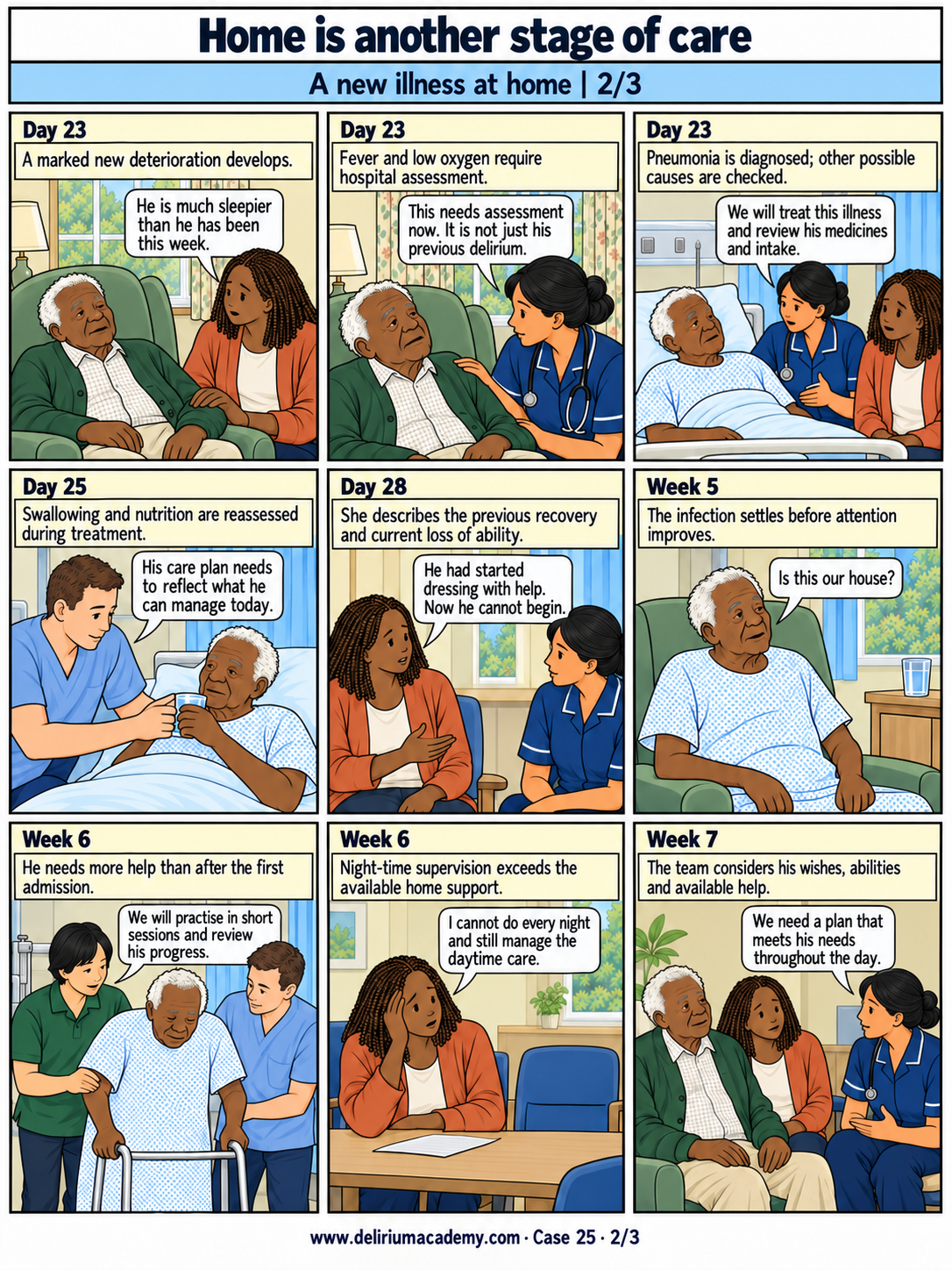
Page 2
Panel 10: Day 23
A marked new deterioration develops.
Rosa: He is much sleepier than he has been this week.
Panel 11: Day 23
Fever and low oxygen require hospital assessment.
Ward doctor Amira: This needs assessment now. It is not just his previous delirium.
Panel 12: Day 23
Pneumonia is diagnosed; other possible causes are checked.
Ward doctor Amira: We will treat this illness and review his medicines and intake.
Panel 13: Day 25
Swallowing and nutrition are reassessed during treatment.
Nurse Tom: His care plan needs to reflect what he can manage today.
Panel 14: Day 28
She describes the previous recovery and current loss of ability.
Rosa: He had started dressing with help. Now he cannot begin.
Panel 15: Week 5
The infection settles before attention improves.
Bernard: Is this our house?
Panel 16: Week 6
He needs more help than after the first admission.
Physiotherapist Lin: We will practise in short sessions and review his progress.
Panel 17: Week 6
Night-time supervision exceeds the available home support.
Rosa: I cannot do every night and still manage the daytime care.
Panel 18: Week 7
The team considers his wishes, abilities and available help.
Ward doctor Amira: We need a plan that meets his needs throughout the day.
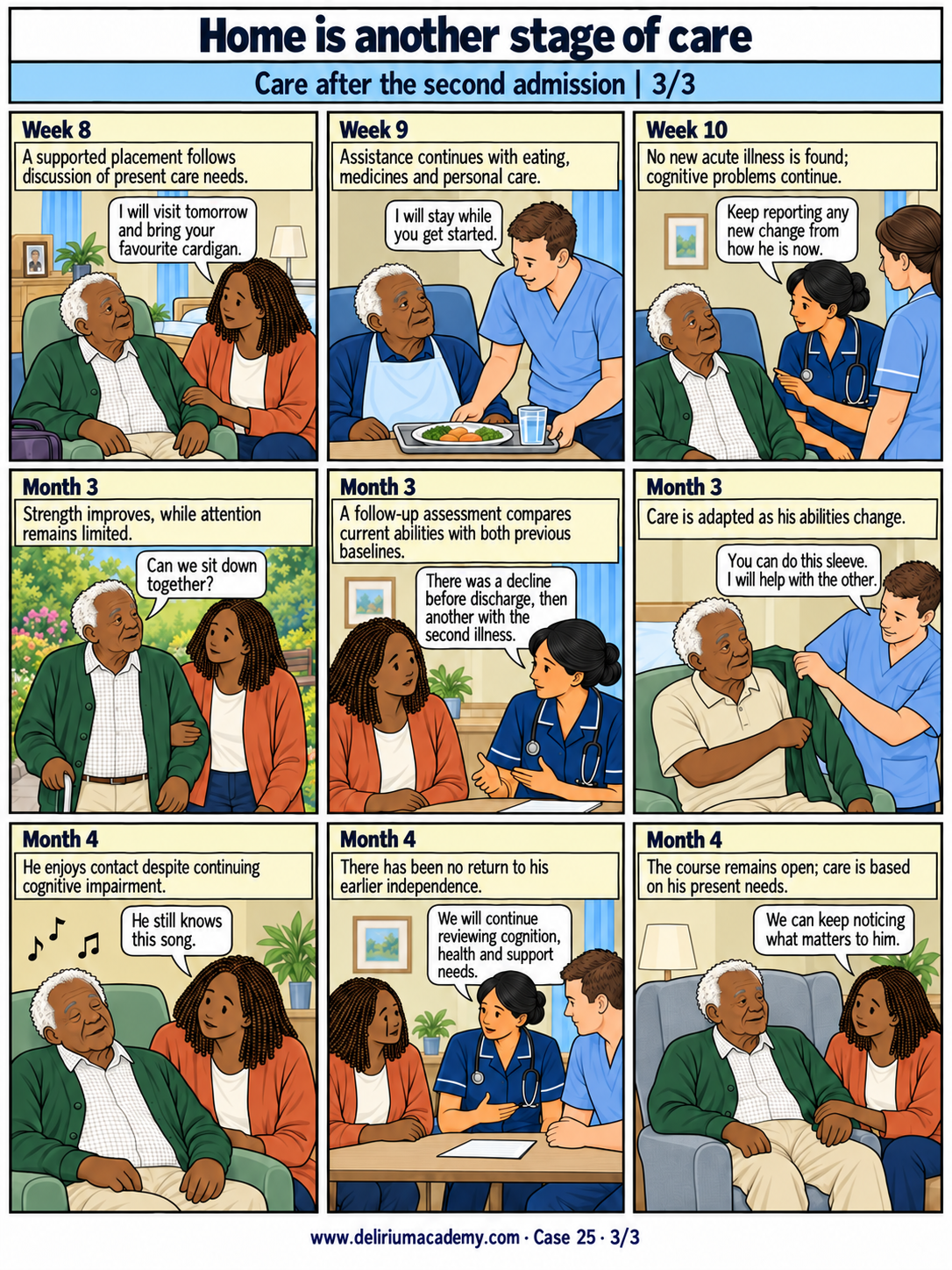
Page 3
Panel 19: Week 8
A supported placement follows discussion of present care needs.
Rosa: I will visit tomorrow and bring your favourite cardigan.
Panel 20: Week 9
Assistance continues with eating, medicines and personal care.
Nurse Tom: I will stay while you get started.
Panel 21: Week 10
No new acute illness is found; cognitive problems continue.
Ward doctor Amira: Keep reporting any new change from how he is now.
Panel 22: Month 3
Strength improves, while attention remains limited.
Bernard: Can we sit down together?
Panel 23: Month 3
A follow-up assessment compares current abilities with both previous baselines.
Ward doctor Amira: There was a decline before discharge, then another with the second illness.
Panel 24: Month 3
Care is adapted as his abilities change.
Nurse Tom: You can do this sleeve. I will help with the other.
Panel 25: Month 4
He enjoys contact despite continuing cognitive impairment.
Rosa: He still knows this song.
Panel 26: Month 4
There has been no return to his earlier independence.
Ward doctor Amira: We will continue reviewing cognition, health and support needs.
Panel 27: Month 4
The course remains open; care is based on his present needs.
Rosa: We can keep noticing what matters to him.
Sources
- [P42] Cole MG, McCusker J, Bailey R, Bonnycastle M, Fung S, Ciampi A, Belzile E. Partial and no recovery from delirium after hospital discharge predict increased adverse events. Age and Ageing. 2017;46:90–95.
- [S40] JS Mind Body Pilates (2022) ‘Pam's Delirium Journey & Why You Need To Know What Delirium Is’, 11 December.
- [T02] MacLullich AMJ. Persistent delirium. CHG Singapore teaching presentation, 2025. Supplied slides.
- [G01] National Institute for Health and Care Excellence. Delirium: prevention, diagnosis and management in hospital and long-term care. CG103.
Commentary
Bernard is first discharged after improvement, although he has not fully recovered. He can walk with help and participate in brief conversation, but needs prompting for meals, dressing and medicines. The handover makes those needs explicit. Rosa's agreement to help is accompanied by organised support and a route for reassessment; it is not treated as consent to provide unlimited care.
A later increase in drowsiness is compared with his recent post-discharge state as well as his earlier baseline. The clinician finds new fever and hypoxia and arranges hospital assessment. This is a new deterioration within a longer recovery, rather than inevitable fluctuation that should simply be tolerated [G01].
Cole and colleagues found that worse recovery status after discharge was associated with more subsequent adverse events [P42]. That study does not prove that every partially recovered patient will be readmitted, or that all such admissions are preventable. It supports taking persistent symptoms and care needs seriously. The family narrative in S40 describes the practical demands of sustained supervision, without establishing the cause of that published patient's illness.
Bernard's second recovery is slower. The final page shows a review of support based on actual night-time needs, mobility and cognition. Moving to a care home is a considered response to present needs, not proof that cognitive improvement has ended. At four months he remains substantially impaired. Both further assessment and opportunities for ordinary enjoyment continue, without a promised return to his previous independence.
An anonymised composite case that does not describe one identifiable person and is not research evidence.