Example case 31 of 40
The blood tests are better
Retain an acute cognitive formulation when mood symptoms and apparently reassuring laboratory results distract from fluctuating inattention.
Click or tap each illustration to enlarge it. The commentary and text transcript follow below.
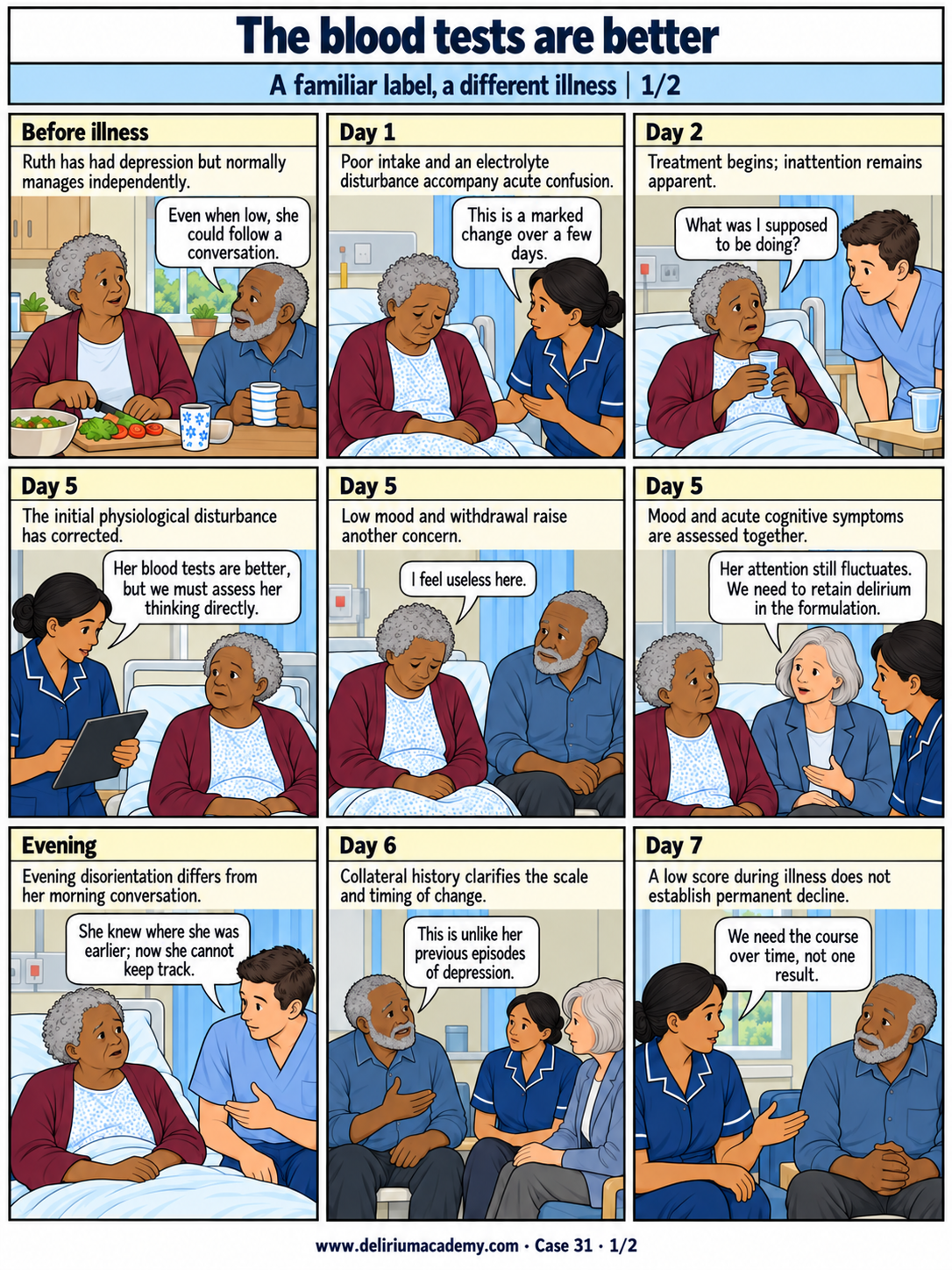
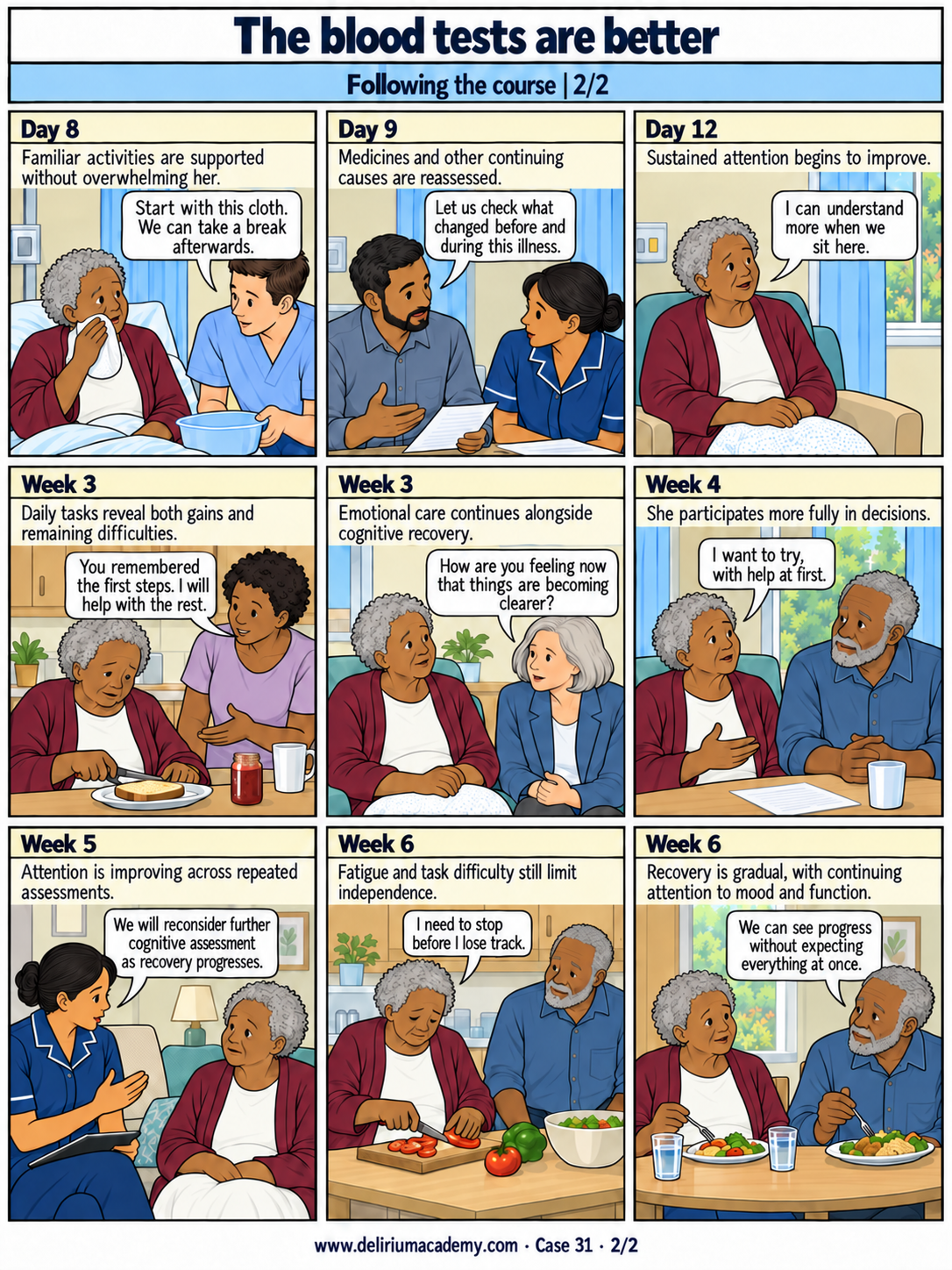
Read the text transcript
Page 1
Panel 1: Before illness
Ruth has had depression but normally manages independently.
Ben: Even when low, she could follow a conversation.
Panel 2: Day 1
Poor intake and an electrolyte disturbance accompany acute confusion.
Ward doctor Amira: This is a marked change over a few days.
Panel 3: Day 2
Treatment begins; inattention remains apparent.
Ruth: What was I supposed to be doing?
Panel 4: Day 5
The initial physiological disturbance has corrected.
Ward doctor Amira: Her blood tests are better, but we must assess her thinking directly.
Panel 5: Day 5
Low mood and withdrawal raise another concern.
Ruth: I feel useless here.
Panel 6: Day 5
Mood and acute cognitive symptoms are assessed together.
Liaison psychiatrist Clare: Her attention still fluctuates. We need to retain delirium in the formulation.
Panel 7: Evening
Evening disorientation differs from her morning conversation.
Nurse Tom: She knew where she was earlier; now she cannot keep track.
Panel 8: Day 6
Collateral history clarifies the scale and timing of change.
Ben: This is unlike her previous episodes of depression.
Panel 9: Day 7
A low score during illness does not establish permanent decline.
Ward doctor Amira: We need the course over time, not one result.
Page 2
Panel 10: Day 8
Familiar activities are supported without overwhelming her.
Nurse Tom: Start with this cloth. We can take a break afterwards.
Panel 11: Day 9
Medicines and other continuing causes are reassessed.
Pharmacist Samir: Let us check what changed before and during this illness.
Panel 12: Day 12
Sustained attention begins to improve.
Ruth: I can understand more when we sit here.
Panel 13: Week 3
Daily tasks reveal both gains and remaining difficulties.
Occupational therapist Ruth: You remembered the first steps. I will help with the rest.
Panel 14: Week 3
Emotional care continues alongside cognitive recovery.
Liaison psychiatrist Clare: How are you feeling now that things are becoming clearer?
Panel 15: Week 4
She participates more fully in decisions.
Ruth: I want to try, with help at first.
Panel 16: Week 5
Attention is improving across repeated assessments.
Ward doctor Amira: We will reconsider further cognitive assessment as recovery progresses.
Panel 17: Week 6
Fatigue and task difficulty still limit independence.
Ruth: I need to stop before I lose track.
Panel 18: Week 6
Recovery is gradual, with continuing attention to mood and function.
Ben: We can see progress without expecting everything at once.
Sources
- [S03] Cao, F., Salem, H., Nagpal, C. and Teixeira, A.L. (2017) ‘Prolonged delirium misdiagnosed as a mood disorder’, Dementia & Neuropsychologia, 11(2), pp. 206–208.
- [S28] Kato, T., Tsujii, T., Kida, H., Mochizuki, D., Nikkuni, S. and Sakuma, K. (2025) ‘A case of late-onset psychosis secondary to traumatic brain injury difficult to differentiate from delirium’, Psychiatry and Clinical Neurosciences Reports, 4(2), e70125.
- [P41] Cole MG. Persistent delirium in older hospital patients. Current Opinion in Psychiatry. 2010;23:250–254.
- [G01] National Institute for Health and Care Excellence. Delirium: prevention, diagnosis and management in hospital and long-term care. CG103.
Commentary
Ruth's history of depression is relevant, but the current episode includes a rapid change in attention, awareness and everyday functioning. These features fluctuate even after the initial electrolyte disturbance has been corrected. Reduced activity and speech, with expressions of hopelessness, do not remove the need to assess ongoing delirium.
The psychiatrist and medical team contribute to a shared formulation. They consider mood symptoms while repeating cognitive and physical assessment and reviewing medicines. Joint assessment avoids a false choice between medical and psychiatric care. The supplied reports illustrate how psychiatric and neurological histories can complicate recognition of acute cognitive change [S03, S28].
The low score obtained during illness is not used to diagnose permanent dementia. Serial observations, functional performance and collateral history are more informative about the trajectory. Later cognitive assessment may be appropriate, but its interpretation must include the recent delirium and the course since admission [P41, G01].
Ruth improves gradually. By the final panel she can manage more familiar tasks but still tires and needs support. The team attends in parallel to mood, safety, physical illness and cognition. The case neither attributes every depressive symptom to delirium nor postpones depression care until cognition is normal. Discussion should focus on which findings distinguish this acute episode from her previous depression and what evidence would justify revising the formulation over time.
An anonymised composite case that does not describe one identifiable person and is not research evidence.